
AI Invoice Parsing Solutions
Stop paying people to retype what's already printed on the invoice. Invoice parsing reads the supplier details, invoice numbers, dates, tax amounts, totals, and line items on a PDF, scanned, or image-based invoice and turns them into structured data your accounting and ERP systems can use right away. As a form of intelligent document processing (IDP) applied to accounts payable (AP), Wappnet.ai's AI invoice parsing workflows combine invoice OCR, field identification, and configurable validation, so your team spends less time keying data and more time reviewing the exceptions that genuinely need a person.
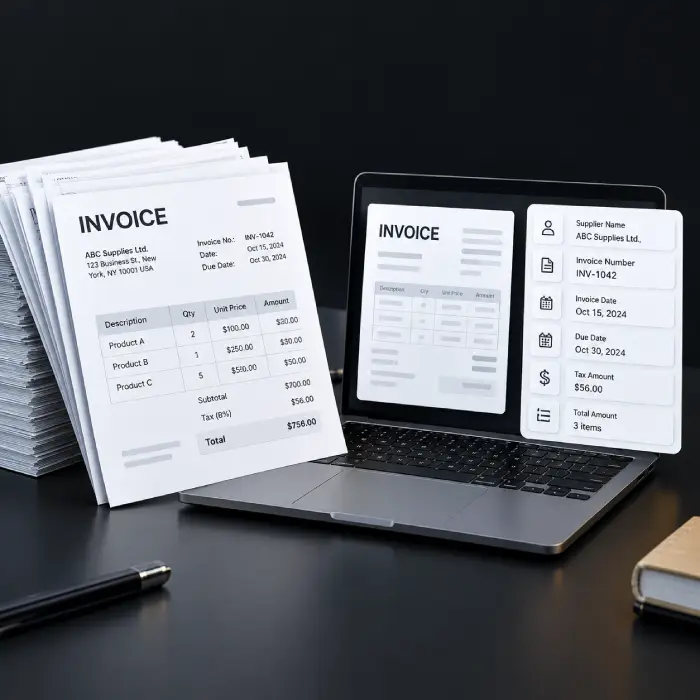
Why Businesses Invest in AI Invoice Parsing
As invoice volume grows, manual entry and inconsistent formats make it harder to keep accounts payable accurate and on schedule. These are common challenges, not something every business necessarily experiences in full.
Manual Invoice Entry Takes Staff Time
Every invoice retyped by hand into an accounting or ERP system is time your accounts payable team isn't spending on exceptions, vendor relationships, or closing the books faster.
Inconsistent Invoice Layouts
Every supplier formats invoices differently, which makes it harder to apply one consistent process for reading and entering the same types of information.
Difficulty Extracting Line Items and Tax Details
Multi-line invoices with per-item pricing, tax rates, and subtotals are harder to capture accurately than a single invoice total, especially across varied layouts.
Data Entry Mistakes and Incomplete Information
Manually keyed invoice data is prone to typos, transposed numbers, and missed fields, which can affect downstream reporting and vendor payments.
Delays From Correcting Extracted Data
When extracted or entered data is wrong, the time spent finding and correcting it can offset much of the time a faster intake process was meant to save.
Scaling Invoice Volume Without Scaling Headcount
As invoice volume increases with business growth, handling it with purely manual processes tends to require proportionally more staff time.
Getting Structured Data Into Existing Systems
Even accurately captured invoice information has limited value until it can be transferred into the accounting, ERP, or finance systems that depend on it.
Validating Data Before It's Trusted
Extracted fields still need to be checked against business rules or reference data before finance teams can rely on them without a manual double-check.
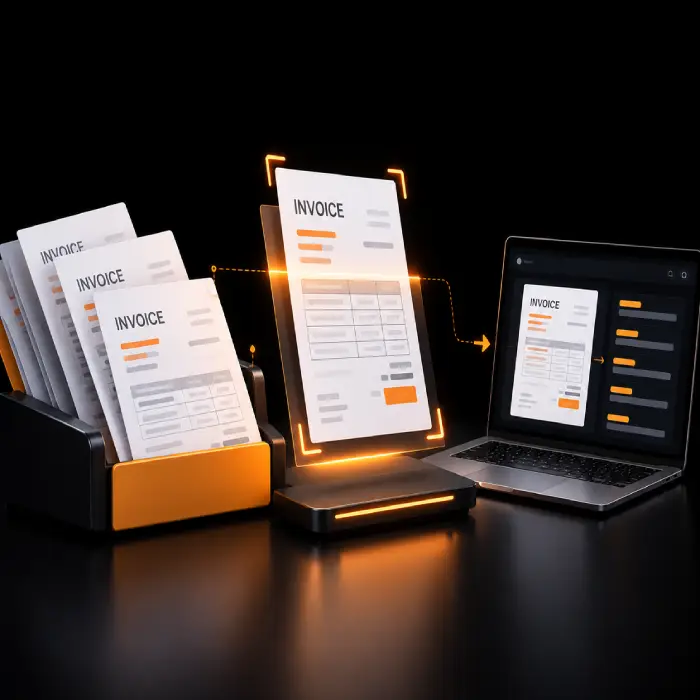
What Does AI Invoice Parsing Include?
AI invoice parsing combines invoice OCR with field-identification logic to read a PDF, scanned, or photographed invoice and convert its content into structured data. Invoice data extraction is the step that captures the relevant information, such as supplier details, invoice numbers, dates, tax amounts, totals, and line items, while invoice parsing is what organizes that captured information into consistent, usable fields. The two work together, but they are not the same step, and neither one automatically includes everything that follows.
- Invoice document intake from PDFs, scanned documents, and image files.
- Invoice OCR and text recognition across supported formats and languages.
- Supplier identification and invoice-level field extraction.
- Invoice field extraction for invoice numbers, dates, purchase order references, and payment terms.
- Invoice line item extraction, including tax, subtotal, total, and currency where present on the document.
- Invoice data validation against configured business rules or reference data, where this capability is included in your workflow.
- Structured output and, where configured, exception routing for low-confidence or incomplete fields.
Invoice Parsing Solutions Built for Your Business
Every accounts payable team deals with a different mix of invoice formats, suppliers, and systems. Our invoice parsing solutions are grouped around the problems businesses most often bring to us.
PDF and Scanned Invoice Data Extraction
PDF invoice parsing and scanned invoice data extraction are configured to handle digital, scanned, and photographed invoices in one intake process, so your team isn't manually sorting "easy" invoices from harder ones.
Supplier and Invoice Field Extraction
Invoice field extraction is configured to recognize supplier details, invoice numbers, and dates across your supplier mix, so fewer invoices need a human just to find basic header information.
Invoice Line Item Extraction
Invoice line item extraction captures item quantities, prices, tax, subtotal, and total fields where the layout supports it, turning multi-line invoices into structured data without re-keying every row.
Invoice Data Validation
Invoice data validation checks extracted fields against formats, totals logic, or reference data before they reach finance systems, catching errors that unchecked extraction output can carry downstream.
Structured Invoice Data for ERP and Accounting Systems
Structured output is delivered through supported integration methods into your accounting or ERP platform, cutting the duplicate entry between intake and your system of record.
High-Volume Invoice Data Capture
An invoice data extraction software workflow with automated invoice data capture handles larger invoice batches consistently, routing exceptions for review so volume growth doesn't mean proportional growth in manual entry.
Make Invoice Data Easier to Capture and Validate
Bring us a handful of real invoices. We'll walk through which fields, line items, and validation rules a working invoice parsing setup would need for your formats and systems.
Works With the Tools You Already Use
A complete intelligent invoice processing workflow gets structured data into the accounting, ERP, or database systems your finance team already runs, not just extracted on its own.
Our AI Invoice Parsing Services Process
A structured path from understanding your invoice formats to a monitored, live invoice parsing workflow.
- 1
Understand Invoice Formats & Requirements
We review your supplier mix, invoice formats, required fields, and current accounts payable process.
- 2
Collect Samples & Identify Required Fields
We gather representative invoice samples and agree which fields and line items need to be extracted.
- 3
Configure Extraction & Validation Rules
We configure invoice OCR, field extraction, and suitable AI models, along with any data validation rules.
- 4
Test Fields, Line Items & Validation
We test extraction accuracy against your real invoice samples, including line items, tax, and totals.
- 5
Connect to Downstream Systems
We connect structured output to your accounting, ERP, or other required business systems.
- 6
Monitor & Refine Exception Handling
We track extraction quality after launch and refine field rules and exception routing as formats change.
Invoice Parsing: Use Cases
A structured path from understanding your invoice formats to a monitored, live invoice parsing workflow.
Supplier Invoice Data Capture
Capture supplier details and invoice-level information across a varied supplier base.
Invoice Field Extraction for Accounting Entry
Extract invoice numbers, dates, totals, and references needed for accounting entry.
Invoice Line Item Extraction
Capture item descriptions, quantities, unit prices, and line totals from itemized invoices.
Processing PDF Invoices
Handle digital PDF invoices received directly from suppliers by email or upload.
Processing Scanned Invoices
Handle paper invoices that have been scanned or photographed before intake.
Extracting Tax and Total Information
Capture tax rates, tax amounts, subtotals, and totals for accurate downstream entry.
Validating Extracted Invoice Data
Check extracted fields against business rules or reference data before they're trusted downstream.
Preparing Data for Accounting or ERP Workflows
Deliver structured invoice data in a format ready for your accounting or ERP system.
Handling Multiple Suppliers and Layouts
Process invoices from many suppliers without a separate manual process per format.
Invoice Parsing vs. Manual Entry and Basic OCR
Basic OCR alone can read text on an invoice, but structured field extraction, line item extraction, and data validation are additional capabilities layered on top of it, not something OCR does by itself. Capability in each row below depends on the specific tools and implementation used.
| Factor | Manual Invoice Data Entry | Basic OCR-Based Extraction | AI Invoice Parsing With Validation | Broader Automated Invoice Processing |
|---|---|---|---|---|
Text recognition | Manual reading | Yes | Yes | Yes |
Structured field extraction | Manual entry | Limited without added logic | Yes, within trained scope | Yes |
Line item extraction | Manual, row by row | Depends on added configuration | Supported where layout allows | Supported where layout allows |
Handling variable invoice layouts | Yes, via staff judgment | Limited without templates or rules | Designed to adapt, within configured scope | Designed to adapt, within configured scope |
Data validation | Yes, manually | Not included by default | Configurable against business rules | Configurable against business rules |
Human review and exception handling | Inherent to the process | Typically absent | Routed for low-confidence fields | Routed for low-confidence fields |
Downstream workflow support (routing, approvals, accounting integration) | Yes, manually | Not included | Depends on scope; parsing alone may not include this | Included as part of the broader workflow |
Industries We Help With AI Invoice Parsing Solutions
Invoice volume, supplier variety, and formatting differ by industry, which is why invoice parsing requirements are scoped per business rather than applied as a single template.
Manufacturing
Capture supplier, parts, and purchase-order invoice data across recurring vendor relationships and varied formats.
Retail and E-Commerce
Process high volumes of supplier and vendor invoices across frequent, recurring purchasing cycles.
Logistics and Transportation
Handle freight, fuel, and carrier invoices that often arrive in varied formats from many providers.
Healthcare Administration
Support supplier and vendor invoice capture for medical supplies, equipment, and facility services.
Professional Services
Capture vendor and subcontractor invoice data for firms managing client-billable expenses.
Construction
Process subcontractor and materials invoices that frequently vary in format across projects and vendors.
Wholesale and Distribution
Handle a high volume of recurring supplier invoices across a broad and changing vendor list.
Shared Services & Finance Operations
Centralize invoice intake and extraction for teams processing invoices on behalf of multiple business units.
Why Choose Wappnet AI as Your Invoice Parsing Company?
As an invoice parsing company, we don't start from a fixed template. Our invoice parsing services begin with your invoice formats, required fields, validation needs, and downstream systems, so the implementation reflects how your accounts payable process actually works rather than a one-size-fits-all script.
- Scope extraction fields and line items around your actual invoice formats, not a generic field list.
- Configure data validation rules that match your business requirements and available reference data.
- Design for integration with the accounting, ERP, or database systems you already use.
- Build human review into the workflow for low-confidence results and business-critical fields.
- Pay attention to data quality and operational workflow, not extraction alone.
- Support evolving requirements as your supplier base, invoice formats, or systems change.
Real-World Invoice Parsing Solutions We've Delivered
Ready to Reduce Manual Invoice Data Entry?
We can help assess your invoice formats, the fields you need extracted, your validation requirements, and how structured data should reach your systems.
Latest AI Insights & Industry Trends
 RAG
RAG vs Fine-Tuning vs Prompt Engineering: Which Approach Fits Your Use Case?
Compare RAG, fine-tuning, and prompt engineering to explore costs, use cases, and the best approach for enterprise AI.
 AI Copilot
What is an AI Copilot? Use Cases & Build Guide
What is an AI Copilot? Learn how it works, how it differs from AI agents, key use cases, and how to build one for your business.
 RAG
What Is RAG? A Complete Guide to Retrieval-Augmented Generation
Learn what RAG is, how Retrieval-Augmented Generation works, reduces AI hallucinations, and powers smarter enterprise AI.
Frequently Asked Questions
Invoice parsing is the process of identifying relevant information on an invoice, such as supplier details, invoice numbers, dates, tax amounts, totals, and line items, and converting it into structured fields that applications and business systems can use. It relies on invoice OCR to read the document and on field-identification logic to understand what each piece of text represents.
Invoice OCR recognizes and reads the text on an invoice image, scan, or PDF. Invoice parsing goes a step further by identifying which recognized text belongs to which field, such as supplier name, invoice number, or total, and organizing that information into structured data. OCR is a component of invoice parsing, not a replacement for it.
Yes. AI invoice data extraction can process both digital PDF invoices and scanned or photographed invoices. Scanned invoice data extraction typically depends more heavily on document image quality, so results can vary based on scan resolution, lighting, and how the original document was captured.
Common invoice field extraction targets include supplier and buyer details, invoice number, invoice and due dates, purchase order references, currency, tax amounts, subtotal, total, and payment terms. Invoice line item extraction can also capture item descriptions, quantities, unit prices, and line totals where the invoice layout supports it.
The accuracy of AI invoice data extraction depends on document quality, invoice layout complexity, language, how consistent a supplier's invoice format is, and how the solution has been configured or trained. We do not quote a fixed accuracy percentage without first reviewing representative invoice samples from your business.
Invoice data validation can be configured alongside invoice parsing to check extracted fields against business rules, expected formats, purchase order data, or other reference information. Validation is a distinct capability from extraction itself and is scoped separately based on the rules your finance or accounts payable team requires.
Low-confidence or incomplete fields can be flagged for human review rather than passed downstream automatically. Routing low-confidence extractions to a reviewer is a common way to protect data quality on business-critical fields like totals and tax amounts.
Handling varied supplier layouts is one of the core challenges invoice parsing is designed to address. The ability to adapt to different invoice formats depends on the extraction approach used and, in many cases, on configuration or examples provided during setup.
No. Invoice parsing specifically covers identifying and structuring invoice information. Automated invoice processing is a broader term that can include intake, extraction, validation, routing, approvals, and accounting or ERP integration. Invoice parsing is typically one part of a wider automated invoice processing workflow, not the whole of it.
Structured invoice data can be transferred to accounting platforms, ERP systems, databases, or other business applications through supported integration methods such as APIs, webhooks, or custom connectors. Feasibility depends on the target system's available APIs, data format requirements, and permissions.
As an invoice parsing company, Wappnet.ai scopes extraction fields, validation rules, and integration requirements around your actual invoice formats and workflow rather than a fixed template, and builds human review into the process for exceptions and business-critical fields.
Implementation timelines depend on the number of invoice formats involved, the fields and validation rules required, the systems being integrated, and how much testing is needed. We review these factors with you before proposing a timeline rather than quoting a fixed duration up front.
Cost depends on the number of invoice formats and fields involved, the validation rules required, integration complexity, and ongoing volume. The return typically comes from reduced manual entry time, fewer correction cycles, and faster access to structured data, but we size the actual time savings against your current process rather than quoting a fixed ROI figure before reviewing it.
Initial configuration, integration, and testing are typically handled as part of the implementation engagement. Your team's involvement is usually limited to providing invoice samples, confirming business rules, and approving access to the systems structured data needs to reach, rather than building the extraction logic yourselves.