
AI Solutions for Manufacturing and Supply Chain
Unplanned stops, inspection backlogs, late supplier deliveries, and planning data scattered across machines, spreadsheets, and warehouse and ERP systems keep teams reacting instead of planning. We build AI solutions for manufacturing and supply chain teams, helping plants, planners, buyers, and logistics teams explore manufacturing AI services and supply chain AI solutions for equipment monitoring, visual inspection, demand forecasting, inventory, and logistics. We start with the operational problem, build around the systems you already run, keep your people in the review loop, and measure results against your own baseline.
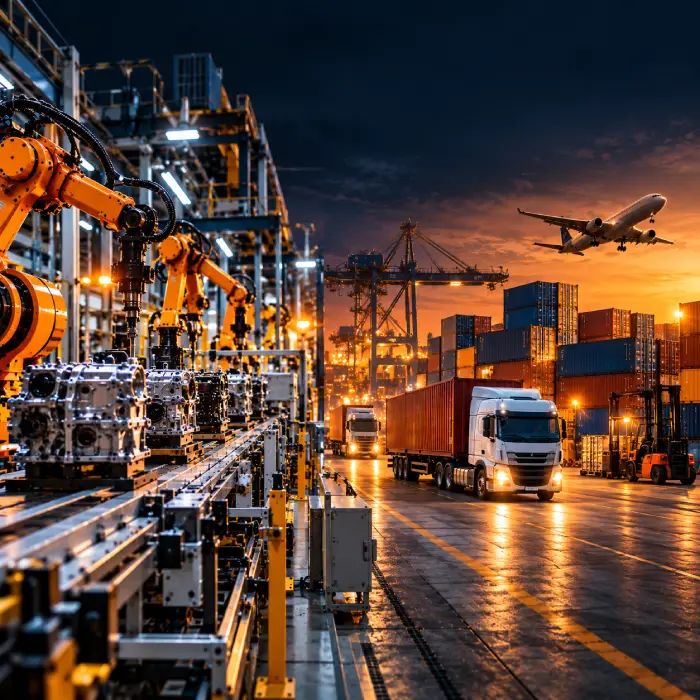
What Is AI in Manufacturing and Supply Chain?
AI in manufacturing uses production, equipment, and quality data to flag early signs of equipment trouble and visual defects. AI in supply chain applies the same idea to orders, inventory, suppliers, and shipments, such as forecasting demand or warning of a late delivery. Industrial AI solutions target specific problems, and industrial AI automation handles routine checks while people review exceptions and make decisions.
Watch equipment
Reads sensor and maintenance data and flags unusual behavior for your maintenance team to check.
Inspect quality
Reviews images from cameras on the line and routes doubtful parts to an inspector.
Plan production
Weighs orders, capacity, and material availability and suggests schedules that planners approve.
See operations clearly
Brings machine, quality, and inventory data together so managers spot problems sooner.
Forecast demand
Uses order history and seasonality to estimate what to make and buy, with assumptions shown.
Track suppliers and shipments
Watches delivery history and lead times and flags orders likely to arrive late.
Manage stock
Suggests reorder levels and transfers between sites for planners to approve.
Coordinate warehouse and logistics
Spots delivery exceptions and picking delays and routes them to the right person.
Key Challenges Facing Manufacturing and Supply Chain Teams
Most projects start with a day-to-day operational frustration, not a model. Not every challenge applies to every plant or network, so which of these sounds like yours?
Unplanned Equipment Downtime
A stopped line delays orders and pulls maintenance into emergency work. Calendar-based servicing and fixed alarm limits can miss slow changes in how a machine behaves.
Inconsistent Product Quality
Variation found late means rework, scrap, or returns. Sampling checks only see a fraction of output, so drift can run for hours before anyone notices.
Manual or Slow Inspection Processes
Inspectors tire, judgment varies between shifts, and inspection can become the bottleneck at line speed. Fixed-rule vision systems can struggle when products or lighting change.
Production Bottlenecks
One constrained station idles everything downstream. Spreadsheet schedules are hard to adjust when orders, materials, or machine availability change mid-shift.
Fragmented Operational Data
Machine data, quality records, maintenance logs, and ERP orders sit in separate systems, so answering one question means exporting and matching several files by hand.
Difficulty Integrating AI Into Existing Systems
Older equipment, mixed protocols, and strict change control make a standalone AI tool hard to adopt. A pilot that cannot reach live data rarely leaves the lab.
Limited Supply Chain Visibility
Planners find out about a late shipment or a short supply when it hits the line. Updates arrive by email and portal, and few people see the whole picture.
Demand Forecasting Inaccuracy
Forecasts built on last year's averages react slowly to promotions, seasonality, or customer changes, so production and purchasing run on stale numbers.
Inventory Imbalance
Too much stock ties up cash and too little stops production. Static reorder points do not reflect lead-time changes or demand swings across sites.
Supplier Delays and Disruption
One late component can idle a line. Teams often learn of supplier problems after the delivery date has already slipped.
Warehouse and Logistics Inefficiency
Picking routes, dock schedules, and delivery exceptions are managed by hand or by fixed rules, which struggle when order mix or carrier performance changes.
Manual Planning and Exception Handling
Planners and buyers spend their day chasing updates in spreadsheets and email instead of resolving the exceptions that matter.
Manufacturing and Supply Chain AI Solutions We Build
Our AI solutions for the manufacturing industry and AI solutions for supply chain management start with one problem worth solving and fit your existing platforms. As a manufacturing AI development company, we scope these with you, not as off-the-shelf products. Each card shows the problem, the data, and what you can measure, plus a tag for any extra sensors, cameras, or integration needed.
Predictive Maintenance and Equipment Intelligence
Machines fail with little warning. AI-powered predictive maintenance flags drift in sensor and work-order data for technicians to check, supporting AI for equipment monitoring before a stop. May need added sensors. Track unplanned downtime.
AI-Powered Visual Quality Inspection
Manual inspection is slow and varies. AI quality inspection uses computer vision for manufacturing to check line-camera images and send doubtful parts to an inspector. May need cameras and lighting. Track defect rate and first-pass yield.
Manufacturing Process Analytics
Nobody sees what drives yield loss. AI-powered production analytics link machine, quality, and shift data to support manufacturing process optimization. Uses existing data. Track first-pass yield and OEE.
Production Planning and Optimization
Schedules break when orders or machines change. Production planning and optimization suggests schedules from ERP and MES data for planners to adjust. Uses existing data. Track schedule adherence and OEE.
Demand Forecasting and Planning
Forecasts lag behind demand. AI-powered demand forecasting estimates what to make and buy from order history and lead times, for planners to approve. Uses existing data. Track forecast accuracy.
Inventory Intelligence
Stock levels follow static rules. Inventory optimization suggests reorder levels and site transfers for planners to approve. Uses existing data. Track inventory turnover and stockout rate.
Supply Chain Visibility and Supplier Risk
Supplier delays surface only when parts run short. Supply chain visibility connects purchase order, delivery, and carrier data to flag orders at risk, supporting supply chain optimization for manufacturers. Buyers decide. Track on-time in-full delivery.
Warehouse Operations
Picking follows fixed rules. Warehouse automation support suggests picking batches and flags stock mismatches using WMS and scan data. May need scanners or WMS integration. Track order cycle time and picking accuracy.
Logistics and Delivery Optimization
Delivery exceptions are found too late. AI for logistics compares planned and actual shipment progress to flag likely delays for dispatchers. Needs carrier or telematics data. Track on-time in-full delivery.
Operational Decision Support
Answers are spread across systems. This supports AI-driven manufacturing operations with one view of production, quality, maintenance, and supply chain data, answering plain-language questions. Managers decide. Track time to find an answer.
AI-Enabled Workflow Automation
Follow-ups stall between teams. Industrial AI automation turns an alert into a work order, notifies the owner, and tracks it to closure, escalating exceptions. Needs ERP or ticketing integration. Track maintenance response time.
Manufacturing Knowledge Assistants
Troubleshooting knowledge is hard to find. As one of our manufacturing AI solutions, this assistant answers from approved manuals and notes, shows the source, and says when it does not know. It does not replace safety procedures. Track troubleshooting time.
Ready to Explore AI Opportunities for Your Manufacturing and Supply Chain Operations?
Tell us which problem costs your team the most time, whether it is unplanned downtime, slow inspection, a forecast that keeps missing, or late supplier deliveries. We will tell you plainly where AI can help and what it would take.
AI Use Cases Across Manufacturing and Supply Chain
These use cases from our AI services for manufacturing and supply chain work show where AI fits into a normal shift, with a clear owner and review step. Any improvement is something to test against your baseline, not a guarantee.
01. Identifying Equipment Anomalies Before Failure
A maintenance planner picks the assets in scope. The model learns each machine's normal vibration and temperature and flags drift with the recent trend. A technician decides whether to schedule work. Evaluate earlier warning and fewer surprise stops.
02. Detecting Product Defects Through Image Analysis
A quality lead defines defect classes with example images. The model scores each part and sends uncertain ones to an inspector, whose decisions feed back. This manufacturing quality control using AI is judged on inspection time, defect rate, and inspector overrules.
03. Flagging Production Deviations
A shift supervisor gets an alert when cycle time, temperature, or throughput leaves its usual range, showing what changed and when. Operators decide whether to intervene. Evaluate time to notice and respond.
04. Supporting Root-Cause Analysis
After a quality drop, an engineer asks which settings, material lots, suppliers, or shifts coincide with it. The AI assembles the linked data and suggests factors to test. It shows correlations, not proven causes.
05. Optimizing Production Schedules
When a rush order arrives or a machine goes down, the system proposes revised schedules that respect changeovers and materials. The planner picks one or overrides it. Evaluate schedule adherence and planning time.
06. Identifying Unusual Energy Consumption
A plant manager sees when a line's energy use departs from its normal pattern, which can point to a fault or idle running. Engineers investigate. Evaluate how quickly unusual use is found.
07. Forecasting Material Requirements
A planner compares forecast demand with stock and lead times and gets suggested order quantities with assumptions shown. This AI-powered demand planning step lets the planner approve or edit. Evaluate forecast accuracy and stockouts.
08. Early Warning on Late Supplier Deliveries
A buyer sees which open purchase orders are likely to slip, based on supplier history and lead-time changes. This supplier risk management step suggests options like expediting, and the buyer decides. Evaluate how early problems are found.
09. Rebalancing Inventory Across Sites
A planner sees one site overstocked and another low on the same part, with suggested transfers and reasoning, and approves the moves. Evaluate inventory turnover and stockout rate.
10. Improving Warehouse Picking and Slotting
A supervisor receives suggested picking batches, slotting changes, and stock mismatch flags, and accepts or adjusts them. Evaluate order cycle time and picking accuracy.
11. Spotting Delivery Exceptions Early
A dispatcher sees shipments likely to miss their promise date, with the probable cause. This logistics optimization step lets the team contact the carrier or customer. Evaluate exception handling time and on-time in-full delivery.
12. Helping Teams Analyze Operational Reports
A manager asks which line had the most unplanned stops, or which supplier delayed the most orders, and gets an answer from your data with the definition shown. This manufacturing data analytics saves analysts report-building time.
Business Benefits of AI in Manufacturing and Supply Chain
The benefits of AI depend on the use case, your data, and how your teams adopt it. So we agree what success looks like before we build, and compare against your own starting point instead of promising numbers.
Unplanned downtime
Hours of unscheduled stoppage on the assets in scope.
Overall equipment effectiveness (OEE)
Availability, performance, and quality combined into one view of how well equipment is used.
First-pass yield
Share of units that pass without rework or repair.
Defect rate
How often defective units are found, and at which stage.
Inspection time
How long inspection takes per unit or batch.
Maintenance response time
Time from an alert to action by the maintenance team.
Schedule adherence
How closely actual production follows the plan.
Forecast accuracy
How closely forecasts match actual demand or material use.
Inventory turnover
How quickly stock is used and replaced.
Stockout rate
How often an item is needed and not available.
On-time in-full delivery
Share of orders delivered on the promised date and in the promised quantity.
Supplier lead-time variability
How much supplier delivery times swing from the quoted time.
Our Approach to Manufacturing and Supply Chain AI Implementation
Whether you need manufacturing AI consulting services or AI development services for manufacturing, you see progress in stages, with a go or no-go decision at each one. Timelines depend on scope, data, and integrations, and we agree on them after the assessment.
- 1
Manufacturing and Supply Chain Workflow and Data Assessment
We map how work moves through your plants, warehouses, and planning teams, and check what data exists and how clean it is.
- 2
Use-Case Prioritization and Feasibility
We rank use cases by value, feasibility, data readiness, and risk, and agree how each is measured.
- 3
Data Preparation and Solution Design
We prepare the data, choose the approach, and add human review points that fit how your teams work.
- 4
AI Model or Application Development
We build the model or tool, such as anomaly detection, vision, or forecasting, and test it on your historical data.
- 5
Integration, Testing, and Validation
We connect to agreed systems, such as sensors, MES, ERP, or warehouse tools, and validate on realistic scenarios. We confirm compatibility before assuming it.
- 6
Deployment, Monitoring, and Improvement
AI implementation for manufacturing continues after go-live. We start with one line or site, track agreed KPIs, and refine as things change.
Technologies Powering Our Manufacturing and Supply Chain AI Solutions
You should not have to pick technology first. Our custom AI solutions for manufacturing and supply chain projects begin with your data, existing systems, and the problem at hand, not a favorite tool.
Manufacturing and Supply Chain Segments Where AI Can Help
AI starts from different workflows in each sector. Here is where supply chain AI solutions and plant tools could fit. Regulated sectors need extra validation, which we agree with your quality and compliance teams first.
Automotive and Transportation Equipment
Complex assemblies, many suppliers, and tight delivery windows. Visual inspection, supplier delay warnings, and line-side material forecasting are common starting points.
Industrial Machinery and Equipment
Made-to-order products and long component lead times. Production planning, bill-of-materials-based forecasting, and equipment monitoring can help planners and service teams.
Electronics and Electrical Equipment
Small parts, fine tolerances, and fast product changes. Computer vision for inspection and demand and component forecasting are typical starting points.
Food and Beverage
Short shelf lives, batch production, and variable demand. Demand forecasting, inventory planning, and line monitoring support planners, with quality and safety checks staying with your teams.
Pharmaceutical and Life Sciences Manufacturing
Batch records, strict documentation, and regulated processes. AI can support document handling, analytics, and planning, with validation and human sign-off agreed upfront. We make no compliance claims.
Consumer Goods and FMCG
Fast-moving products, promotions, and many distribution points. Demand planning, inventory optimization across sites, and delivery exception alerts are common starting points.
Metals, Plastics, and Packaging
Continuous or high-volume processes where small drifts waste material. Process analytics, anomaly alerts, and energy-use analysis help engineers find causes sooner.
Logistics, Warehousing, and Distribution
Order peaks, picking effort, and delivery promises. Picking support, shipment exception alerts, and route suggestions help supervisors and dispatchers act sooner.
Distributors and Wholesalers
Large catalogs, supplier lead times, and stock spread across locations. Inventory intelligence, supplier risk flags, and light supply chain automation support buyers and planners.
Why Choose Wappnet AI for Manufacturing and Supply Chain Solutions?
We are an AI development company for manufacturing and supply chain teams that want engineering built around their own operations, not a fixed product. Here is what you can expect from us and hold us to.
Start With Your Costliest Problem
We begin with the bottleneck your team feels most, such as line downtime or late supplier orders, and rank options by value, feasibility, and risk.
Data Readiness Comes Before Models
We check what data exists and whether new sensors or feeds are needed, so the plan matches what your operation can support.
Designed Around Your Existing Systems
We review what your MES, ERP, warehouse, and maintenance systems expose, and design around them instead of replacing them.
Evaluation Criteria Agreed Upfront
We record a baseline from your own data first, so you judge results against your starting point, not a generic benchmark.
People Stay in the Loop
Operators, inspectors, planners, and buyers review what matters, with clear escalation for anything uncertain or safety-related.
Built to Be Monitored After Launch
Our MLOps and AI infrastructure work covers deployment and monitoring, so models improve as products, suppliers, and equipment change.
Real-World AI Solutions for Manufacturing and Supply Chain We've Delivered
Proven real-world AI implementations delivering measurable operational improvements, quality scale, and inventory visibility across industrial facilities.
High-Precision Anomaly Detection & Failure Prevention System
Vibration and telemetry analysis model detecting mechanical anomalies 72 hours before critical pump and motor failure across 4 processing plants.
Automated Inline Visual Defect Inspection for Precision Assembly
High-speed camera vision model classifying surface defects and dimensional deviations on line speed with sub-millimeter precision.
End-to-End Supplier Delivery Risk & Replenishment Forecasting
Supply chain intelligence platform predicting supplier lead-time drift and rebalancing multi-site inventory to eliminate stockout downtime.
Ready to Discuss Your Manufacturing and Supply Chain AI Use Case?
Not sure where to begin? Tell us one challenge, such as downtime, inspection, forecasting, inventory, or supplier delays. As an AI development company for supply chain and plant teams, we will help you pick a first use case and how to measure it.
Latest AI Insights & Industry Trends
 RAG
RAG vs Fine-Tuning vs Prompt Engineering: Which Approach Fits Your Use Case?
Compare RAG, fine-tuning, and prompt engineering to explore costs, use cases, and the best approach for enterprise AI.
 AI Copilot
What is an AI Copilot? Use Cases & Build Guide
What is an AI Copilot? Learn how it works, how it differs from AI agents, key use cases, and how to build one for your business.
 RAG
What Is RAG? A Complete Guide to Retrieval-Augmented Generation
Learn what RAG is, how Retrieval-Augmented Generation works, reduces AI hallucinations, and powers smarter enterprise AI.
Frequently Asked Questions
AI solutions for manufacturing and supply chain are software tools that use machine learning, computer vision, or language models to support equipment monitoring, inspection, planning, forecasting, and supplier tracking. They assist engineers, planners, and operators and do not replace their judgment on safety, quality, and purchasing.
Common uses include equipment monitoring, visual inspection, production scheduling, and energy analysis. AI in manufacturing usually starts with one workflow and is measured against a baseline taken before launch.
Common uses include demand forecasting, inventory planning, supplier delay warnings, and delivery exception alerts. AI supply chain optimization works best with connected order, stock, supplier, and shipment data, and with planners approving what it suggests.
It can flag early signs such as unusual vibration or temperature, so maintenance can investigate sooner. It does not predict every failure, and predictive maintenance depends on sensor coverage, failure history, and data quality, with technicians reviewing each alert.
Computer vision compares camera images with examples of good and defective parts, supports manufacturing defect detection, and sends doubtful parts to an inspector. It needs suitable cameras, lighting, and labeled images, and people confirm the outcomes that matter.
It depends on the use case: sensor and maintenance data for equipment monitoring, labeled images for inspection, and order, stock, and lead-time history for forecasting. We assess quality, coverage, and access first, and tell you plainly if more data is needed.
Often, yes, depending on what your systems expose, through APIs, database access, file exports, or data platforms. We check integration early and do not claim compatibility with a specific MES, ERP, WMS, or SCADA product until it has been reviewed.
Set a baseline before launch, track measures such as unplanned downtime, first-pass yield, forecast accuracy, or on-time in-full delivery, and compare over an agreed period, including running costs. No ROI figure can be promised in advance.
It depends on scope, data readiness, integrations, and approvals. A one-line or one-site pilot is usually quicker than a multi-site rollout, and you get a milestone plan after the assessment. Be cautious of fixed timelines quoted before anyone has seen your data.