
AI Solutions for Legal Tech
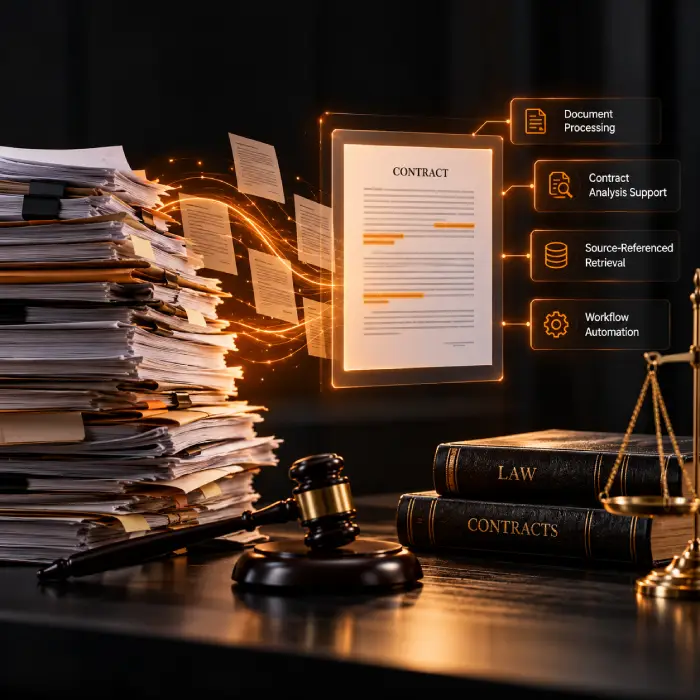
Contracts stuck in review, precedent buried in shared drives, and renewal dates re-keyed by hand: this admin keeps legal professionals from the judgment calls only they can make. We build AI solutions for legal tech and AI solutions for law firms, plus AI services for legal firms, covering document processing, contract analysis support, source-referenced retrieval, and workflow automation. AI prepares and organizes, and your legal professionals review and decide.
What Is AI in Legal Tech?
AI in legal technology applies language models, document reading, and search to legal content, so routine handling takes less time and information is easier to find. Our legal AI solutions target specific workflows, and qualified professionals review anything consequential. Legal judgment, advice, and professional responsibility stay with your lawyers, under your own policies and confidentiality rules.
Read legal documents
Classifies documents and pulls agreed fields from contracts, filings, and correspondence.
Analyze contracts
Finds clauses and flags language outside your criteria for a lawyer to review.
Find information
Searches approved documents and authorized sources and shows where each answer came from.
Summarize with sources
Drafts summaries that point to source pages so a reviewer can check them.
Automate intake and routing
Classifies requests, routes them, and updates records within the permissions you set.
Track dates and obligations
Extracts renewals and commitments into a tracker for confirmation.
See operations clearly
Brings matter and workflow data together so bottlenecks surface sooner.
Share legal knowledge
Makes approved precedents and guidance easier to find across the team.
Key Challenges Facing Legal Teams
Practice areas, jurisdictions, data environments, and technology stacks differ, so not every challenge applies to every firm or legal department. Which of these sounds like yours?
High Volumes of Legal Documents
Contracts, correspondence, and filings arrive as PDFs, scans, and emails. Sorting and reading them consumes time that fee earners and in-house counsel need elsewhere.
Time-Consuming Contract Review
Each agreement needs checking against standard positions. Queues grow, and business teams waiting on a signature feel every day of delay.
Hard to Find Relevant Information
Prior agreements, advice, and templates sit across repositories and inboxes. Searching by file name misses what matters, and work gets repeated.
Repetitive Matter Administration
Opening matters, updating statuses, and handing off information are routine but constant. Skilled people spend part of every week on them.
Manual Obligation Tracking
Renewal dates, notice periods, and commitments are often re-keyed by hand. A missed date can carry a real commercial consequence.
Fragmented Legal Knowledge
Know-how lives in people's heads and personal folders. Answers vary by who is asked, and new joiners take longer to become productive.
Inconsistent Document Workflows
Different teams review, name, and file documents differently. Inconsistency makes reporting harder and handoffs error-prone.
Difficulty Integrating AI Into Existing Systems
Established document and matter systems, change control, and limited interfaces make standalone tools hard to adopt. A pilot that cannot reach approved data rarely goes live.
Confidentiality and Access Control
Client and privileged information must stay within the right audience. Any AI tool that ignores existing permissions creates risk instead of removing work.
Legal Tech AI Solutions We Build
As a legal AI development company, we scope custom AI solutions for legal tech around one workflow at a time, using your own documents and systems. AI supports your lawyers and never decides legal outcomes.
AI-Powered Legal Document Processing
Documents arrive unsorted and in mixed formats. AI legal document processing classifies them, extracts agreed fields, and drafts summaries from your document store, so staff spend less time sorting and re-keying. Extraction can be wrong, so staff verify against the source.
Contract Analysis and Review Support
Reviewers check every agreement against the same checklist. AI contract analysis finds clauses, extracts obligations, and flags language outside your criteria, supporting contract review automation and version comparison. It supports legal review and does not replace it, so a qualified lawyer makes the call.
Legal Research and Knowledge Retrieval
Precedent and templates are hard to find across repositories. AI legal research tools retrieve passages from approved documents and authorized sources and show where each came from, so less time goes on searching. This is not legal advice, so users verify the source and that the law is current.
Legal Workflow Automation
Intake and status updates often run on email and spreadsheets. Legal workflow automation classifies and routes requests, drafts updates, and passes information between systems within set permissions, so routine requests need fewer manual touches. Sensitive or unusual items go to a person.
Due Diligence and Document Review
Large document sets need organizing under time pressure. AI groups documents, extracts relevant fields, and ranks them to support due diligence document review, so reviewers see likely important items first. It can miss relevant items, so reviewers still read what matters.
Legal Operations Analytics
Managers often see bottlenecks only after the fact. Analytics combines matter, request, and workflow data to show where work waits and answers plain-language questions, giving earlier visibility of recurring delays. Output depends on data quality, and managers interpret the results.
Ready to Explore AI Opportunities for Your Legal Operations?
Tell us which legal workflow costs your team the most time, whether it is contract review, document search, intake routing, or date tracking. We’ll tell you plainly where AI can help and where a legal professional must stay in the loop.
AI Use Cases Across Legal Workflows
These examples show how AI can fit into an ordinary working day, each with a named reviewer. Extracted information, summaries, and flagged issues always need appropriate verification against the source.
01. Extracting Clauses From Contracts
When a team needs termination and liability clauses from a batch of agreements, AI can locate and tag them with page references, so reviewers start from the relevant text. A lawyer confirms each extraction.
02. Summarizing Lengthy Legal Documents
Before a call on a long agreement, AI can draft a summary that points to the source sections, so people get oriented faster. It is a starting point, not a substitute for reading the key terms.
03. Comparing Contract Versions
When a counterparty returns a redline, AI can list what changed and group the changes by clause type, which saves time spotting differences. Reviewers still assess what the changes mean.
04. Identifying Missing Contract Information
AI can check each agreement for the fields you require before approval and flag any gaps, so fewer incomplete agreements move forward. Staff confirm each flag.
05. Organizing Due Diligence Documents
When a data room holds thousands of mixed files, AI can sort documents against a request list so reviewers work from an organized set. The categorization is spot-checked.
06. Retrieving Relevant Internal Legal Knowledge
When a lawyer needs a precedent clause the firm has used before, AI can retrieve candidates from approved repositories with their sources shown, which cuts searching time. The lawyer checks whether each one suits the matter.
07. Routing Legal Intake Requests
Requests that land in a shared inbox can be classified and sent to the right owner automatically, which speeds up the first response. Unclear requests go to a person.
08. Tracking Important Contract Dates
Renewals and notice periods often live inside documents rather than systems. AI can extract the dates into a tracker, reducing manual entry, and each date is verified before anyone relies on an alert.
09. Summarizing Matter-Related Documentation
When someone joins a running matter, AI can draft a source-referenced summary of the file to speed up onboarding. The matter lead checks it.
10. Identifying Recurring Administrative Bottlenecks
When certain approvals always stall, AI can analyze workflow data to show where requests wait, so managers can target the cause. Interpretation stays with the managers.
Business Benefits of AI in Legal Tech
Results depend on the workflow, the documents, and how your team adopts the solution. So we agree what success looks like before the build and compare against your own starting point instead of promising numbers.
Document processing time
Time from receipt to a classified, filed document.
Contract review turnaround time
Time from request to completed review.
Time locating relevant documents
Time to find the prior work or guidance needed.
Legal intake response time
Time from a request to a first useful reply.
Matter administration effort
Hours spent on routine matter handling.
Information extraction accuracy
Share of extracted fields that match the source, tested on professionally reviewed examples.
Document review backlog
Number of documents waiting for review.
Workflow completion time
Time to complete a routine workflow end to end.
Our Approach to Legal Tech AI Implementation
Whether you need AI consulting for legal tech or full development, you see progress in stages with a go or no-go decision at each one. Requirements depend on your jurisdiction, confidentiality obligations, document types, and existing technology, and we agree timelines after the assessment.
- 1
Legal Workflow Assessment
We identify document-heavy tasks, business objectives, users, and current processes.
- 2
Use-Case Prioritization
We evaluate feasibility, potential value, data availability, confidentiality, and risk.
- 3
Data Preparation and Solution Design
We assess source quality, access permissions, document types, and system requirements, then design review points.
- 4
AI Development and Validation
We build the proposed models, applications, or workflows and evaluate them on representative test cases.
- 5
Integration, Testing, and Deployment
We connect the solution to appropriate existing systems and test the complete workflow. We confirm compatibility with your platforms instead of assuming it.
- 6
Monitoring and Improvement
We monitor quality, reliability, access, errors, and user feedback as documents and policies change.
Technologies Powering Our Legal Tech AI Solutions
You should not have to pick technology first. Our legal AI services begin with your documents, systems, and the problem at hand. Each technology below is a possible implementation option, chosen only if it serves the workflow.
Legal Tech Segments Where AI Can Help
AI starts from different workflows in each segment. Here is where AI solutions for the legal industry could fit for these teams. Obligations vary by jurisdiction, practice area, and client, so we agree confidentiality and review rules with your legal and security leads first.
Law Firms
Document-heavy matters and know-how spread across partners. Document processing, precedent search, and legal matter management automation are common starting points.
Corporate Legal Departments
Business teams send a steady stream of contract and advice requests. Corporate legal AI solutions and legal compliance workflow automation help with intake, tracking, and routing.
Legal Operations Teams
Process, tooling, and reporting across the function. Legal operations analytics and workflow automation show where work waits.
Legal Service Providers
Outsourced review and support at volume. Document classification, extraction, and triage support consistent handling under client rules.
Contract Management Teams
Agreements across many counterparties. Contract lifecycle automation and contract obligation tracking reduce manual re-keying of dates and terms.
Legal Technology Businesses
Product teams adding AI features. Assistants, retrieval, and extraction can be built around your existing product, with interfaces confirmed first.
In-House Counsel and Legal Administrators
Small teams answering the same questions repeatedly. Legal knowledge management and routine-request routing free time for advice.
Compliance and Risk Teams
Evidence gathering and policy lookups. AI collects relevant records and drafts summaries for your team to check. It does not decide what is compliant.
Organizations With Large Legal Document Volumes
Any business holding many agreements or records. Organizing and searching them is often the first step.
Why Choose Wappnet AI for Legal Tech AI Solutions?
We are an engineering-led team building AI solutions for legal firms and other legal organizations that want AI built around their own documents and workflows, not a fixed product. This is what you can expect from us and hold us to.
Start Where Your Team Loses the Most Time
We begin with the process your lawyers feel most, such as contract intake or document search, and rank options by value, feasibility, and risk.
Document and Data Readiness Come First
We review your contracts, templates, and repositories, who may access them, and whether they suit the use case, before any model is chosen.
Built Around Your Legal Systems
We review what your document, matter, and contract systems expose and design around them, confirming compatibility instead of assuming it.
Results Measured Against Your Baseline
Before the build, we record current review times and handling effort, and test accuracy on examples your professionals have reviewed.
Confidentiality and Professional Review Stay in Control
We plan role-based access, data minimization, and source-referenced answers. Qualified professionals review consequential output, with escalation and a manual fallback. Your legal and privacy leads confirm obligations for your jurisdiction.
Quality Watched After Go-Live
Where the engagement includes it, we track extraction quality, errors, access, and user feedback as your documents and playbooks change.
Real-World AI Solutions for Legal Tech We've Delivered
Proven real-world AI implementations delivering measurable efficiency, accelerated contract review, and compliant automation for legal teams.
Automated Contract Clause Extraction & Deviation Flagging Engine
Accelerated commercial contract review turnaround by 60% with clause-level risk detection and automated redline comparison against firm playbook standards.
Intelligent M&A Data Room Document Classification & Triage Pipeline
Organized and indexed over 150,000 multi-format data room files for expedited cross-border transactional due diligence with source-verified summaries.
Enterprise Legal Intake, Routing & Obligation Tracking System
Automated incoming request triage across corporate legal departments, reducing initial triage delay from days to minutes while extracting critical renewal obligations.
Ready to Discuss Your Legal Tech AI Use Case?
Tell us one challenge, such as contract analysis, document processing, legal knowledge retrieval, or workflow automation. As an AI development company for legal tech, we will help you choose a first use case and how to measure it.
Latest AI Insights & Industry Trends
 RAG
RAG vs Fine-Tuning vs Prompt Engineering: Which Approach Fits Your Use Case?
Compare RAG, fine-tuning, and prompt engineering to explore costs, use cases, and the best approach for enterprise AI.
 AI Copilot
What is an AI Copilot? Use Cases & Build Guide
What is an AI Copilot? Learn how it works, how it differs from AI agents, key use cases, and how to build one for your business.
 RAG
What Is RAG? A Complete Guide to Retrieval-Augmented Generation
Learn what RAG is, how Retrieval-Augmented Generation works, reduces AI hallucinations, and powers smarter enterprise AI.
Frequently Asked Questions
AI solutions for legal tech are software tools and services built around specific legal workflows, such as processing documents, supporting contract review, retrieving information from approved sources, and automating routine handling. They assist legal professionals and do not replace them.
AI in legal technology is the underlying set of methods, including language models, document AI, search, and machine learning, applied across contracts, research, matter administration, and legal operations. Qualified people remain responsible for consequential legal decisions.
Law firms commonly use AI to sort and summarize documents, extract clauses for contract review, search precedent and internal know-how, triage due diligence materials, and route matter intake. A sensible start is one high-volume task, measured against a baseline. Lawyers stay responsible for advice and client work, and client confidentiality rules decide what data the tools may use.
Teams use AI to classify and summarize documents, extract clauses and dates, search knowledge bases, route intake requests, and analyze operational data. Most start with one workflow and measure it against a baseline taken before launch.
AI can identify clauses, extract obligations, compare language against criteria you define, and draft summaries. These outputs may contain errors, so a qualified professional verifies them against the source. AI supports contract review and does not replace legal review.
AI can classify documents, read scans with OCR, extract agreed fields, and help organize repositories. Quality depends on document type and condition, so we test on representative samples and keep staff verification in the workflow.
Yes, as retrieval. AI can find relevant passages across approved internal documents and authorized sources and show where they came from. It does not provide authoritative legal advice, and users should verify the cited source and that the law is current.
Most projects start with representative documents such as contracts or templates, your review criteria, and examples checked by your lawyers. We also check data quality, access permissions, and the systems the data lives in before designing anything.
Implementation usually follows six stages, agreed with a go or no-go decision at each one. Timelines depend on scope, data readiness, and approvals: Assess the legal workflow: document-heavy tasks, users, and current processes. Prioritize use cases by feasibility, value, data availability, confidentiality, and risk. Prepare data and design the solution, including access permissions and review points. Build and validate on representative test cases reviewed by your professionals. Integrate with your existing systems and test the complete workflow. Monitor quality, errors, access, and user feedback after go-live.
Often, depending on what your document management, matter management, or contract systems expose, such as APIs, data exports, or file access. We check integration early and do not claim compatibility with a specific platform until it has been reviewed.
Limit the data used, apply role-based access that mirrors existing permissions, agree where data is processed and retained, keep humans reviewing consequential output, and keep records where required. Obligations vary by jurisdiction and use case, so involve your legal, privacy, and security leads.
No. AI can reduce repetitive handling and help locate information, but legal judgment, advice, and professional responsibility stay with qualified people. AI outputs may be wrong and should always be verified.
Record a baseline before launch, track measures such as contract review turnaround or time locating documents, and compare over an agreed period, including running costs. No ROI figure can be promised in advance.
Look for a partner that starts from your workflow, agrees success criteria first, is clear about human review and confidentiality, and confirms integrations instead of assuming them. Be cautious of guaranteed accuracy or unexplained compliance claims.