AI Automation Services: Pricing and ROI

How much does AI automation cost? Rarely does it have a one-line answer. AI Automation Services Pricing depends on workflow complexity, the number of systems you’re connecting, which AI models you use, data readiness, custom development, security and compliance needs, infrastructure, and maintenance. A single-step email bot and an agentic system that updates a CRM and triggers approvals across five departments both get called “automation,” but they sit at opposite ends of the same price range. This guide breaks down realistic 2026 pricing tiers, what moves your quote up or down, how vendors price it, and how to calculate AI automation ROI. Wappnet.ai also offers prebuilt AI automation workflows for common business processes.
AI automation services typically cost $2,500 to $250,000+, and enterprise-wide, multi-agent deployments can exceed $1 million. Price depends on workflow complexity, integrations, AI model usage, data readiness, and compliance needs. ROI is calculated as (Financial Benefits − Investment) ÷ Investment × 100, and is strongest when a workflow is high-volume, repetitive, and measured against a documented baseline.
Key Takeaways

Most businesses spend $2,500 to $250,000+ on AI automation, depending on scope. These are market-based estimates cross-referenced across multiple 2026 pricing guides, not a fixed quote.
| AI Automation Type | Typical Cost Range | Typical Timeline | Best For |
|---|---|---|---|
| Simple workflow automation | $2,500 – $15,000 | 2–4 weeks | Small businesses |
| AI-powered workflow (LLM-driven) | $15,000 – $60,000 | 4–10 weeks | Growing companies |
| Custom AI automation (agentic) | $60,000 – $250,000 | 3–6 months | Mid-market companies |
| Enterprise AI automation | $250,000 – $1,000,000+ | 6–12+ months | Large enterprises |
The custom and enterprise tiers are typically where agentic AI development engagements come in, since multi-step, autonomous workflows carry more build and testing cost than a single trigger-response bot.
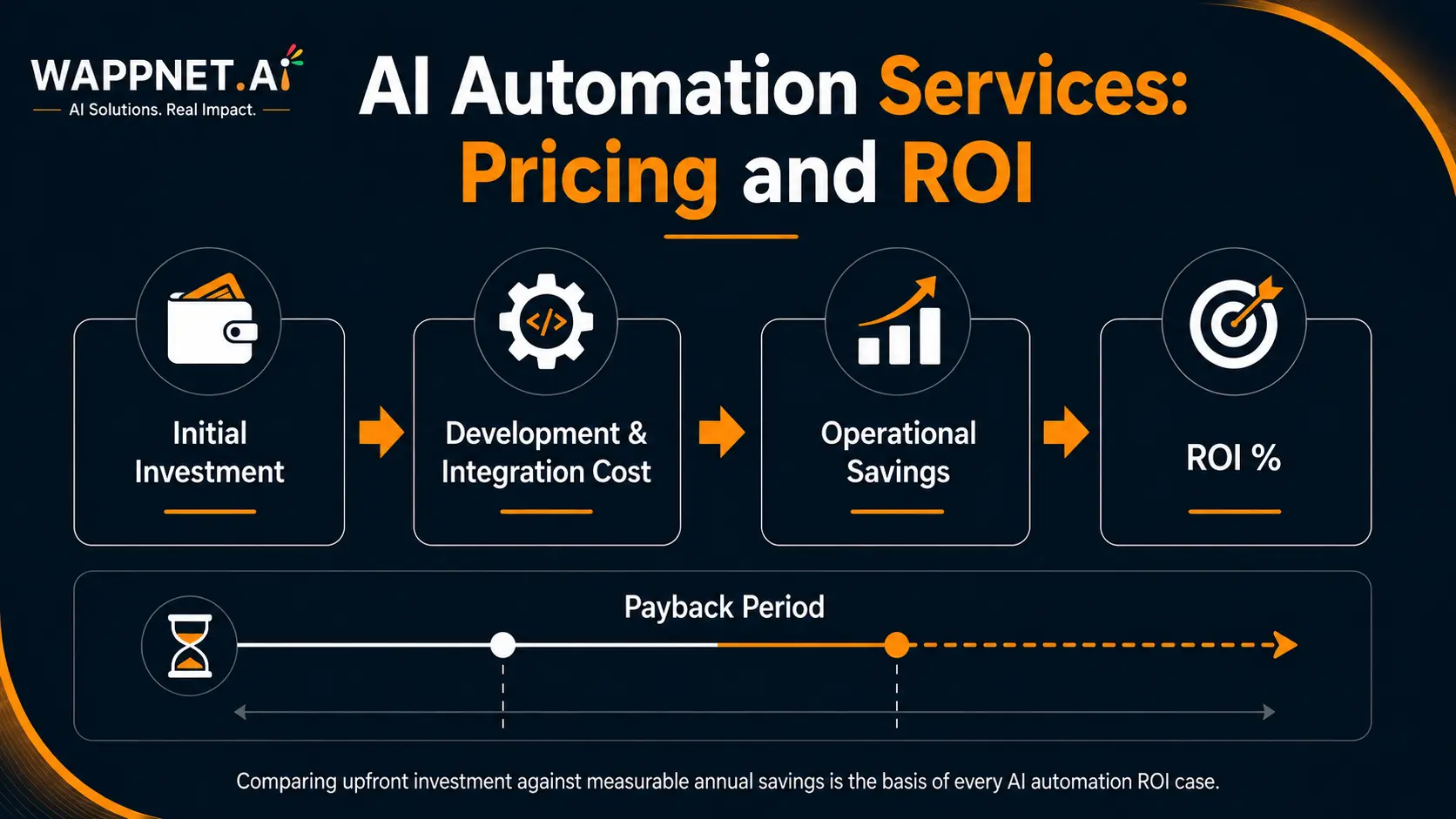
AI Automation ROI = (Financial Benefits − Automation Investment) ÷ Automation Investment × 100
Benefits include labor hours saved, reduced operational expense, fewer errors, faster processing, incremental revenue, improved conversion, and productivity gains.
Example: a company invests $40,000 and generates $80,000 in annual measurable benefits.
ROI = ($80,000 − $40,000) ÷ $40,000 × 100 = 100%, a 2x return in year one, provided the $80,000 is tracked against a real baseline, not estimated after the fact.
There’s no universal figure, and any guide promising guaranteed 5x or 10x returns is oversimplifying. Here’s what current 2026 research shows:
ROI depends on use case, baseline cost, workflow volume, employee adoption, implementation quality, and ongoing optimization, not the technology alone. For a broader look at where returns are showing up across the enterprise, see our roundup of AI and automation trends driving enterprise ROI in 2026.
Simple, single-workflow automation can show savings within weeks. Medium-complexity workflows typically take two to six months. Enterprise automation spanning multiple departments often needs six months to two years before the full case materializes. Quick wins build internal buy-in; complex rollouts need a realistic timeline set upfront.
| Factor | Manual Process | AI Automation |
|---|---|---|
| Labor | High recurring effort | Lower recurring effort |
| Processing speed | Human dependent | Automated |
| Availability | Business hours | Potentially 24/7 |
| Error risk | Human error possible | Requires monitoring |
| Scalability | Requires additional staff | Digital scalability |
| Initial investment | Lower | Higher |
Evaluate Total Cost of Ownership (TCO), not just build cost. A cheaper build with heavy API usage can cost more over three years than a pricier, efficient one.
Automation pays off fastest when processes are repetitive, volume is high, errors are costly, and outcomes can be measured against a baseline. It’s a weaker fit for low-volume, judgment-heavy, or constantly changing processes, where the automation can cost more than the manual work it replaces. Scoping honestly separates a good ROI story from a stalled pilot; our enterprise AI transformation strategy guide walks through that process in more depth.

Wappnet.ai works with startups and enterprises to scope AI automation projects around measurable outcomes, from single-workflow pilots to enterprise-wide, multi-agent deployments. Every engagement starts with honest cost and architecture planning before a line of code is written, with pricing models that let you validate one workflow before committing to a broader rollout.
Get a clear, honest cost and ROI breakdown before you commit to a budget.
AI Automation Services Pricing ranges from a few thousand dollars for a single workflow to seven figures for enterprise-wide, multi-agent systems, depending on complexity, integrations, and data readiness. ROI follows the same logic: real and measurable when scoped tightly and tracked against a baseline, disappointing when businesses automate broadly without a plan. Total Cost of Ownership, not just build price, decides whether automation pays off. Start narrow, measure honestly, and scale once the numbers hold up. Talk to Wappnet.ai about building an AI automation solution aligned with your business goals and ROI targets.
Most businesses spend $2,500 to $250,000+, depending on complexity, integrations, and whether the system uses simple rules or autonomous agents. Enterprise deployments can exceed $1 million.
Workflow complexity, integrations, AI model choice, data preparation, compliance, infrastructure, and maintenance.
ROI = (Financial Benefits − Automation Investment) ÷ Automation Investment × 100, tracked against a documented baseline.
2–4 weeks for simple workflows, 4–10 weeks for mid-complexity, and 6–12+ months for enterprise automation.
Yes, when scoped to one repetitive, high-volume process. It often has faster payback than enterprise deployments.
Traditional automation follows fixed if-then rules. AI automation uses machine learning and language models to interpret unstructured data and adapt to exceptions.