Phone:(+1) 312-698-3083
Email:
info@wappnet.ai
Introduction
In 2026, artificial intelligence is not experimental anymore. It is a business, quantifiable, and income-generating.
Businesses are moving towards AI applications for AI profitability. The issue is no longer whether AI is effective, but the extent to which it can be used to deliver ROI.
The most effective companies are allocating investments in AI consulting and development services to shape their AI strategy to attain their business objectives. Enterprise adoption of scalable AI ecosystems is replacing isolated automation projects, driven by cloud-powered AI solutions and powerful generative AI frameworks.
These trends of AI automation that 2026 enterprise ROI leaders are embracing are changing cost centers into profit engines.
We shall discuss the 11 trends that are driving enterprise growth.
Key Takeaways
- AI has become a central part of infrastructure as opposed to an experimental layer.
- Agentic AI enables autonomous enterprise operations that minimize the level of friction in operations.
- Generative AI copilots have a huge impact on the productivity of the workforce.
- AI solutions based on clouds allow for deployment at scale, enterprise-wide.
- An integrated AI system enhances efficiency in ROI.
- Predictive systems enhance profitability and forecasting.
- The AI governance guarantees AI development sustainability.
- AI consulting and developing services assist in aligning AI with quantifiable business results

13 minute(s) read
May 6, 2026
Table of Contents
- AI as Core Enterprise Infrastructure
- Agentic AI & Autonomous Workflows
- Generative AI Copilots Transforming Workforces
- Knowledge Work Automation at Scale
- Unified AI Architecture Powered by Cloud
- Retrieval-Augmented Generation (RAG) for Enterprise Trust
- Edge AI for Real-Time Decisions
- Human–Machine Collaboration
- Hyperautomation 2.0
- Predictive & Self-Optimizing Systems
- AI Governance & Sustainable AI Economics
- How Enterprises Should Measure AI ROI in 2026
- Final Thoughts
- Frequently Asked Question
AI as Core Enterprise Infrastructure
AI is now embedded directly into enterprise architecture.
Through cloud-powered AI solutions, organizations integrate AI into:
- ERP platforms
- CRM systems
- Supply chain operations
- Finance analytics
- HR automation
Cloud architecture enables scalable AI implementation along geographical boundaries without costly on-premises investments.
ROI Impact
- Faster deployment cycles
- Less infrastructure expenditure.
- Real-time analytics
- Data visibility on an enterprise-wide basis.
Businesses in the field of specialized AI consulting and development services are increasingly more successful since the strategy and infrastructure are in line from day one.
Agentic AI & Autonomous Workflows
Agentic AI systems are more than automation. They are goal-oriented operators.
These AI systems:
- Monitor workflows
- Make decisions
- Execute multi-step processes
- Adjust in real time
As an illustration, an artificial intelligence system can independently control procurement cycles, including inventory analysis and vendor approvals.
Enterprise ROI Benefit
- Lower administrative overhead
- Faster operational cycles
- Reduced human bottlenecks
It is considered one of the most influential AI trends that will drive enterprise ROI in 2026, as it will transform enterprises from task automation to complete workflow autonomy.
Generative AI Copilots Transforming Workforces
Generative AI is no longer limited to content creation. It drives enterprise pilots in 2026 through departments.
Use cases include:
- Sales proposal generation
- Auto-summarized financial reports.
- Intelligent HR onboarding
- Legal contract drafting
These copilots, when incorporated via cloud-powered AI solutions, scale safely throughout the organization.
Productivity Gains
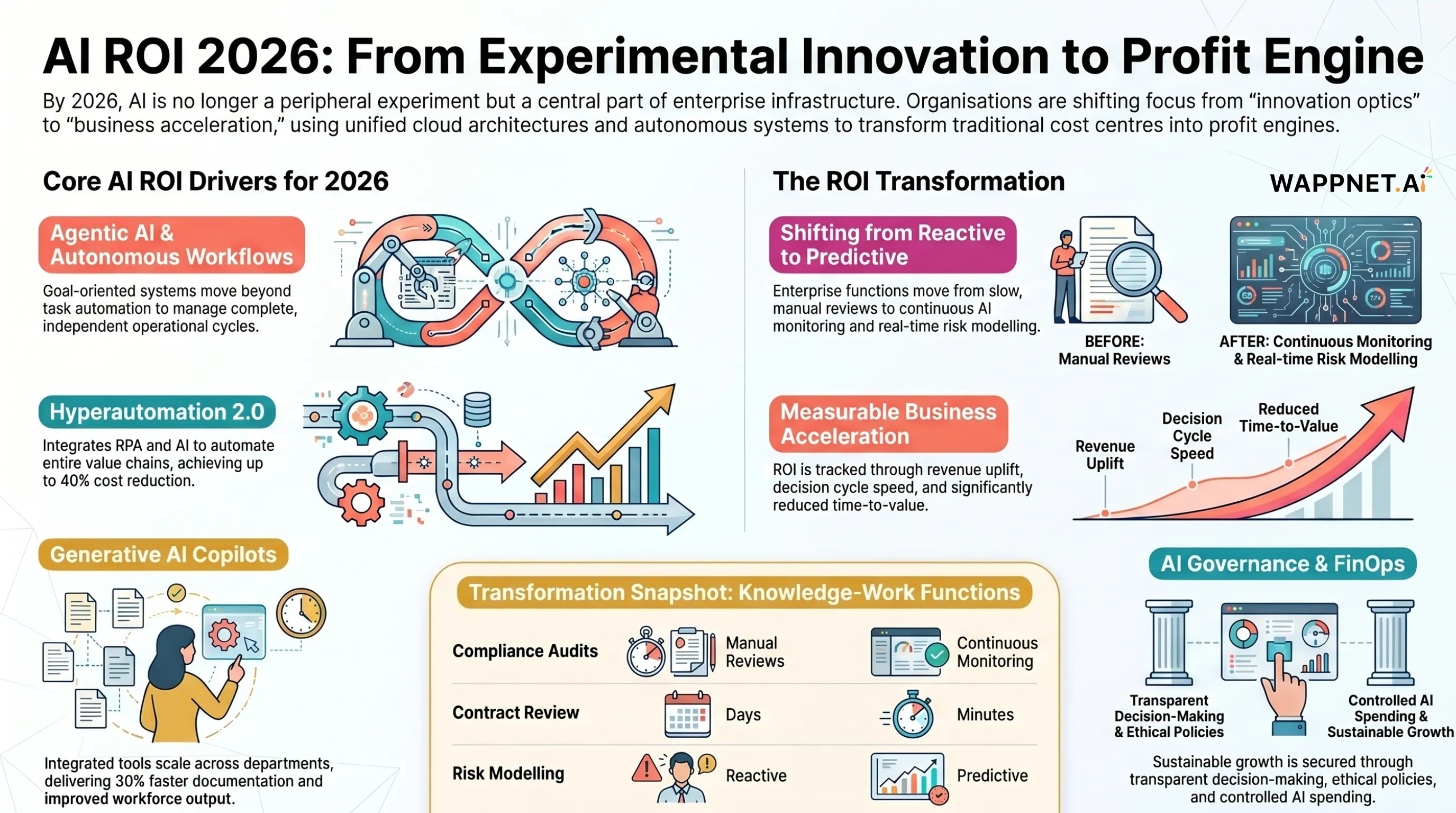
- 30% faster documentation
- Reduced manual reporting
- Improved accuracy
- Enhanced employee output
Those companies that are tactically using generative AI are turning efficiency in the workforce into profit.
Knowledge Work Automation at Scale
AI is automating the high-value thinking processes, including:
- Risk assessment
- Regulatory compliance
- Contract intelligence
- Financial auditing
High-level AI models that have been trained through enterprise-grade AI consulting and development services are customized to industry-specific demands.
ROI Transformation
| Function | Before AI | After AI |
| Compliance Audits | Manual reviews | Continuous AI monitoring |
| Contract Review | Days | Minutes |
| Risk Modeling | Reactive | Predictive |
At this level, enterprises significantly reduce legal exposure while eliminating operational inefficiencies.
Unified AI Architecture Powered by Cloud
In 2026, AI success depends on a unified architecture—not disconnected tools.
Enterprises are consolidating generative AI, predictive models, automation systems, and governance into centralized cloud-powered ecosystems.
Core Components:
- Centralized enterprise data lakes
- Multi-model AI deployment
- Cross-functional automation
- Governance frameworks
- API-first scalability
ROI Impact:
- Faster enterprise deployment
- Reduced infrastructure fragmentation
- Lower operational costs
- Global scalability
Strategic Advantage:
Unified cloud AI architecture transforms isolated AI tools into an enterprise-wide profit infrastructure.
Retrieval-Augmented Generation (RAG) for Enterprise Trust
AI needs trust to be implemented.
The generative AI systems that are RAG-based provide responses based on validated enterprise data.
AI does not guess; it retrieves correct internal information and then produces an output.
Business Benefits
- Reduced hallucination risk
- Stronger compliance
- Greater executive confidence.
- Greater reliability of decisions.
This is especially important to finance, health care, and regulated industries.
Edge AI for Real-Time Decisions
Cloud AI handles scale. Edge AI handles speed.
Manufacturing, logistics, and retail enterprises are using localized AI models to process in real time.
Applications
- Anticipatory equipment maintenance.
- Instant supply chain alerts
- Intelligent inventory management.
ROI Gains
- Reduced downtime
- Quickening of operational response.
- Lower bandwidth costs
Edge AI is a tool that is used to complement cloud-powered AI solutions so as to develop hybrid intelligence ecosystems.
Human–Machine Collaboration
The world is not going to stop being human and start being AI-enhanced; the world is AI-enhanced.
Firms are currently training workers with the help of AI systems, which are developed with the aid of AI Consulting and Development Services.
New roles include:
- AI Governance Lead
- Automation Strategist
- AI Operations Architect
ROI Outcome
- Increased productivity of employees.
- Reduced burnout
- Rapid innovation rate.
Sustainable growth is developed through human-machine synergy.
Hyperautomation 2.0
Hyperautomation integrates:
- RPA
- AI
- Process mining
- Low-code platforms
- Advanced analytics
Enterprises automate whole value chains, not tasks, with cloud-powered AI solutions.
Example: Order-to-Cash Automation
Customer Order → AI Validation → Invoice Creation → Payment Processing → Reconciliation
ROI Impact
- 40% cost reduction
- Faster revenue cycles
- End-to-end transparency
The trends of AI automation in 2026 for enterprise ROI acceleration focus on hyper automation.
Read More: AI Transformation for Enterprises in 2026: Strategy, Tools, ROI & Implementation
Predictive & Self-Optimizing Systems
Enterprise strategy is being changed by predictive intelligence.
AI systems now:
- Forecast demand
- Adjust marketing budgets
- Predict supply chain disruptions
- Optimize logistics routes
Modernized predictive models are generated by means of expert AI consulting & development services, which allow aligning with enterprise KPIs.
Business Value
- Reduced waste
- Improved revenue forecasting
- Lower operational risk
- Higher margin stability
Predictive AI converts uncertainty into strategic advantage.
AI Governance & Sustainable AI Economics
Governance is essential as the scale of AI increases.
Enterprises are adopting:
- Explainable AI frameworks
- AI audit trails
- AI cost governance (AI FinOps)
- Ethical AI policies
Without governance, AI investments can increase risk rather than ROI.
Sustainable ROI Framework
- Transparent decision-making
- Controlled AI spending
- Regulatory compliance
- Long-term scalability
Responsible AI ensures long-term profitability.
How Enterprises Should Measure AI ROI in 2026
To maximize returns, enterprises track:
- Cost reduction percentages
- Productivity improvement rates
- Revenue uplift from personalization
- Decision cycle speed
- Time-to-value
Organizations leveraging AI consulting & development services, generative AI, and scalable cloud-powered AI solutions consistently outperform fragmented AI adopters.
Final Thoughts
The companies that are ahead in 2026 are not experimenting with AI but putting it into practice at scale.
The trends of enterprise ROI pioneers in AI automation in 2026 are integrating infrastructure, intelligence, governance, and quantifiable metrics of performance.
AI is no longer about innovation optics—it is about measurable business acceleration.
It is regarding quantifiable business speeding up.
Companies that invest strategically in AI consulting and development services, implement generative AI at its most advanced level, and use scalable cloud-powered AI solutions will take leadership positions in their respective industries in the coming years.
Frequently Asked Question
What are the top AI automation trends in 2026?
The top AI automation trends in 2026 include Agentic AI, Generative AI copilots, Hyperautomation 2.0, RAG (Retrieval-Augmented Generation), Edge AI, predictive systems, cloud AI architecture, and AI governance. These technologies help enterprises improve efficiency, reduce costs, and increase ROI.
How does Agentic AI improve enterprise ROI?
Agentic AI improves ROI by autonomously managing workflows, making decisions, and executing tasks in real time. It reduces manual effort, lowers operational costs, and speeds up business processes.
What is Hyperautomation 2.0?
Hyperautomation 2.0 combines AI, RPA, process mining, and analytics to automate entire business processes instead of individual tasks. It helps enterprises reduce costs, improve speed, and scale operations.
Why is RAG important for enterprise AI?
RAG improves enterprise AI by connecting generative AI to verified business data, reducing hallucinations and improving accuracy. This makes AI more reliable for decision-making and compliance.
How should enterprises measure AI ROI?
Enterprises should measure AI ROI through cost savings, productivity improvements, revenue growth, faster decision-making, and operational efficiency. Success depends on aligning AI with clear business KPIs.
Ankit Patel
Ankit Patel is the visionary CEO at Wappnet, passionately steering the company towards new frontiers in artificial intelligence and technology innovation. With a dynamic background in transformative leadership and strategic foresight, Ankit champions the integration of AI-driven solutions that revolutionize business processes and catalyze growth.
Related Post
AI Automation Services: Pricing and ROI
August 17th , 2026