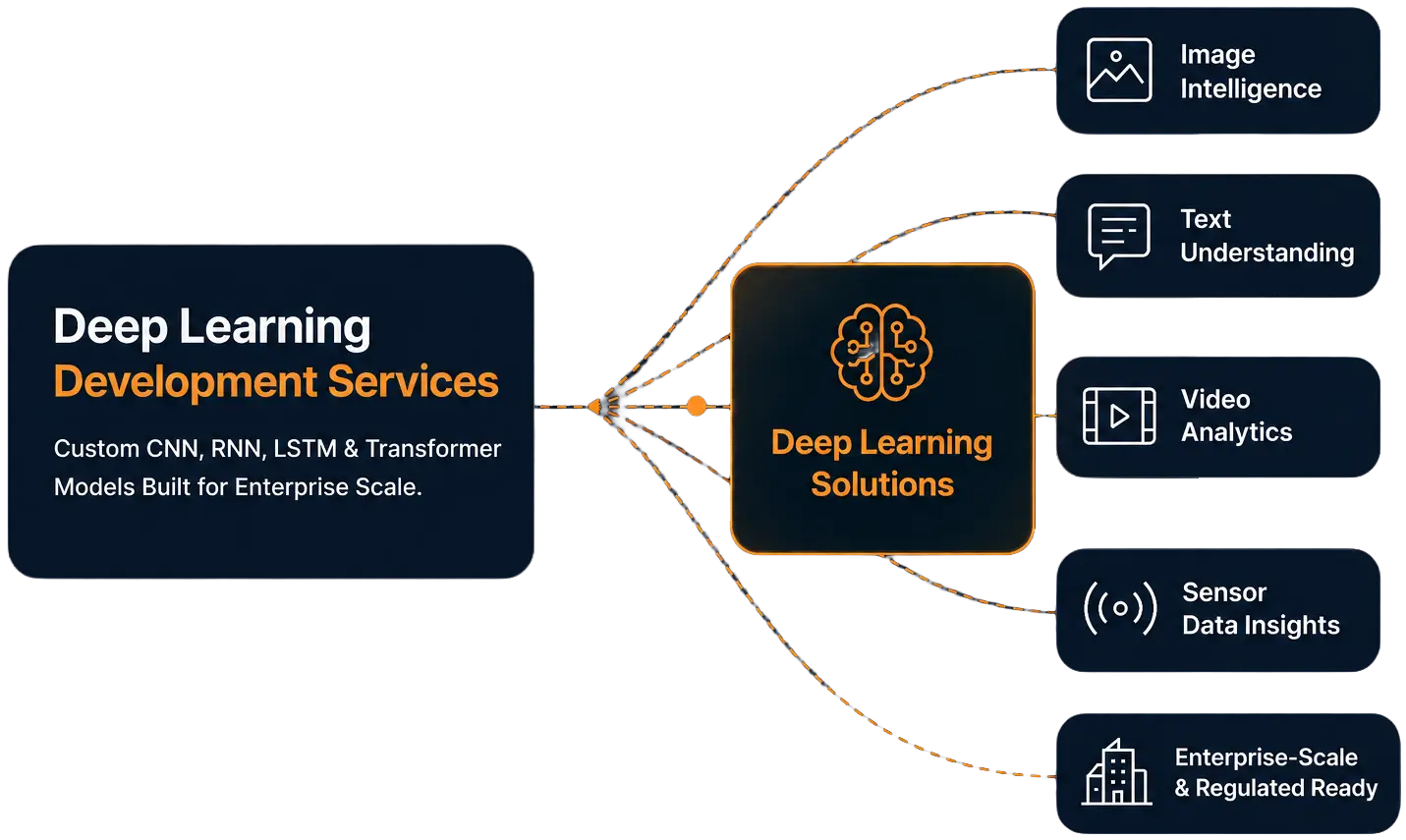
Deep Learning Development Services
Custom CNN, RNN, LSTM & Transformer Models Built for Enterprise Scale. Wappnet AI is a leading Deep Learning Development Company delivering custom deep learning solutions and enterprise deep learning services that turn images, text, video, and sensor data into accurate, real-time business decisions, engineered for enterprise data volumes and regulated environments.
What Is Deep Learning Development?
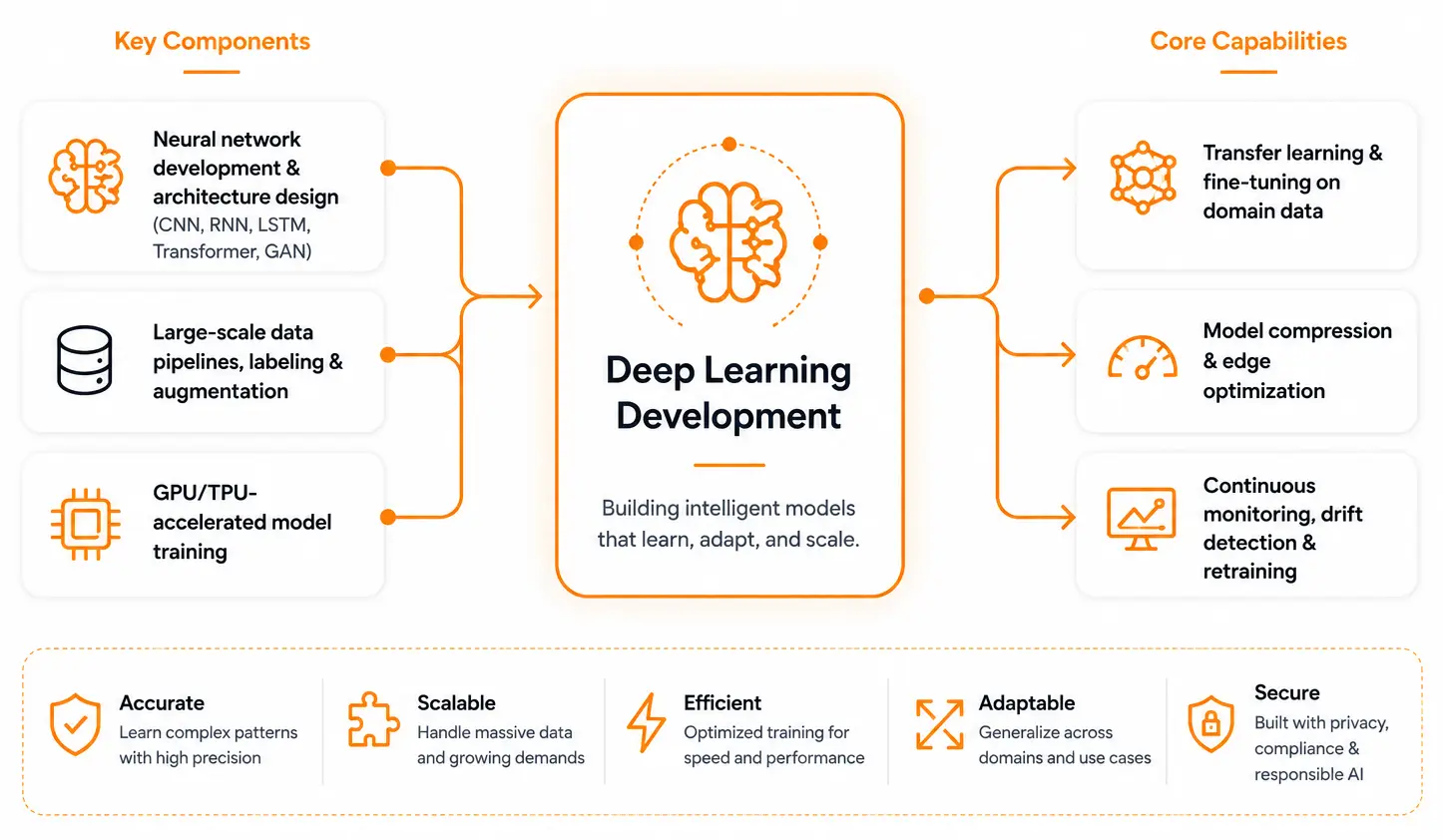
Deep learning development is the process of designing, training, and deploying multi-layered neural networks that learn patterns directly from raw data, images, audio, text, and time-series signals, without manual feature engineering. This form of neural network development sits at the core of modern AI model development, and is typically delivered as part of a broader deep learning software development engagement that covers data pipelines, training, and deployment.
- Neural network development & architecture design (CNN, RNN, LSTM, Transformer, GAN)
- Large-scale data pipelines, labeling & augmentation
- GPU/TPU-accelerated model training
- Transfer learning & fine-tuning on domain data
- Model compression & edge optimization
- Continuous monitoring, drift detection & retraining
Why Enterprises Need Deep Learning Development Services
Higher Prediction Accuracy
Automate Complex Tasks
Real-Time Decision Intelligence
Lower Operational Costs
Unlock Unstructured Data
Competitive Differentiation
Our Deep Learning Development Services
Custom Deep Learning Model Development
Computer Vision & Image Recognition
Video Analytics
Natural Language Processing (NLP) & Speech AI
Generative AI Development
Recommendation Systems
Predictive Analytics & Forecasting
AI-Powered Process Automation
Edge AI & Model Optimization
Medical Imaging & Healthcare AI
MLOps & Model Deployment
AI Consulting & Integration
How Our Deep Learning Development Process Works
Discovery & Feasibility
Data Collection & Prep
Architecture Design
Training & Validation
Optimization & Deployment
Monitoring & Improvement
Deep Learning Use Cases by Industry
Healthcare
- Medical imaging diagnosis support
- Patient risk prediction models
Finance & Banking
- Fraud detection with neural networks
- Credit risk & algorithmic trading models
Retail & E-commerce
- Visual search & recommendation engines
- Demand forecasting models
Manufacturing
- Automated visual defect detection
- Predictive maintenance from sensor data
Media & Telecom
- Speech & video content moderation
- Network anomaly & churn prediction
Deep Learning vs Traditional Machine Learning
| Feature | Deep Learning | Traditional Machine Learning |
|---|---|---|
| Feature Engineering | Learns features automatically from raw data | Requires manual feature engineering |
| Data Requirements | Performs best with large, high-volume datasets | Works well with smaller structured datasets |
| Unstructured Data | Handles images, video, audio & text natively | Limited - requires heavy preprocessing |
| Accuracy at Scale | Improves as data volume grows | Plateaus after a certain data volume |
| Compute Requirements | GPU/TPU-accelerated training | Runs on standard CPU infrastructure |
| Interpretability | Lower - needs explainability tools (SHAP, LIME) | Higher - simpler models are easier to interpret |
Technology Stack We Use for Deep Learning Development
Industries We Serve
Healthcare
- Medical imaging diagnostics & radiology analysis
- Clinical risk prediction models
- Patient monitoring via computer vision
- HIPAA-aligned model governance
Finance & Fintech
- Fraud detection with neural networks
- Credit risk & underwriting models
- Algorithmic trading signals
- AML transaction pattern analysis
Retail & E-commerce
- Visual search & product recommendation
- Demand forecasting models
- Customer sentiment & review analysis
- Shelf-monitoring vision systems
Manufacturing & Supply Chain
- Automated visual defect detection
- Predictive maintenance from sensor data
- Production line quality control
- Supply chain demand forecasting
Insurance
- Claims document automation
- Risk & underwriting models
- Fraud detection in claims processing
- Damage assessment via image recognition
Legal Tech
- Contract review & clause extraction
- Case outcome prediction models
- Legal document classification
- Compliance risk flagging
Education (Edtech)
- Adaptive learning models
- Automated content grading
- Student engagement prediction
- Plagiarism & content detection
Why Choose Wappnet AI for Deep Learning Development?
- Enterprise-grade security and governance built into every engagement
- Models engineered to scale across data volume without re-architecture
- Dedicated agile pods with transparent sprint-level reporting
- End-to-end delivery, from data strategy through deployment and monitoring
- Ongoing model monitoring and retraining after deployment, not just at launch

Results You Can Expect
Ready to Put Deep Learning to Work in Your Business?
Frequently Asked Questions
Deep learning development is the process of designing, training, and deploying multi-layered neural networks, such as CNNs, RNNs, LSTMs, and Transformers, that learn patterns directly from raw data like images, audio, text, and sensor signals without manual feature engineering.
Deep learning is a subset of machine learning that uses multi-layered neural networks to learn features automatically from raw data. Traditional machine learning typically requires manual feature engineering and works best on smaller, structured datasets.
Healthcare, finance and fintech, retail, manufacturing, insurance, legal tech, and education see the strongest returns, since deep learning excels at interpreting images, video, speech, and other unstructured data common in these industries.
Cost depends on data readiness, model complexity, and deployment scope. Most engagements start with a scoped discovery phase before a fixed-price or milestone-based proposal, so budgets align with a defined set of deliverables.
A production-ready deep learning model typically takes 8 to 16 weeks, covering data preparation, architecture design, training, validation, and deployment. Complex, multi-model systems can take longer.
Deep learning models generally need larger, labeled datasets than traditional machine learning, though transfer learning and data augmentation can reduce this requirement significantly for many use cases.
A Convolutional Neural Network (CNN) is used for image and video-based tasks such as object detection, image classification, medical imaging analysis, and visual defect detection.
Recurrent Neural Networks (RNNs) and Long Short-Term Memory (LSTM) networks are used for sequential data such as time series forecasting, speech recognition, and text generation, where order and context matter.
Transformer models power modern natural language processing and increasingly computer vision tasks, including text classification, summarization, translation, and large language model applications.
A GAN is a deep learning architecture with two competing networks, a generator and a discriminator, used to create synthetic images, augment training data, and detect anomalies.
Yes. Through quantization, pruning, and ONNX conversion, deep learning models can be compressed to run efficiently on edge devices, mobile hardware, and embedded systems with limited compute.
Production deployment uses containerized serving with tools like NVIDIA Triton or Docker and Kubernetes, connected to CI/CD pipelines that support versioning, rollback, and automated retraining.
MLOps is the discipline of managing the deep learning model lifecycle in production, including monitoring, retraining, and version control. It ensures models stay accurate as real-world data changes over time.
Accuracy is measured using metrics suited to the task, such as precision, recall, and F1-score for classification, or mean absolute error for forecasting, validated against a held-out test dataset.
Yes. Existing machine learning systems can be audited and re-architected with deep neural networks where unstructured data or accuracy limitations justify the added complexity and compute requirements.
AWS, Microsoft Azure, and Google Cloud all offer GPU and TPU infrastructure, managed training services, and deployment tooling suited to enterprise deep learning workloads.
Overfitting is controlled through techniques like dropout, regularization, data augmentation, early stopping, and cross-validation, ensuring the model generalizes to new, unseen data.
Transfer learning reuses a model pre-trained on a large dataset and fine-tunes it for a specific task, reducing the data, time, and compute needed to reach production-level accuracy.
Yes. Wappnet AI provides continuous monitoring, drift detection, and scheduled retraining after go-live, so model accuracy is maintained as data and business conditions evolve.