
Computer Vision & Visual Intelligence Development Services
Your cameras are already capturing valuable information. Wappnet.ai's Computer Vision Development Services turn that into something you can act on. Computer Vision sees what's happening, Visual Intelligence turns it into alerts and decisions your team can use. From spotting defects to monitoring safety and processing documents, we build around your existing cameras and systems, from first idea to full deployment.
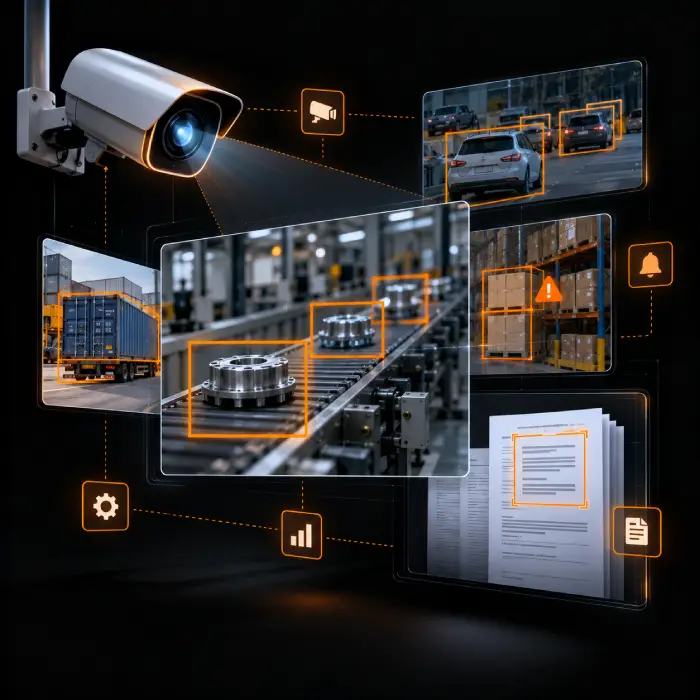
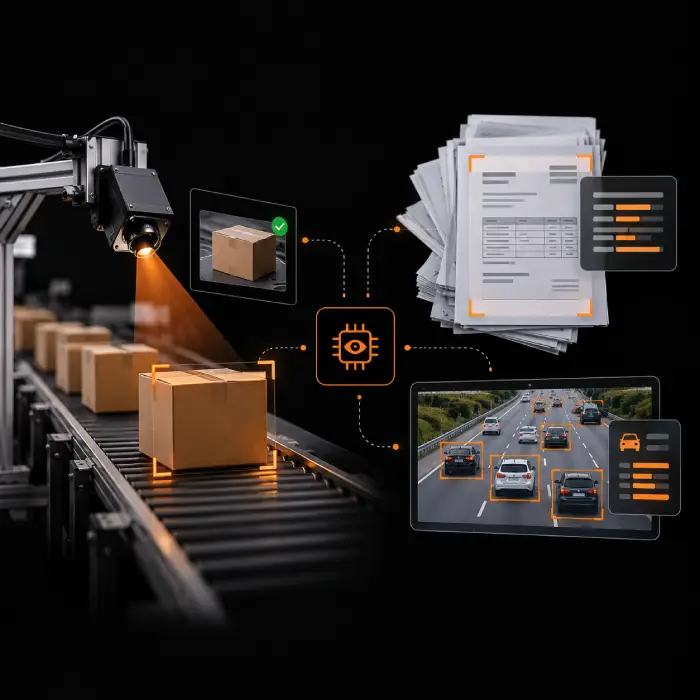
What Do Computer Vision Development Services Include?
Computer vision development services cover everything involved in turning a visual problem, such as a product moving down a line, a stack of invoices, or a live camera feed, into a system that catches what matters without a person watching every frame and surfaces it in a form your team can actually use. The first job isn't picking a model; it's figuring out whether the problem needs one at all and what decision the output needs to support.
A full computer vision engagement runs through four connected disciplines:
- Our computer vision consulting process assesses your data and use case before recommending an approach.
- We label and prepare your images so training matches real conditions.
- We build the system around your existing cameras and software.
- We monitor accuracy after launch and retrain as conditions change.
Why Businesses Invest in Computer Vision & Visual Intelligence
Manual visual review breaks down first, becoming too slow, too inconsistent, and too costly to scale. Computer vision closes that gap by turning what it sees into insights your team can act on.
Consistent Inspection, Every Time
Automated visual inspection applies the same criteria to every unit, on every shift, instead of depending on how alert an inspector is that hour.
Safer Floors and Facilities
Video analytics flag a missing hard hat or an unauthorized zone entry the moment it happens, turning a camera feed into a live safety signal instead of footage reviewed after the fact.
Less Manual Document Work
OCR and document understanding pull structured data out of invoices and forms automatically, so no one's retyping the same fields by hand.
A Real-Time View of Operations
Shelf, yard, and inventory monitoring give teams a current, intelligent picture of what's actually happening, instead of a count from this morning's walkthrough.
Visual Data That Scales With You
As camera and image volume grows past what a team can review manually, a custom computer vision solution keeps pace, and keeps producing usable intelligence, without adding headcount.
Custom Computer Vision & Visual Intelligence Solutions Built for Your Business
Here are ten solutions covering what you'd ask us to build, not how we build it.
Object Detection Systems
One of our most common computer vision applications: locate, classify, and count objects, feeding counts and alerts straight into the systems your team already watches.
Image Classification
Sort high volumes of images into your own categories automatically.
Visual Inspection Systems
Applies the same defect criteria to every unit on a line, at line speed.
Video Analytics
Visual analytics that turn a security camera into an operational sensor instead of footage to scrub through.
OCR & Document Understanding
Turns invoices, forms, and shipping labels into structured, usable data.
Facial Recognition
Identity verification and access control, with consent and governance scoped in from day one.
AI-Powered Surveillance
Part of our AI computer vision lineup, this flags the camera events that matter and routes them to the right person.
Retail Computer Vision
A Visual Intelligence Solution for shelf monitoring and flow analytics that turns foot traffic into staffing and layout decisions.
Industrial & Manufacturing CV
Line speed inspection integrated with MES/ERP, so a defect becomes a logged, actionable event.
Healthcare Computer Vision
Computer vision model development for decision support tooling that assists trained clinical staff, never a replacement for their judgment.
Have a Visual Intelligence Challenge?
Tell us what you're trying to see, measure, or catch automatically, and what decision or action it should trigger once it's caught, before any development work begins.
Our Computer Vision & Visual Intelligence Development Process
From your operational problem to a production-ready computer vision system, we guide you through every stage with a clear focus on measurable outcomes.
- 1
Discovery & Data Assessment
We understand the problem and what decision the output needs to support.
- 2
Strategy & Model Selection
We determine what it will take to turn the output into something your team can act on.
- 3
Annotation & Proof of Concept
We validate both accuracy and usefulness before a full build.
- 4
Model Development & Training
We train and tune until accuracy meets the use case's bar.
- 5
App Development & Integration
Detections reach the people and systems that need them.
- 6
Deployment & Monitoring
Understanding keeps compounding instead of staying frozen at launch.
Computer Vision & Visual Intelligence Development Services: Use Cases
Every business has different visual challenges. Here's where computer vision software development actually earns its keep: practical, scoped problems it solves, not abstract capability labels.
Automated Quality Inspection
Small defects missed under time pressure now trigger a real-time pass/fail decision on every unit.
Retail Product Recognition
Manual shelf walks give way to faster restocking and fewer missed out-of-stocks.
PPE & Safety Monitoring
Inconsistent compliance checks become live safety alerts instead of after-the-fact review.
Document Processing & OCR
Slow manual entry turns into structured data you can use the moment it's captured.
Security, Video & Fleet
Reactive footage review becomes a real-time operational picture for dispatch and security.
Agricultural Image Analysis
Manual scouting that can't scale becomes a prioritized list of where to look first.
From Image Processing to Visual Intelligence
Four approaches, one decision: how much variation your environment throws at the camera.
| Factor | Traditional Image Processing | Machine Vision | AI-Powered Computer Vision | Visual Intelligence |
|---|---|---|---|---|
Approach | Fixed, rule-based algorithms | Rules + calibrated hardware | Trained deep learning models | Business logic layered on CV output |
Best for | Simple, stable environments | Fixed industrial inspection | Complex, variable problems | Turning detection into decisions & automation |
Real time | Yes, very fast | Yes, line speed | Yes, with optimization | Yes, as fast as the system detects |
Typical use | Thresholding, barcode reading | Dimensional checks | Defect/object detection, OCR, video analytics | Visual analytics dashboards, alerts, automated actions |
Technologies We Use to Build Computer Vision Solutions
We choose frameworks, models, and deployment targets based on your accuracy, latency, and hardware constraints, not a fixed stack applied to every project.










Industries We Help With Computer Vision & Visual Intelligence
Why Choose Wappnet AI as Your Computer Vision & Visual Intelligence Partner?
Wappnet AI is a computer vision development company focused on turning visual data into production-ready systems, not just models that work in a demo.
Business First Discovery
We start with the operational problem and the decision it needs to support.
Framework-Agnostic Engineering
We choose the stack based on your data, performance, and deployment needs.
Integration Built-In
What the system sees turns into something your team can use, without manual handoff.
Monitoring After Launch
Understanding keeps improving instead of slowly drifting out of date.
Real-World Computer Vision Solutions We've Delivered
Production visual intelligence applications delivering measurable operational ROI.
Automated Invoice OCR & Document Intelligence
An OCR-based document-processing system that automatically extracts structured fields: invoice ID, amount, date, customer name for a lower-error invoicing workflow.
Real-Time Visual Inspection for Manufacturing Lines
A high-speed vision pipeline powered by custom YOLO & CNN models that catches micro-defects at line speed, reducing scrap rates by 35% and manual inspection overhead.
Edge AI Safety & PPE Compliance Monitoring
Deploying TensorRT-optimized video analytics on existing CCTV cameras to detect missing safety gear and hazardous zone entries with instant automated alerts.
Turn Visual Data Into Business Intelligence
If cameras, images, or documents are generating more data than your team can review manually, there's usually a computer vision and visual intelligence solution that fits, one that sees what's happening and turns it into something your team can act on.
Latest AI Insights & Industry Trends
 RAG
RAG vs Fine-Tuning vs Prompt Engineering: Which Approach Fits Your Use Case?
Compare RAG, fine-tuning, and prompt engineering to explore costs, use cases, and the best approach for enterprise AI.
 AI Copilot
What is an AI Copilot? Use Cases & Build Guide
What is an AI Copilot? Learn how it works, how it differs from AI agents, key use cases, and how to build one for your business.
 RAG
What Is RAG? A Complete Guide to Retrieval-Augmented Generation
Learn what RAG is, how Retrieval-Augmented Generation works, reduces AI hallucinations, and powers smarter enterprise AI.
Frequently Asked Questions
It's the process of building AI systems that interpret images and video, detecting objects, reading text, and recognizing patterns, then turning that visual data into structured output that other systems and people can act on.
Computer Vision is the technology that lets a system see and interpret images or video. Visual Intelligence is what happens next: using that output to understand context and support a decision. In short, Computer Vision sees; Visual Intelligence helps a business use what it sees.
They cover the full set of activities needed to go from a business problem to a working system: consulting, data annotation, model development, application development, system integration, deployment, and ongoing monitoring.
Machine vision uses calibrated hardware and fixed rules under controlled conditions; it's reliable but doesn't adapt when conditions change. Computer vision uses trained deep learning models that generalize across varied, real-world images and video. Many systems combine both.
In most cases, yes. Systems are typically built around your existing camera infrastructure; what matters more is placement, resolution, and lighting, which we assess during consulting before recommending any hardware changes.
Cost depends on data readiness, model complexity, and integration scope. Most engagements start with a scoped consulting assessment before a fixed-price or milestone-based proposal.
A proof of concept typically takes 4 to 8 weeks. A full production deployment typically takes 3 to 6 months.
OpenCV, TensorFlow, and PyTorch as frameworks; CNNs, YOLO, and Vision Transformers as architectures; Python and C++; deployed to AWS, Azure, Google Cloud, or edge hardware.
Yes, connecting detection output to MES, ERP, WMS, POS, and EHR platforms your team already uses.
Yes, using optimized models and, where needed, edge deployment with NVIDIA TensorRT and CUDA.
Yes. Automated visual inspection is one of the most common applications, applying the same detection criteria to every unit on a line.
No. Visual Intelligence isn't a standalone product; it's the outcome you get when a computer vision system's detections are connected to dashboards, alerts, and business systems. Our Visual Intelligence services are built into every computer vision engagement; you don't need to buy them separately.
Yes, trained specifically on your products, environments, and camera conditions, which typically outperforms generic detection APIs.
Yes, using frameworks like NVIDIA TensorRT for latency-sensitive or low connectivity environments.
Manufacturing, healthcare, retail, finance, logistics, education, travel, real estate, and automotive most commonly, though any business generating image, video, or document data beyond manual review volume is a fit.