
AI Chatbot Development Services
Customers ask the same questions on your website, in messaging apps, and on the phone, and your team cannot answer them all as fast as people expect. As an AI chatbot development company, we build chatbots and voicebots that understand what customers ask, answer from your own information, work with your CRM and helpdesk, and hand over to a person when a conversation needs one. We help you decide whether text, voice, or both fit your customers, then design, build, and improve the solution with you.
What Do AI Chatbot Development Services Include?
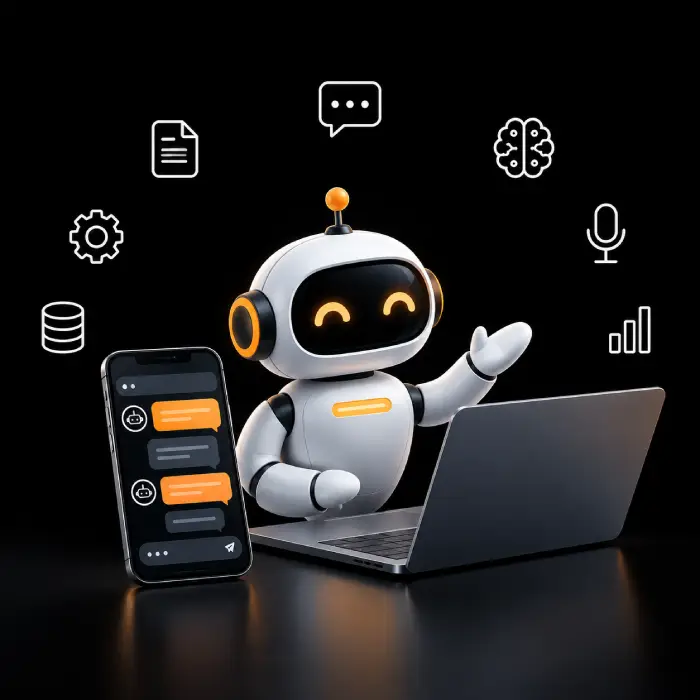
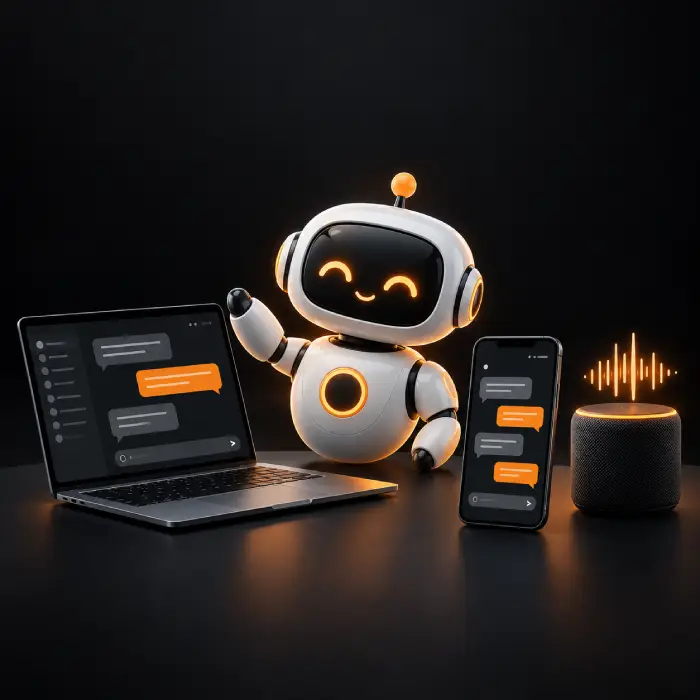
AI chatbot development services cover the design, build, integration, testing, and ongoing improvement of software that holds natural-language conversations with customers or employees. A chatbot works by text on a website, app, or messaging channel. A voicebot works by speech, usually over the phone, by adding speech recognition and speech synthesis around the same kind of conversation logic. The two share a core and differ in channel, so we plan them together. The mix varies by project.
Our conversational AI development usually combines the components below:
- Discovery and use-case assessment: which conversations to automate, in which channel, and where a person should stay in the loop.
- Custom AI chatbot development for websites, mobile apps, and messaging channels, using NLP, NLU, and LLM integration where they fit.
- AI voicebot development services and AI voice assistant development: automatic speech recognition (ASR), speech-to-text integration, text-to-speech integration, telephony connections and voice interaction design.
- Knowledge-based assistants that answer from your documents, product data, and policies instead of general knowledge.
- AI chatbot integration services that connect assistants to your CRM, helpdesk, ERP, and databases.
- Human handoff and escalation rules, plus conversation design for uncertain or sensitive requests.
- Chatbot testing and optimization, deployment, monitoring, and continuing support after launch.
Why Businesses Invest in AI Chatbots and Voicebots
Support, sales, and service teams spend much of the day on repeat questions, simple requests, and routing. A well-built assistant takes the predictable part and passes the rest to people with the context attached. It needs good source content, clear escalation rules, and regular review, so we describe benefits as what can change for your teams, not as promised savings or accuracy.
Faster Answers to Common Questions
Customers get an immediate response to routine questions in chat or on a call, instead of waiting in a queue.
More Consistent Conversations
Answers come from approved content, so customers hear the same policy and product information on every channel.
Coverage Outside Office Hours
Assistants can take questions and requests at any hour, with a clear route to a person for anything they should not handle alone.
Less Manual Work and Better Routing
Agents spend less time on status checks and FAQs, while assistants qualify leads and send each request to the right team with details attached.
What Success Depends On
AI-powered chatbot development works best with reliable source content, integrations that work with your systems, human escalation for hard cases, protection of customer data, and monitoring to catch wrong or unhelpful answers. Language models can produce incorrect responses, so we use grounding, response validation and testing, and we tell you where a simpler rule-based flow is the safer choice.
AI Chatbot Solutions and Voice AI Solutions Built for Your Business
Explore our AI chatbot solutions and voice AI solutions designed to improve customer interactions, streamline support, and automate conversations across business channels. From text-based chatbots to voice-enabled assistants, we build tailored solutions around your workflows, customer needs, and integration requirements.
AI Customer Support Chatbots
Customers ask about orders, accounts, policies, and products. Our customer service chatbot development produces AI customer support chatbots that answer from your approved content, collect details for open tickets, and pass difficult cases to an agent with the conversation attached.
Voice-Based Customer Support
Callers want an answer without a menu of options. A voicebot understands the request in natural speech, answers routine questions, takes simple actions, and transfers the call when a person is needed.
Lead Generation and Sales Assistants
Lead generation chatbots greet visitors, ask qualifying questions, answer product queries, and send qualified leads to your CRM or sales team, so prospects are not lost between a visit and a follow-up.
Appointment and Booking Assistants
Booking by form or phone tag wastes time on both sides. These assistants check availability, confirm or reschedule, and send reminders through the channel the customer prefers.
Contact Center and Call Routing Assistants
Our contact center automation work handles first-line calls and chats, identifies intent, collects key details, and routes each conversation to the right queue with context for the agent.
Internal Knowledge Assistants
Employees lose time searching for HR, IT, or product answers. In intelligent virtual assistant development for staff, a knowledge assistant retrieves from approved documents, respects access permissions, and points to its source. For this build, see RAG as a service.
CRM and Business-System Assistants
Answers are more useful when the assistant knows the customer. With CRM chatbot integration and helpdesk links, it can look up records, log conversations, and update tickets within the permissions you set.
Multilingual and Omnichannel Assistants
Multilingual chatbots serve customers in the languages they use across web, app, and messaging channels, with one engine behind them. Supported languages depend on the models and speech services chosen.
Website and Product Assistants
Visitors often leave without finding the right product or plan. A guided assistant asks what they need, explains options in plain language, and links to the right page. Our generative AI solutions team covers broader model work.
Not Sure Whether You Need a Chatbot, a Voicebot or Both?
Tell us where your customers ask questions today, which systems hold the answers, and where a person must stay involved. Choosing a voice chatbot development company or a chat-first team starts with that same question. We will help you choose the right channel and scope a practical first assistant.
Our AI Chatbot and Voicebot Development Process
Our conversational AI development process takes your project from identifying the right use cases to designing, developing, testing, and deploying AI chatbots and voicebots. We define a clear implementation plan and timeline based on your business goals, conversation flows, channel requirements, integration needs, and content readiness during discovery.
- 1
Discovery and Use-Case Assessment
We map your conversation volume, channels, systems, and risks, then agree which requests to automate first and where people stay involved.
- 2
Conversation Design and Architecture
We design dialogue flows, tone, fallbacks, and escalation rules, and choose the models, speech services, and architecture that fit your latency, cost, and privacy needs.
- 3
Knowledge, Data and Integration Preparation
We prepare the content the assistant may answer from, set access permissions, and define how it connects to your CRM, helpdesk and other systems.
- 4
Build
We build the chatbot or voicebot, including language understanding, retrieval, guardrails and, for voice, speech-to-text and text-to-speech with telephony connections.
- 5
Testing and Conversation Quality Evaluation
Our chatbot testing and optimization covers real conversation scenarios, wrong or unsafe answers, escalation, security checks, and for voice, accents, noise and interruptions. We share results and open risks.
- 6
Deployment, Monitoring and Improvement
We deploy to your channels, then review conversation logs, failed answers and handoffs, and keep an improvement backlog so quality improves after launch.
AI Chatbot and Voice Chatbot Development: Use Cases
Explore practical use cases for AI chatbot and voice chatbot development across customer service, sales, and business operations. From automating routine inquiries to supporting appointment scheduling and customer engagement, each solution can be tailored to your business goals, conversation flows, and integration requirements.
Customer Support and FAQs
Agents answer the same questions all day. A chatbot answers from approved content and opens a ticket with full details when it cannot, so agents handle fewer repeats.
Lead Qualification and Sales Assistance
Web visitors leave before anyone speaks to them. An assistant asks a few qualifying questions, records the answers in the CRM, and flags ready prospects for the sales team.
Appointment Scheduling
Booking by phone or email causes missed slots and no-shows. An assistant checks availability, confirms the time, and sends reminders by chat or an automated call.
Order and Delivery Status Inquiries
Status questions flood support after every dispatch. A chatbot or voicebot looks up the order in your system and replies with the current status, with an agent as backup.
Internal Employee Support
Staff wait on HR or IT for simple answers. An internal assistant answers policy and how-to questions from approved documents and raises a ticket when it cannot.
Product Discovery and Recommendations
Shoppers struggle to compare options. A guided assistant asks about needs and budget, suggests suitable items from your catalog, and explains the differences.
Contact Center Support and Call Routing
Menu-based phone systems frustrate callers. A voicebot identifies the reason for the call, handles simple requests, and routes the rest to the right team with a summary.
Multilingual Customer Communication
Support teams cannot cover every customer language. A multilingual assistant answers in the customer’s language, subject to the languages your chosen models support, and escalates when quality is uncertain.
AI Chatbot vs Voice Chatbot vs Rule-Based Chatbot: Which Do You Need?
Compare AI chatbots, voice chatbots, and rule-based chatbots to find the right solution for your business needs. Understand how they differ in communication channels, conversational capabilities, flexibility, and automation to choose the approach that best fits your customer interactions, workflows, and integration requirements.
Technologies We Use to Build AI Chatbot and Voicebot Solutions
We use proven AI technologies and development frameworks to build AI chatbot and voicebot solutions tailored to your business needs. Our technology choices depend on your use cases, integration requirements, response speed, budget, data privacy, and existing systems to ensure each solution is reliable, scalable, and suited to your operations.
















Industries We Help With AI Chatbots and Voicebots
Why Choose Wappnet AI as Your AI Chatbot Development Company?
As an AI chatbot and voicebot development company, Wappnet.ai builds intelligent chatbots and voice assistants that handle real customer conversations, streamline support, and automate business workflows. We focus on conversation design, system integrations, security, and continuous improvement to deliver reliable solutions tailored to your business needs.
Channel and Architecture Fit
We start with where your customers contact you, then recommend text, voice, or both, and the simplest architecture that meets the need.
Integration With Your Systems
Assistants work best when connected to your CRM, helpdesk, and data. See our enterprise integration work for how we approach it.
Quality, Escalation and Safety
We design human handoff, test for wrong answers, and evaluate conversations before launch, supported by our Responsible AI practice.
Support Beyond Launch
We monitor conversations, tune responses, and extend capabilities, or work alongside your team with dedicated AI developers. Compliance duties stay with your organization.
Real-World AI Chatbot and Voicebot Solutions We've Delivered
Omnichannel conversational AI bots and voice assistants driving higher resolution rates and seamless agent handoffs.
Multilingual E-Commerce Support Chatbot with Ticket Deflection
Integrated AI chat assistant handling 65%+ of order queries across web and WhatsApp with automated Zendesk ticket sync.
Telephony-Connected Voicebot for Clinic Appointment Booking
Natural speech phone agent checking availability, booking slots in EHR, and reducing receptionist call load by 48%.
Conversational B2B Lead Qualification & CRM Orchestration
Interactive conversational agent engaging inbound website visitors, qualifying enterprise prospects, and creating HubSpot deals.
Ready to Build Your Chatbot or Voicebot?
Looking for a custom AI chatbot development company that tests quality and plans escalation from day one? Bring your use case, your channels, and your systems. We will discuss the approach, integrations, and a practical first step, with no obligation.
Latest AI Insights & Industry Trends
 RAG
RAG vs Fine-Tuning vs Prompt Engineering: Which Approach Fits Your Use Case?
Compare RAG, fine-tuning, and prompt engineering to explore costs, use cases, and the best approach for enterprise AI.
 AI Copilot
What is an AI Copilot? Use Cases & Build Guide
What is an AI Copilot? Learn how it works, how it differs from AI agents, key use cases, and how to build one for your business.
 RAG
What Is RAG? A Complete Guide to Retrieval-Augmented Generation
Learn what RAG is, how Retrieval-Augmented Generation works, reduces AI hallucinations, and powers smarter enterprise AI.
Frequently Asked Questions
AI chatbot development services cover the design, build, integration, testing, and ongoing improvement of software that holds natural-language conversations by text or voice. They include conversation design, language understanding, knowledge sources, connections to business systems, human handoff, and monitoring after launch.
An AI chatbot talks by text, for example on a website, app, or messaging channel. A voicebot talks by speech, usually over the phone, so it adds speech recognition and speech synthesis around the conversation logic. Both can share the same underlying intelligence, and a voicebot does not have to use generative AI.
Conversational AI is the set of technologies that lets software understand and respond to human language in text or speech, including NLP, NLU, dialogue management, and, in many modern systems, language models. Chatbots and voicebots are two common ways to deliver it.
They can answer common questions quickly, work outside office hours, collect details before an agent joins, and keep answers consistent. The effect depends on the quality of your content, the integrations, and how well escalation to people is designed.
A voicebot converts the caller’s speech to text, works out what they want, looks up or updates information in connected systems, and replies with synthesized speech. It can handle routine requests such as status checks or bookings and transfer the call to an agent when the request is complex, or the caller asks for a person.
Yes. Assistants can be connected through APIs to CRM, helpdesk, ERP, and database systems to look up records, log conversations, and create or update tickets. The scope depends on the APIs available and the permissions you grant, and integration is often the largest part of the work.
Yes. We design human handoff and escalation rules for cases such as low confidence, sensitive topics, or an explicit request, and pass the conversation history to the agent so customers do not have to repeat themselves.
Many can. Supported languages and quality depend on the language and speech models used, and voice adds accents and dialects. We test each language you need rather than assuming equal quality across all of them.
Cost depends on the channels, whether voice is included, the number and complexity of integrations, languages, the volume of knowledge content, security and compliance needs, and ongoing monitoring. A simple single-channel chatbot costs less than a multilingual voicebot connected to several systems. We provide an estimate once requirements are clear.
Timelines depend on scope, integrations, content readiness, and how quickly feedback is given. A focused prototype takes less time than a production voicebot with telephony and CRM connections. We propose a phased plan after discovery instead of promising a fixed number in advance.
Common measures include access control, encryption, data minimization, limits on what the assistant can see and do, logging, and choosing deployment options that keep data under your control. For AI chatbot security and data privacy, compliance obligations remain with your organization and legal advisers.
Look for a team that starts with your use case, explains how it will test answer quality and escalation, handles integration and security, and supports the solution after launch. Ask for documented examples and be cautious of guaranteed accuracy or savings.