Natural Language Processing (NLP) Development Services
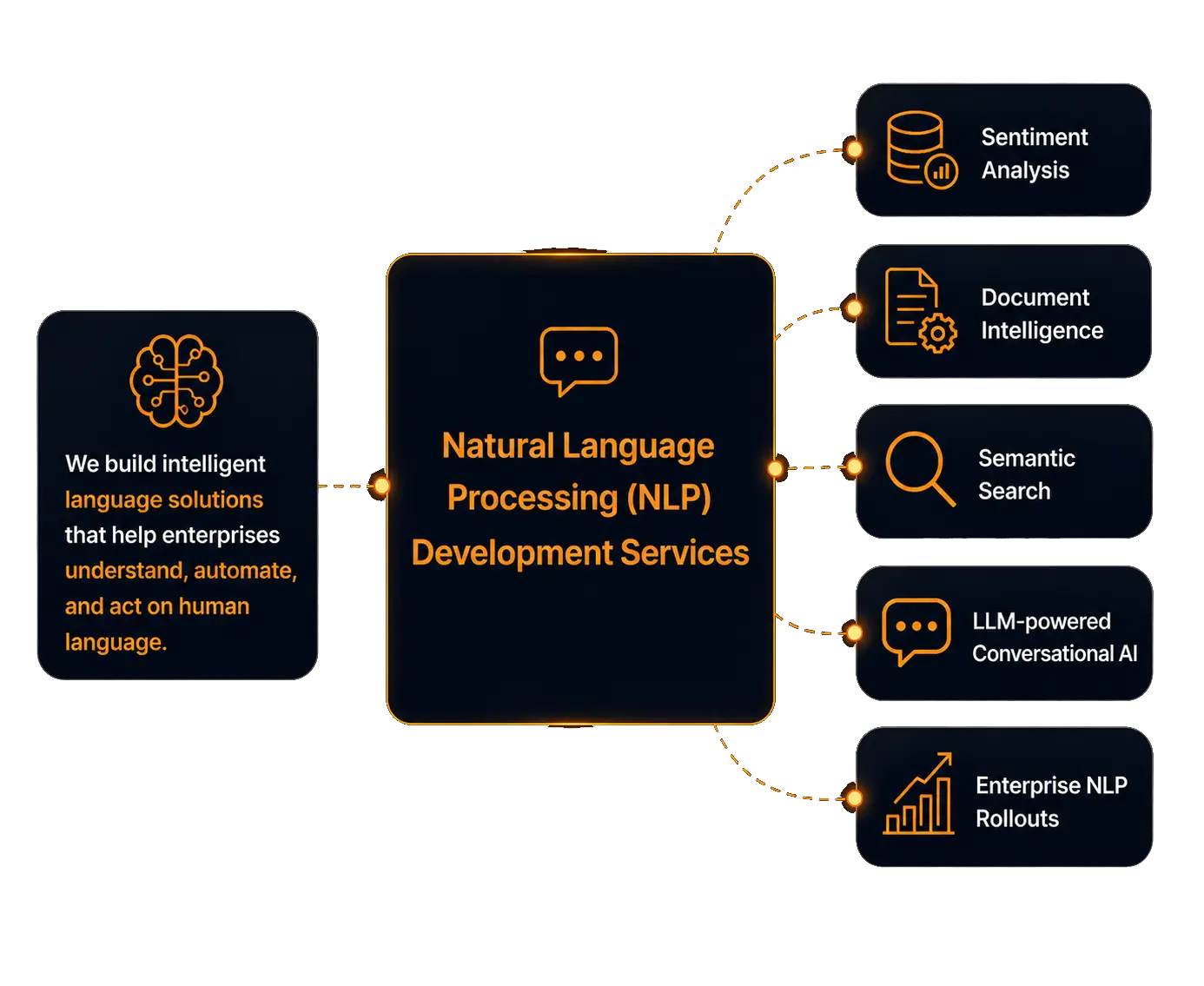
Wappnet AI is an enterprise NLP Development Company building custom Natural Language Processing Solutions, including sentiment analysis, document intelligence, semantic search, and LLM-powered conversational AI, for Enterprise NLP rollouts, backed by hands-on NLP Consulting. From a single focused capability to a full enterprise language-AI platform, our engineers take you from raw text and speech data to a production system your teams rely on daily: accurate, secure, and built to scale.
What is Natural Language Processing?
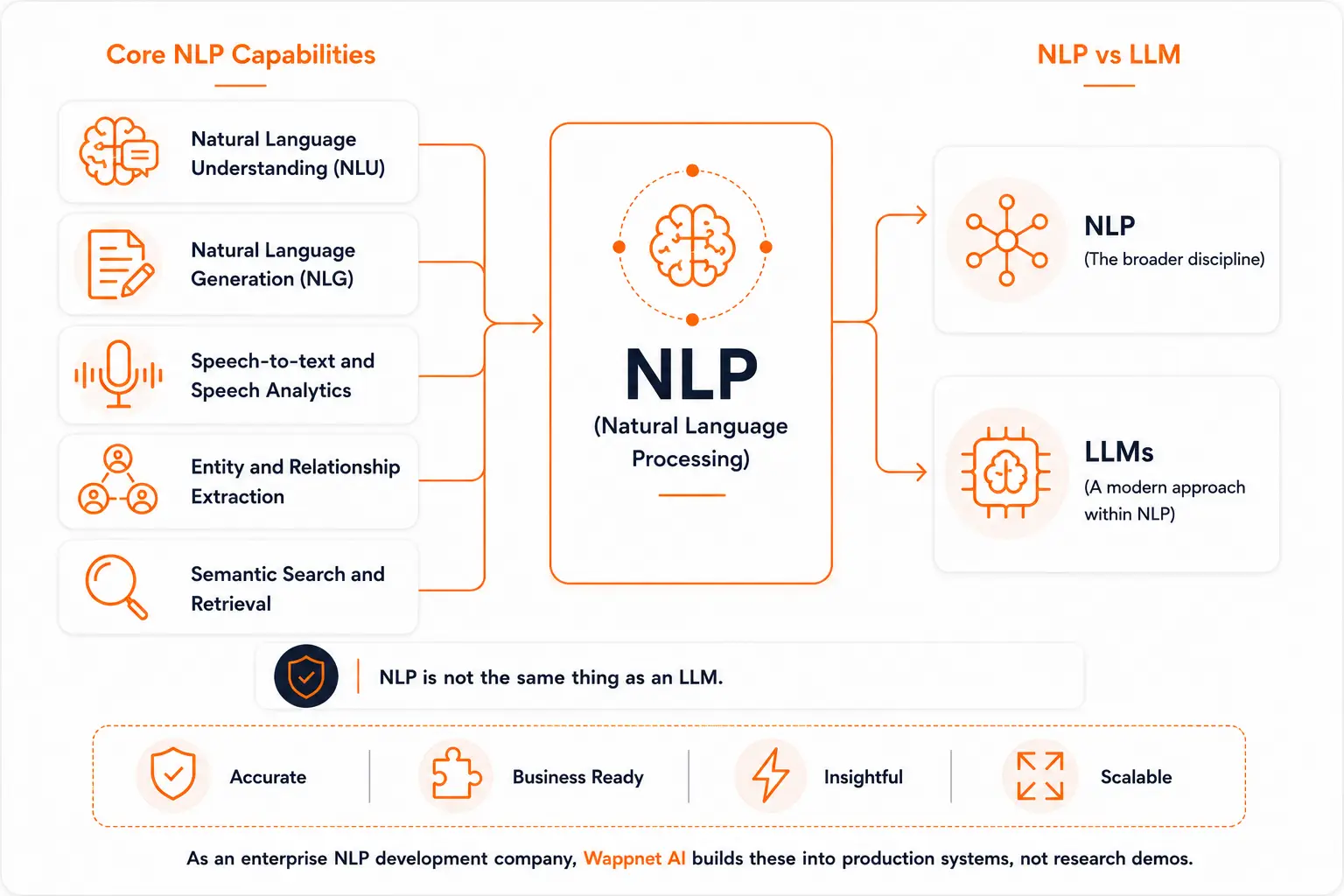
Natural Language Processing (NLP) is a branch of artificial intelligence that enables computers to read, interpret, understand, and generate human language, text and speech, in a way that is both accurate and useful for business decision-making.
Core NLP capabilities include:
- Natural Language Understanding (NLU): extracting meaning, intent, and sentiment from text
- Natural Language Generation (NLG): producing human-quality summaries, responses, and reports
- Speech-to-text and speech analytics: converting and analyzing spoken language at scale
- Entity and relationship extraction: pulling structured facts out of unstructured text
- Semantic search and retrieval: finding meaning-based matches, not just keyword matches
Why Businesses Need NLP
Faster Decisions
Reduced Operational Cost
Better Customer Experience
Risk & Compliance Visibility
Scalable Knowledge Access
Competitive Differentiation
Our Natural Language Processing Services
Text Classification
Sentiment Analysis
Named Entity Recognition (NER)
Document Processing & Intelligence
Conversational AI & AI Chatbots
Machine Translation
Speech Analytics
Semantic Search & Knowledge Graph Integration
Summarization & Question Answering
Custom NLP Models, LLM Fine-Tuning & Prompt Engineering
How NLP Development Works
Discovery & Data Assessment
Data Preparation & Annotation
Model Selection & Development
Testing & Evaluation
Deployment & Integration
Monitoring & Continuous Optimization
NLP Use Cases That Drive Business Outcomes
Healthcare
- Clinical documentation summarization and coding support
- Extracting structured data from unstructured patient records
- Patient intake and triage chat assistants
Finance & Insurance
- Fraud signal detection in claims and transaction narratives
- Automated policy and contract review at scale
- Earnings call and financial document summarization
Retail & E-commerce
- Review and social sentiment analysis for product and brand insight
- Conversational shopping assistants and semantic product search
- Automated catalog tagging and description generation
Legal
- Contract clause extraction, obligation tracking, and redlining support
- E-discovery document classification and summarization
- Regulatory change monitoring and impact analysis
Government & Public Sector
- Automated processing of citizen requests and public records
- Multilingual constituent communication at scale
- Policy document summarization for public transparency
NLP vs. LLMs vs. Generative AI
| Dimension | Classic / Task-Specific NLP | LLMs & Generative AI |
|---|---|---|
| Primary goal | Solve one defined language task | Understand, generate, and create language and content broadly |
| Data requirement | Smaller, labeled, domain-specific datasets | Massive pretraining data plus optional fine-tuning |
| Interpretability | Generally higher, easier to audit | Lower without explainability tooling |
| Typical use cases | Sentiment analysis, NER, classification, routing | Summarization, Q&A, conversational AI, RAG, content generation |
| Best fit | High-volume, well-defined, cost-sensitive tasks | Complex reasoning, open-ended language and generation tasks |
In practice, the right answer is almost always a combination: task-specific NLP for structured extraction, feeding an LLM for reasoning and generation. Deciding that mix correctly, and building it to production standard, is the core of custom NLP development.
Technology Stack
Industries We Serve
Healthcare
- Clinical documentation & records extraction
- Patient intake and communication support
Finance
- Fraud narratives & document review
- Sentiment analysis on customer and investor communications
Insurance
- Claims triage & policy analysis
- Fraud detection in claims narratives
Retail
- Review mining & semantic search
- Conversational shopping assistants
Legal
- Contract analysis & e-discovery
- Regulatory change monitoring
Government
- Citizen request processing
- Multilingual constituent communication
Why Choose Wappnet AI for NLP Development?
- End-to-end NLP and LLM engineering, beyond simple API integration.
- Responsible AI with built-in governance and explainability from day one.
- Cross-industry expertise across healthcare, finance, retail, and manufacturing.
- Hybrid AI stack combining cloud ecosystems and open-source technologies.
- Dedicated data engineering for complex, high-volume unstructured data.
- Transparent, ROI-driven engagement with zero vendor lock-in.

Results You Can Expect
Turn Language Into Your Competitive Advantage
Frequently Asked Questions
Natural Language Processing (NLP) is a branch of artificial intelligence that enables computers to read, interpret, understand, and generate human language, text and speech, in a way that is accurate and useful for business decisions.
No. NLP is the broader field of teaching machines to work with human language. LLMs are one modern approach to NLP: large, general-purpose transformer models. Many enterprise NLP systems combine classic NLP techniques with LLMs for generation and reasoning.
Machine learning is the broader discipline of learning patterns from data; NLP is machine learning applied specifically to language. Generative AI is a category of models that create new content; NLP overlaps with generative AI whenever the output is generated language.
Common enterprise use cases include sentiment analysis, document intelligence, contract and claims review, conversational AI and chatbots, semantic search, summarization, and multilingual customer communication.
Cost depends on scope: a focused capability such as sentiment analysis or a support chatbot typically starts in the low five figures, while a full enterprise NLP or LLM platform is a larger, multi-phase investment. We scope cost against your use case and data readiness during a discovery call.
Most focused NLP deployments take 6-12 weeks from discovery to production. Larger, multi-capability platforms involving fine-tuning, RAG, and integrations typically run 3-6 months.
Retrieval-Augmented Generation (RAG) is generally the better fit when answers must stay current and traceable to source documents. Fine-tuning is better when you need a model to consistently reproduce a specific tone, format, or specialized behavior. Many deployments use both together.
Yes. Modern NLP and multilingual LLMs support dozens of languages. Accuracy for lower-resource languages may require additional fine-tuning, which we account for during scoping.
ROI typically shows up as reduced manual processing time, lower cost per ticket or document, and faster response cycles. We build an ROI model with you before development begins.
No. Wappnet AI provides full-lifecycle NLP development, from data preparation through deployment and monitoring, so you don't need an in-house data science team to get started.
Yes. We follow responsible AI and data governance practices throughout, including secure data handling, access controls, and deployment across cloud, hybrid, or on-premises environments.
Healthcare, finance, insurance, legal, retail, and government see some of the fastest returns because they handle high volumes of unstructured text and have strict accuracy and compliance requirements.
Yes. Our NLP solutions are built to integrate with existing systems, including CRMs, ERPs, ticketing platforms, and internal tools, rather than requiring you to replace what already works.
Off-the-shelf APIs offer fast setup for generic tasks. Custom NLP development tunes accuracy to your domain vocabulary, integrates deeply with your systems, and gives you control over cost, data residency, and model behavior.
We define success metrics up front, including accuracy/precision-recall, processing time reduction, cost per transaction, and user adoption, and monitor them continuously after launch.