Responsible AI Development Services
Responsible AI development means building, deploying, and governing AI systems that are fair, transparent, secure, and compliant with regulations. Key frameworks include the EU AI Act and GDPR. Enterprises in healthcare, finance, retail, and government need responsible AI to scale automation without legal or reputational risk.
What is Responsible AI?
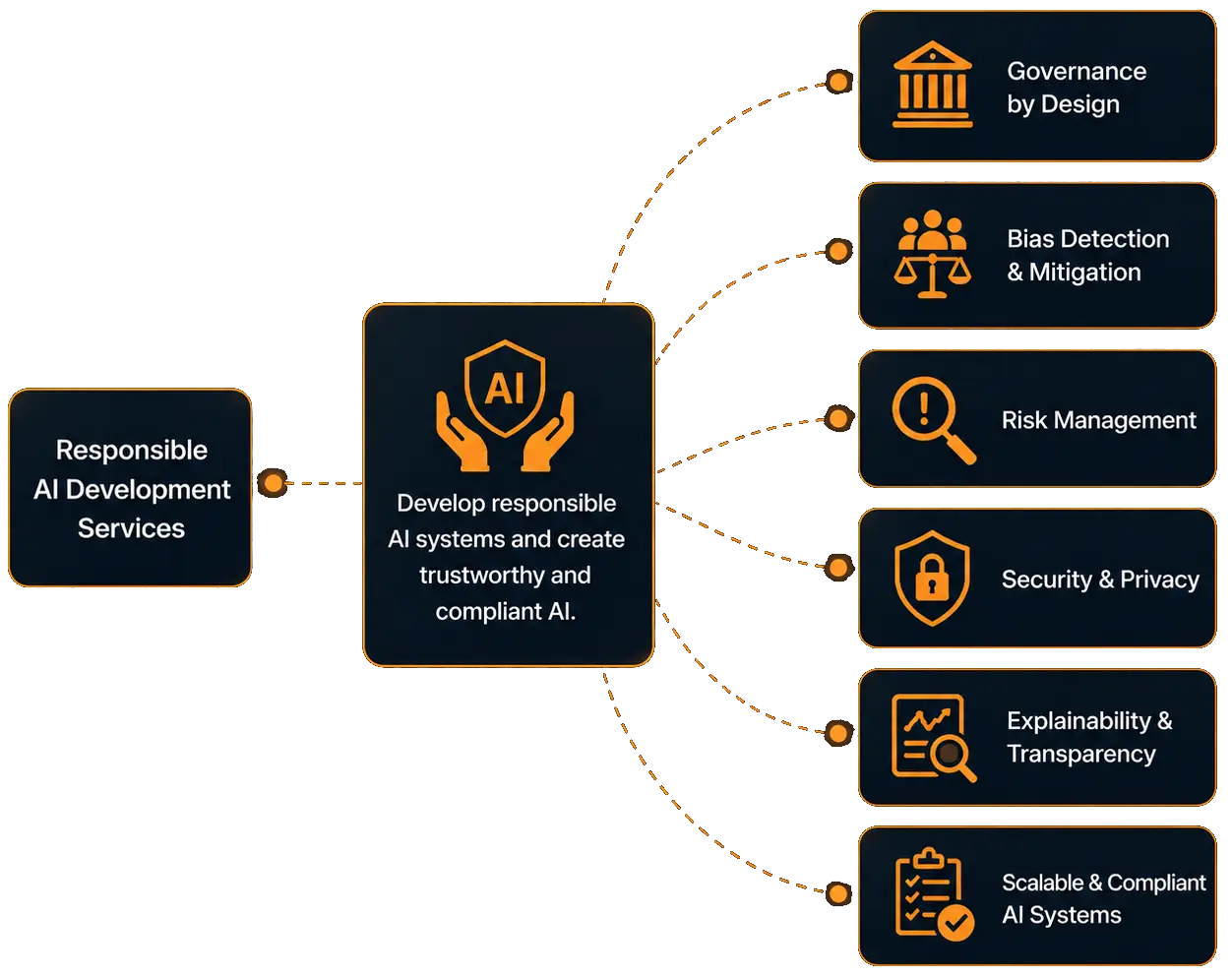
Responsible AI development is the process of designing, building, and managing AI systems that are ethical, transparent, and accountable. These systems stay secure and compliant throughout their lifecycle, combining technical safeguards with governance practices like risk assessments and audit trails.
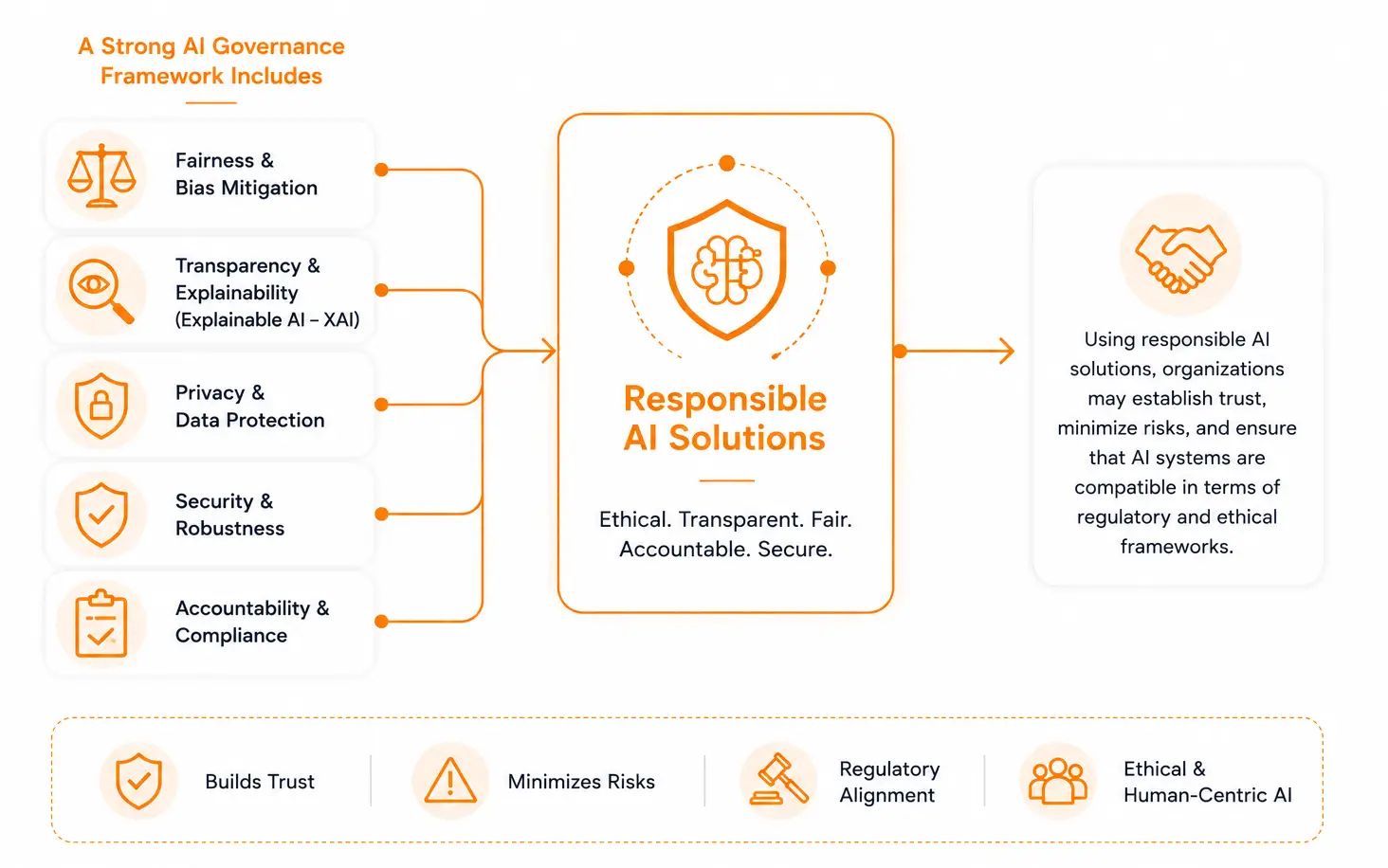
A strong responsible AI framework includes:
- Fairness & Bias Mitigation
- Transparency & Explainability (XAI)
- Privacy & Data Protection
- Security & Robustness
- Accountability & Compliance
Why Businesses Need Responsible AI
Reduce AI Bias
Improve Compliance
Build Customer Trust
Increase Transparency
Simplify Audits
Lower Legal Risk
Our Responsible AI Development Services
Responsible AI Strategy & Consulting
AI Governance & Compliance Services
AI Risk Assessment & Management
Bias Detection & Fairness Optimization
Explainable AI (XAI) Implementation
AI Model Auditing & Validation
Secure & Responsible AI Deployment
How Responsible AI Works
Assessment & Discovery
Risk Analysis
Governance Framework Design
Model Development
Testing & Validation
Deployment & Monitoring
Responsible AI Use Cases
AI in Healthcare
- Bias-free diagnosis support
- Ethical patient data handling
Finance & Banking
- Fair credit scoring systems
- Fraud detection with explainability
Retail & E-commerce
- Transparent recommendation engines
- Ethical personalization systems
HR & Recruitment
- Bias-free hiring systems
- Equal opportunity assessment models
Government & Public Sector
- Transparent decision systems
- AI compliance and governance
Responsible AI vs Traditional AI
| Feature | Responsible AI | Traditional AI |
|---|---|---|
| Ethics | Built into design from day one | Rarely prioritized |
| Transparency | High - decisions are explainable (XAI) | Low - black box outputs |
| Bias Management | Actively detected and minimized | Often undetected |
| Regulatory Compliance | Aligned with EU AI Act, GDPR, NIST AI RMF | Limited or reactive |
| Stakeholder Trust | High | Moderate to low |
Technology Stack
Industries We Serve
Healthcare
- Ethical AI-based patient support.
- Unbiased diagnosis and medical data analysis.
BFSI (Banking, Financial Services & Insurance)
- Fair credit scoring and risk assessment models.
- AI systems for governance and fraud detection.
Retail & E-commerce
- Transparent product recommendation systems.
- AI-driven search and customer service systems.
Manufacturing
- Trustworthy AI models for predictive maintenance.
- Quality control and optimization of processes through AI.
Education
- Explainable AI (XAI) and AI learning assistants.
- Personalized and ethical content delivery systems.
Government
- Transparent decision-making processes based on responsible AI solutions.
- AI governance and compliance of public sector services.
Why Choose WappnetAI for Responsible AI Development?
- End-to-end responsible AI delivery, from strategy to monitoring
- Governance frameworks mapped to EU AI Act, GDPR, and ISO/IEC 42001
- Bias testing and explainability built into every model
- Experience across healthcare, BFSI, retail, and government AI systems
- Human-in-the-loop review for high-stakes AI decisions
- Ongoing model monitoring after deployment, not just at launch

Our Responsible AI Development Process
Discovery & Risk Analysis
AI Governance Framework Design
Ethical AI Model Building
Testing, Validation & Bias Detection
Deployment with Monitoring
Continuous Optimization
Results You Can Expect
Make Your AI Ethical, Transparent, and Future-Ready
Explore Our Responsible AI Solutions
Frequently Asked Questions
Responsible AI development means designing, building, and managing AI systems that are fair and transparent. These systems also stay compliant with regulations. This work combines governance, bias testing, and explainability throughout the AI lifecycle.
Responsible AI reduces legal risk, prevents biased decision-making, and builds the trust customers and regulators need to accept AI-driven outcomes.
Companies build ethical AI by combining bias testing, explainability tools, and governance policies. Human oversight remains essential at every stage of development and deployment.
Healthcare, finance, insurance, retail, manufacturing, and government need responsible AI most. Their AI decisions directly affect people's health, finances, or legal rights.
AI governance is the set of policies, roles, and controls organizations use to keep AI safe and ethical. It also ensures AI use meets legal requirements.
Explainable AI (XAI) refers to techniques that make AI decisions interpretable to users and auditors. It shows why a model produced a specific output.
Bias detection uses statistical fairness tests across demographic groups. Teams follow up with data rebalancing, model retraining, and ongoing monitoring to reduce discriminatory outcomes.
Common frameworks include the EU AI Act, GDPR, and the NIST AI Risk Management Framework. ISO/IEC 42001, the international AI management standard, also applies.
Cost depends on system complexity, data readiness, and compliance scope. Most engagements start with a scoped risk assessment before a fixed-price or milestone-based proposal.
Most responsible AI engagements take 4 to 12 weeks. Timelines depend on model complexity, data preparation, and the number of compliance frameworks involved.
Yes. GDPR requires transparency and data protection safeguards. The EU AI Act adds obligations for high-risk AI systems, including risk management and human oversight.
Yes. Existing models can be audited for bias, security, and compliance gaps. Teams can then add explainability tools, monitoring, and governance controls without a full rebuild.
Human-in-the-loop AI keeps a person involved in reviewing or approving AI decisions. This matters most for high-stakes cases like lending, hiring, or medical diagnosis.