Data Engineering Services & Consulting
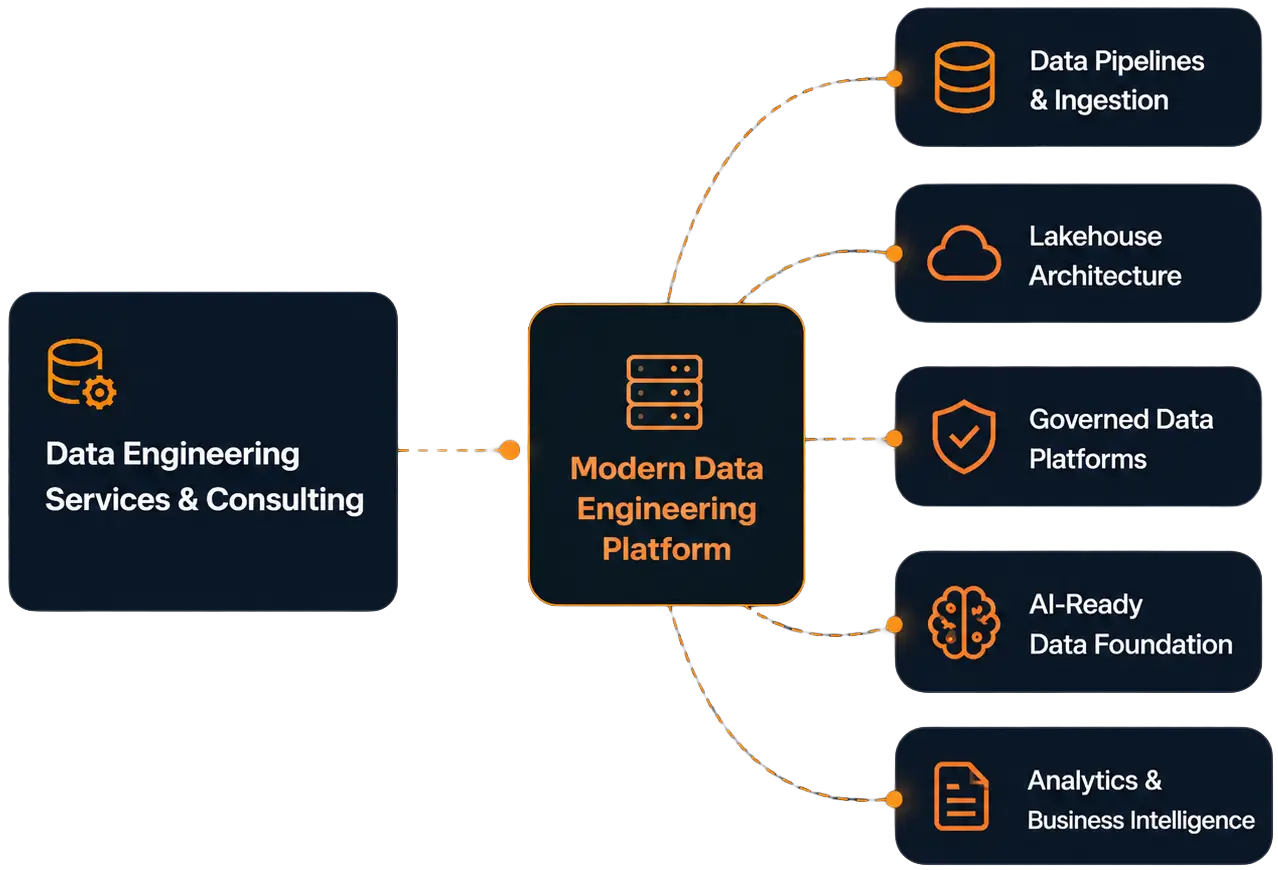
Build the data foundation your business and your AI initiatives can actually depend on. We design, engineer, and operate modern data engineering services, including data pipelines, lakehouse architectures, and governed data platforms, turning scattered data into a reliable, AI-ready asset.
What Is Data Engineering?
Data engineering is the discipline of designing, building, and operating the systems that collect, move, transform, store, and govern an organization's data, so it is accurate, timely, and usable by analytics teams, applications, and AI models.
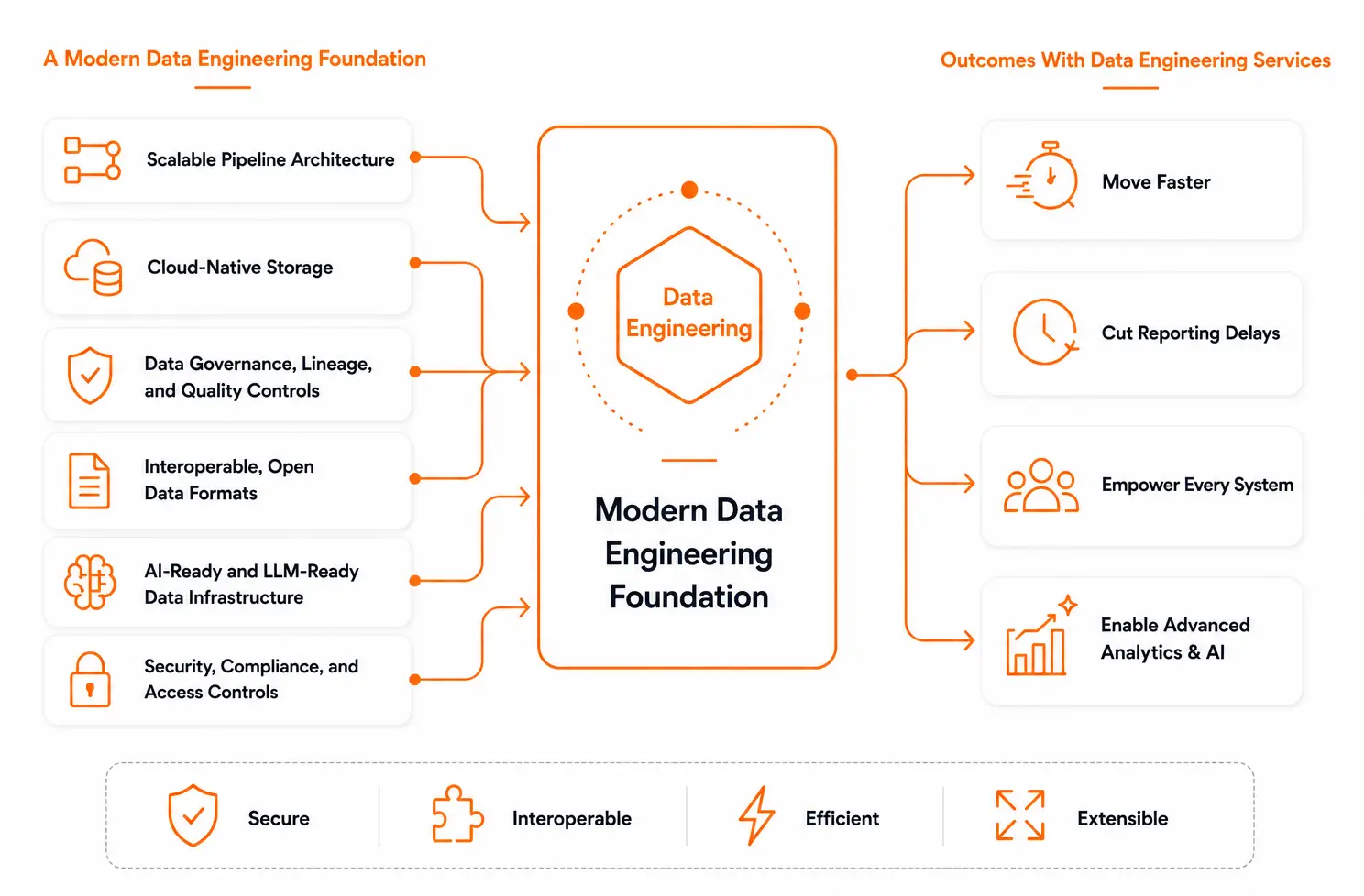
A modern data engineering foundation includes:
- Scalable pipeline architecture for batch and real-time processing
- Cloud-native storage across data lakes, warehouses, and lakehouses
- Data governance, lineage, and quality controls
- Interoperable, open data formats such as Parquet, ORC, Iceberg, and Delta Lake
- AI-ready and LLM-ready data infrastructure
- Security, compliance, and access controls built in from day one
Why Businesses Need Data Engineering
Faster, Reliable Decisions
AI & ML Readiness
Lower Data Operating Costs
Reduced Compliance Risk
Scalable Infrastructure
Cross-Team Data Trust
Our Data Engineering Services
Modern Data Architecture & Strategy
Data Pipeline, ETL/ELT & DataOps
Cloud Data Engineering & Migration
Real-Time & Streaming Data Processing
Data Warehouse, Lake & Lakehouse Engineering
Data Governance, Quality & MDM
AI-Ready Data Infrastructure & Integration
How Data Engineering Works
Data Discovery & Sourcing
Data Extraction
Data Loading
Data Transformation
Data Storage & Serving
Data Engineering Use Cases
Financial Services
- Fraud detection on real-time transaction streams
- Unified customer data for risk scoring and compliance reporting
Healthcare
- HIPAA-compliant clinical and claims data pipelines
- Interoperable patient data for AI-assisted diagnostics
Retail & E-commerce
- Real-time inventory and pricing pipelines
- Unified customer data for personalization and recommendations
Manufacturing & Supply Chain
- IoT sensor data pipelines for predictive maintenance
- Demand forecasting on integrated supplier and production data
Insurance & Telecom
- Automated claims and usage data processing
- Churn and risk models fed by governed, real-time data pipelines
Data Engineering vs Traditional Data Management
| Factor | Modern Data Engineering | Traditional Data Management |
|---|---|---|
| Architecture | Cloud-native lakehouse / data mesh | On-premises, siloed databases |
| Processing | Real-time and batch | Batch only |
| AI-Readiness | Built-in, with ML/LLM-ready pipelines | Not designed for AI use cases |
| Governance | Automated lineage, cataloging, data contracts | Manual, inconsistent |
| Scalability | Elastic, pay-as-you-grow cloud infrastructure | Fixed hardware capacity |
| Time to Insight | Minutes to hours | Days to weeks |
| Compliance | Continuous, built into pipelines | Periodic, manual audits |
Modern data engineering doesn't just move data faster; it makes data trustworthy enough for both human decision-makers and AI systems to act on.
Technology Stack
Industries We Serve
Healthcare
- Interoperable, HIPAA-compliant clinical and diagnostic data pipelines.
Finance & Banking (BFSI)
- Real-time fraud detection and unified risk and compliance data.
Retail & E-commerce
- Real-time inventory, pricing, and customer 360 data platforms.
Manufacturing & Supply Chain
- IoT sensor pipelines and integrated production data for predictive maintenance.
Insurance
- Automated claims processing and governed underwriting data.
Telecom
- Large-scale network and usage data pipelines for churn prediction.
Why Choose Wappnet AI for Data Engineering Services?
- Full-lifecycle service as a data engineering solutions provider, from architecture through production operations.
- Certified expertise across AWS, Azure, Google Cloud, Snowflake, and Databricks.
- AI-ready data infrastructure built by a team that also delivers AI, ML, and LLM Solutions.
- Governance, security, and compliance built into every pipeline, not bolted on afterward.
- Flexible engagement models, including dedicated pod, staff augmentation, or fixed-scope delivery.
- Transparent, outcome-driven delivery with clear timelines and measurable results.

Results You Can Expect
Turn Your Data Into a Real Business Advantage
Frequently Asked Questions
Data engineering services cover the design, development, and management of systems that collect, move, transform, store, and govern data, so it's accurate, timely, and usable for analytics, reporting, and AI.
Enterprises need data engineering services to replace slow, manual, siloed data processes with automated, governed pipelines that support faster decisions and reliable AI initiatives.
Data engineering builds and maintains the infrastructure that collects and prepares data, while data analytics uses that prepared data to generate insights, reports, and predictions.
AI-ready data is clean, well-labeled, consistently governed, and structured in formats that machine learning and LLM systems can consume directly, without ad hoc manual preprocessing.
Cost depends on data volume, source complexity, and platform scope. Most engagements start with a scoped assessment before a fixed-price or dedicated-team proposal is provided.
Most data engineering and migration projects take between 6 and 16 weeks, depending on legacy system complexity, data volume, and compliance requirements.
Yes. As a data engineering consulting company, we assess your current data infrastructure, identify gaps, and recommend an architecture and roadmap before any implementation begins.
We build and migrate data platforms on AWS, Microsoft Azure, and Google Cloud, and we work with Snowflake and Databricks for warehouse and lakehouse architectures.
Yes. We specialize in migrating and modernizing on-premises legacy databases and data warehouses to modern cloud architectures without disrupting existing reporting.
A data lakehouse combines the low-cost storage of a data lake with the structure and performance of a data warehouse. It's a strong fit if you need both large-scale storage and fast, reliable analytics and AI access to the same data.
It depends on organizational scale and data ownership needs. Data mesh works well for large enterprises with multiple domains that need independent data ownership, while a centralized model is often simpler and faster for mid-size companies.
We build data cataloging, lineage tracking, access controls, and quality checks directly into pipelines, aligned to the specific compliance requirements of your industry.
Yes. We design data infrastructure, including pipelines for structured data and vector or embedding data for RAG, specifically to feed machine learning models, LLMs, and agentic AI systems.
We serve healthcare, financial services, retail, manufacturing, insurance, telecom, logistics, and other data-intensive industries, tailoring architecture to each sector's compliance and performance needs.
You can work with us as a dedicated data engineering company, an extension of your in-house team through staff augmentation, or on a fixed-scope project basis.
Common warning signs include inconsistent or duplicate data across systems, slow or manual reporting, and frequent pipeline failures; these are all signals that a data engineering assessment is worth doing.