Phone:(+1) 312-698-3083
Email:
info@wappnet.ai
Introduction
AI is not just a future technology but a fundamental part of business infrastructure across all sectors. Across industries, AI is becoming an integral part of business infrastructure rather than a future technology. Companies in 2026 are not sidestepping AI but are fully adopting it into daily workflows, customer experiences, sales, analytics, and decision-making processes.
In healthcare, AI-powered predictive diagnostics enable more efficient resource usage, and AI automation in real estate is driving property engagement at scale. In healthcare, AI-powered predictive diagnostics are helping optimize resource usage, and in real estate, AI-driven automation is facilitating property engagement at scale.
In 2026, the rising prominence of workflow automation, AI agents, generative AI, and industry-specific intelligence models will make AI a transformative force. The question is no longer whether businesses will embrace AI but when. Businesses are now focused on finding the right AI use cases that deliver tangible returns. Rather, they are keen on finding the appropriate use cases of AI that bring tangible returns.
This guide dives into the best use cases of AI by industry in 2026, from practical applications and automation possibilities to ways companies are using AI to stay competitive.
Key Takeaways
- Operational efficiency and automation are the key factors driving AI adoption in 2026.
- AI is being used across industries for customer support, analytics, workflow automation, and personalization.
- The use of generative AI and AI agents is revolutionizing business processes in various industries.
- AI is transforming the way businesses operate, leading to improved scalability, customer experiences, and revenue growth.
- AI workflows are emerging as a key competitive advantage across industry sectors.
- The trend is moving from standalone AI tools to AI business ecosystems.

14 minute(s) read
May 21, 2026
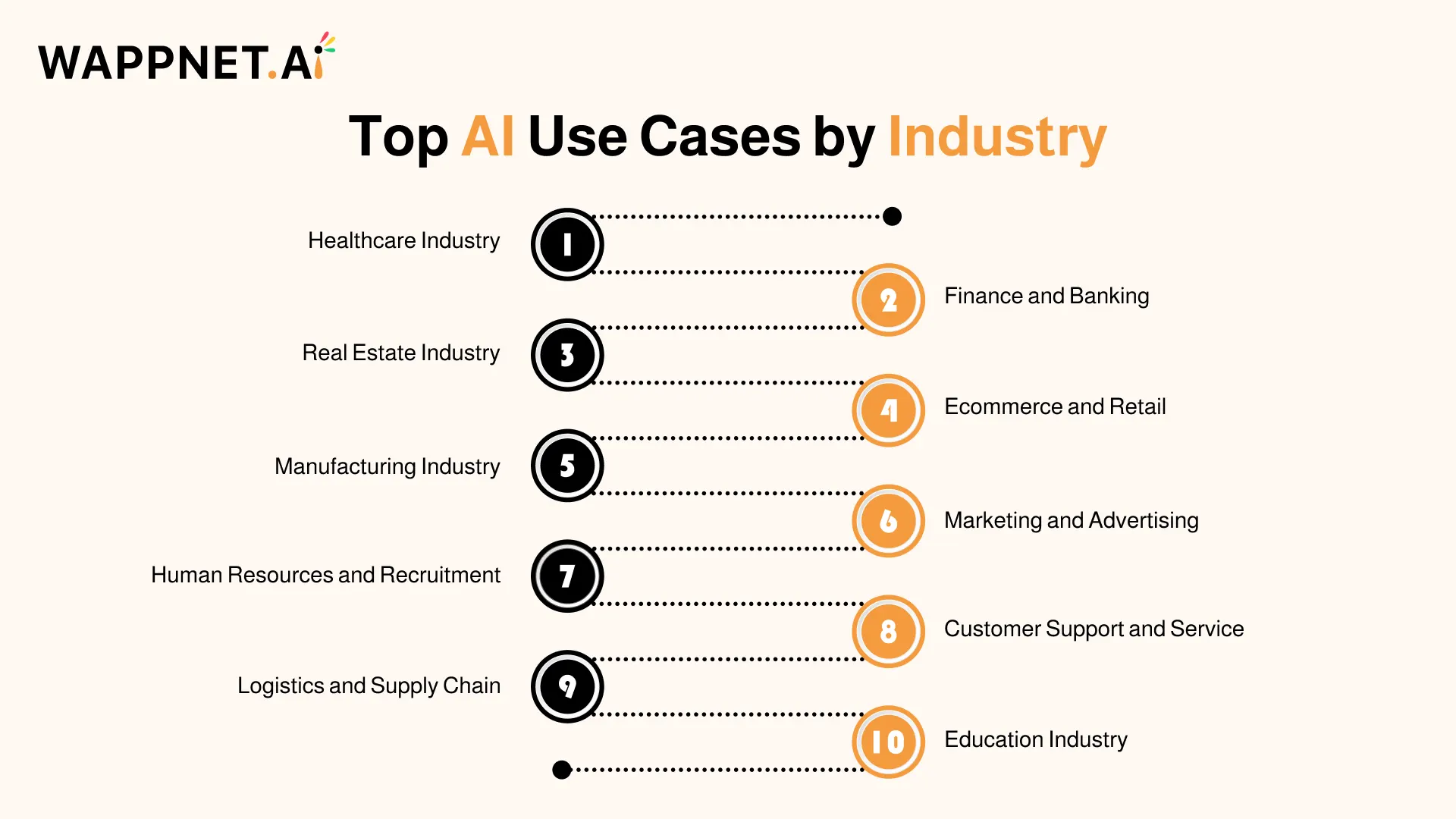
Top AI Use Cases by Industry in 2026

1. Healthcare Industry
Predictive analytics, automation, and intelligent diagnostics are reshaping healthcare through AI.
Top AI Use Cases in Healthcare
- Medical imaging analysis using artificial intelligence technology.
- Predicting patient risk assessment.
- Automated clinical documentation
- Virtual health assistants
- Drug discovery acceleration
- Personalized treatment recommendations
Business Impact
AI-based systems reduce administrative workloads, enhance patient care, and accelerate diagnoses in healthcare.
2. Finance and Banking
In the financial sector, artificial intelligence is being used to improve fraud detection, automate processes, and create better customer experiences.
Top AI Use Cases in Finance
- Fraud detection systems
- AI-based credit scoring
- Automated financial reporting
- Algorithmic trading
- Customer service chatbots
- Personalized financial recommendations
Business Impact
Financial institutions use AI to mitigate risks, ensure compliance, and improve efficiency.
3. Real Estate Industry
AI is revolutionizing how real estate companies discover properties, qualify leads, and engage customers.
Top AI Use Cases in Real Estate
- AI property recommendation engines
- Automated lead nurturing
- Smart pricing analysis
- AI-generated property descriptions
- Predictive market analysis
- Virtual property assistants
Business Impact
AI is helping real estate businesses optimize lead conversion and streamline repetitive marketing and sales processes.
4. E-commerce and Retail
Retailers are leveraging AI to deliver more personalized shopping experiences and manage inventory more efficiently.
Top AI Use Cases in Retail
- Personalized product recommendations
- AI-powered inventory forecasting
- Dynamic pricing optimization
- AI customer support assistants
- Visual search technology
- Automated marketing campaigns
Business Impact
AI-powered personalization is helping retailers improve customer retention, efficiency, and online sales.
Read More: AI Transformation for Enterprises in 2026: Strategy, Tools, ROI & Implementation
5. Manufacturing Industry
AI is increasingly becoming part of production systems, helping manufacturers minimize downtime and enhance quality control.
Top AI Use Cases in Manufacturing
- Predictive equipment maintenance
- Artificial intelligence quality inspection systems
- Supply chain optimization
- Robotics automation
- Demand forecasting
- Energy consumption optimization
Business Impact
By using AI, manufacturers can reduce production costs, gain operational visibility, and boost productivity.
6. Marketing and Advertising
Marketing teams are increasingly using AI automation to enhance campaign performance and content creation.
Top AI Use Cases in Marketing
- AI content generation
- Predictive audience targeting
- Marketing automation workflows
- AI-powered SEO optimization
- Customer behavior analysis
- Automated ad optimization
Business Impact
Marketers can use AI to improve campaign ROI, automate repetitive tasks, and create more personalized customer journeys.
7. Human Resources and Recruitment
AI is helping HR departments streamline hiring and employee management processes.
Top AI Use Cases in HR
- Resume screening automation
- AI interview assistants
- Employee sentiment analysis
- Workforce analytics
- Personalized employee training
- AI onboarding systems
Business Impact
Businesses are optimizing recruitment processes to reduce hiring time and costs.
8. Customer Support and Service
AI-driven customer service is increasingly playing a vital role in enabling scalable customer interactions.
Top AI Use Cases in Customer Support
- AI chatbots
- Automated ticket routing
- Sentiment analysis
- Voice AI assistants
- Self-service knowledge systems
- Customer intent prediction
Business Impact
Companies are achieving faster response times, reducing support costs, and providing round-the-clock customer support experiences.
9. Logistics and Supply Chain
AI is helping logistics firms with route optimization, forecasting, and operational planning.
Top AI Use Cases in Logistics
- Route optimization
- Warehouse automation
- Predictive delivery estimates
- AI demand forecasting
- Fleet management analytics
- Supply chain risk prediction
Business Impact
AI enhances delivery efficiency, reduces transportation costs, and improves supply chain resilience.
10. Education Industry
AI is being used in education to personalize learning experiences and streamline administrative processes.
Top AI Use Cases in Education
- AI tutoring systems
- Personalized learning paths
- Automated grading
- Student performance analytics
- AI learning assistants
- Administrative workflow automation
Business Impact
By leveraging AI, institutions can improve learning outcomes and reduce administrative burdens.
Why AI Adoption Is Accelerating in 2026
Several factors are driving rapid AI adoption across industries:
- Easier access to generative AI tools.
- The rise of no-code and low-code automation platforms.
- The growing demand for operational efficiency.
- Innovations in AI infrastructure and APIs.
- Competitive pressure for digital transformation.
- Enhanced integration between AI systems and business applications.
Companies that have successfully incorporated AI into their operations are experiencing significant improvements in growth, efficiency, and customer engagement.
Read More: 11 AI & Automation Trends Driving Enterprise ROI in 2026
How Businesses Can Successfully Implement AI
To maximize AI ROI, businesses should focus on:
1. Identifying High-Impact Workflows
Begin with repetitive and time-consuming tasks that are suitable for automation.
2. Using AI With Existing Systems
Embed AI into CRM systems, analytics, and business applications.
3. Prioritizing Data Quality
Businesses achieve better AI performance when systems operate on structured and reliable data.
4. Combining Automation With Human Oversight
The ideal use of AI is to augment human productivity, not replace it.
5. Measuring Performance Metrics
Monitor post-implementation performance, customer satisfaction, and revenue impact.
Conclusion
In 2026, AI is poised to become a fundamental business technology across industries. Whether in healthcare, finance, real estate, or ecommerce, AI is helping organizations streamline operations, enhance customer experiences, and drive growth. Partnering with an experienced AI development company enables businesses to implement scalable and industry-specific AI solutions effectively.
Frequently Asked Questions
What are the most common AI use cases in 2026?
The most popular AI applications include customer support automation, predictive analytics, workflow automation, AI content creation, fraud detection, and personalized recommendations.
Which industries are benefiting the most from AI?
Some of the industries experiencing the most significant AI-driven transformation include healthcare, finance, retail, manufacturing, real estate, and logistics.
How is generative AI being used in businesses?
Generative AI is being used for content creation, customer communication, code generation, workflow automation, and personalized marketing campaigns.
Is AI replacing human jobs in 2026?
AI is primarily automating repetitive tasks, allowing employees to focus on more strategic and creative work. AI is being adopted by most businesses to complement human efforts, not to replace them.
What are the biggest benefits of AI for businesses?
The biggest benefits include improved efficiency, cost savings, better decision-making, enhanced customer experiences, and scalable automation.
How can businesses start implementing AI?
The first step in implementing AI is identifying repetitive processes, selecting the right AI tools for your objectives, and gradually integrating automation into existing systems.
Kishan Patel
Kishan Patel is the Co-Founder and CTO of Wappnet Systems with over 12 years of experience in technology leadership and product engineering. He leads the company’s engineering strategy, focusing on AI-driven applications, scalable architecture, and modern DevOps. Kishan has built and scaled high-performance platforms across healthcare, fintech, real estate, and retail, delivering secure and scalable solutions aligned with business growth.
Related Post

AI Automation for Small Business: The Complete ROI Guide for 2026
July 29th , 2026
How Much Does It Cost to Hire AI Developers in 2026?
July 20th , 2026
AI-Powered Web Applications: Architecture Trends CTOs Must Know in 2026
March 10th , 2026