Phone:(+1) 312-698-3083
Email:
info@wappnet.ai
Introduction
Enterprise AI has evolved beyond small-scale experimentation into a strategic necessity. Organizations are rapidly embracing AI in 2026 to drive efficiency, innovation, and growth.
AI Transformation for enterprises forms the foundation of today’s digital ecosystem, while a strong enterprise AI strategy ensures long-term scalability and ROI.
The gap between strategy and execution is being closed by increasingly relying on an AI development company and specialized AI development services to achieve successful AI implementation.
This blog provides a detailed overview of enterprise AI transformation—strategy, tools, ROI, and implementation.
Key Takeaways
- AI transformation for enterprises is essential for growth in 2026.
- A robust enterprise AI strategy ensures successful implementation.
- Collaboration with an AI development firm accelerates adoption.
- AI development services enable scalable and customized solutions.
- Automation, efficiency, and data intelligence drive ROI.

8 minute(s) read
April 24, 2026
What is AI Transformation for Enterprises?
AI transformation is the integration of artificial intelligence technologies into enterprise systems, workflows, and decision-making processes.
Core Capabilities of AI Transformation for Enterprises
- Predictive machine learning (ML).
- Natural language processing (NLP) for automation and communication.
- Computer vision for visual data analysis.
- Generative AI for content and code generation.
- AI-based business process automation.
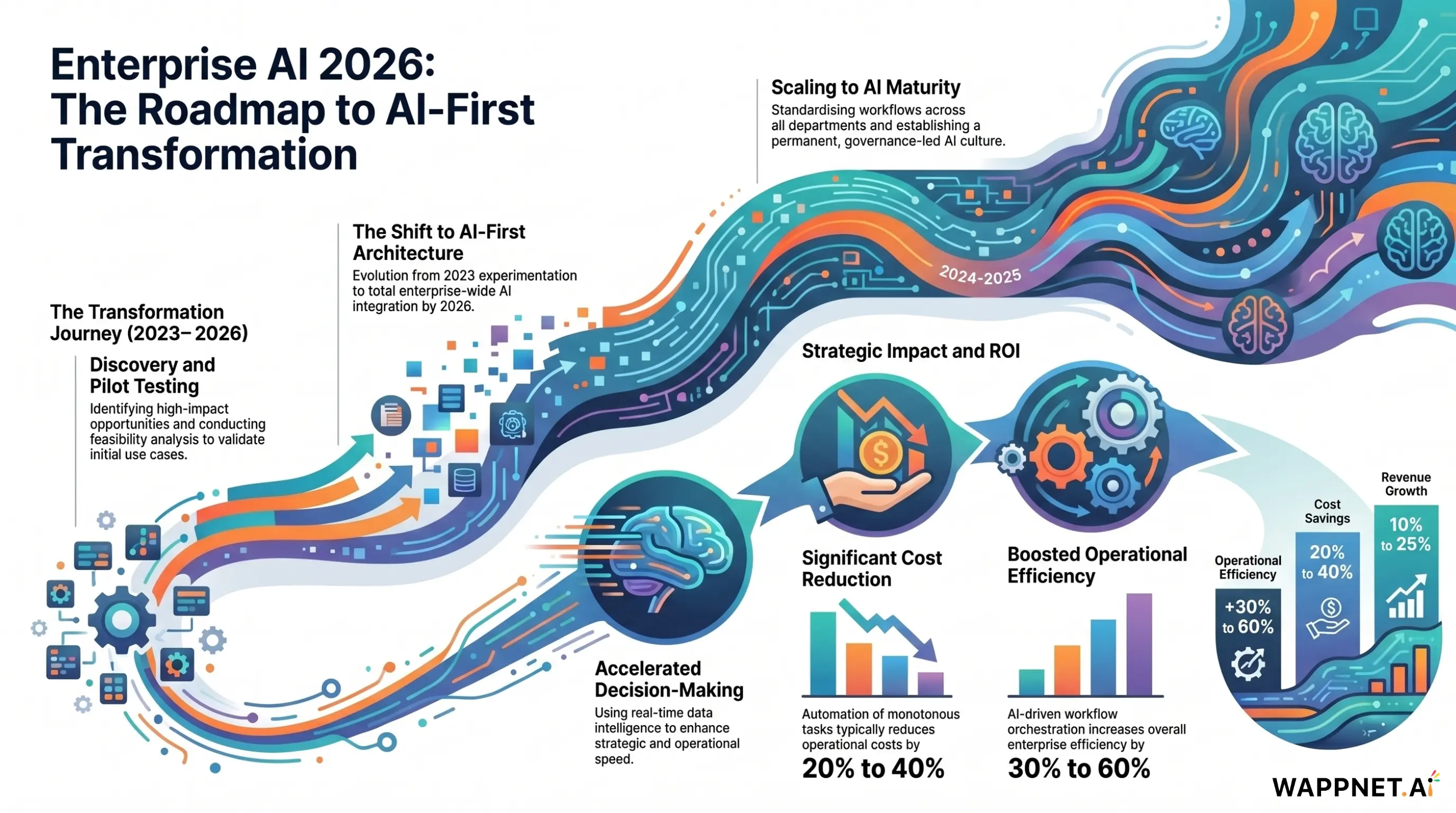
Evolution (2023 → 2026)
| Phase | Focus |
| 2023 | AI experimentation |
| 2024 | Use-case-based adoption |
| 2025 | AI integration across workflows |
| 2026 | AI-first enterprise architecture |
Why AI Transformation Matters in 2026
1. Faster Decision-Making
AI enables real-time insights to enhance strategic and operational decision-making.
2. Cost Reduction
Automation reduces operational costs and manual labor hours.
3. Personalized Customer Experience
AI delivers hyper-targeted experiences across channels.
4. Scalable Operations
Cloud + AI infrastructure allows scalability without proportional cost increases.
5. Competitive Advantage
Companies that leverage AI gain a competitive advantage in speed and innovation.
How to Build a Scalable Enterprise AI Strategy
An effective enterprise AI strategy requires careful planning and execution.
1. Define Business Objectives (Outcome-First Approach)
- Increased revenue (upselling, personalization)
- Cost reduction (automation, efficiency)
- Risk reduction (fraud detection, compliance)
Pro Tip: Directly map AI use cases to KPIs (ROI-driven approach).
2. Data Readiness & Architecture
Data quality is key to AI success.
Requirements:
- Data lakes/warehouses that are centralized.
- Cleaned, tabular, labeled data.
- Real-time data pipelines
Tech Stack:
- Cloud: AWS, Azure, Google Cloud.
- Data Tools: Snowflake, BigQuery.
3. Choose the Right AI Partner
Collaboration with an AI development company ensures:
- Faster implementation
- Availability of skilled labor.
- Scalable AI architecture
4. Select AI Development Services
Key AI development services include:
- Development of custom AI models.
- AI-powered application development
- Workflow automation solutions
- AI integrations (APIs, SaaS solutions)
- Pipeline design and data engineering.
5. Integration & Deployment
- API-first architecture
- Microservices deployment
- Fully integrated with CRM/ERP.
6. Continuous Optimization
- Model retraining
- Performance monitoring
- Feedback-driven improvements
AI Tools Powering Enterprise Transformation (2026)
1. Generative AI Platforms
- Content generation
- AI copilots
- Code automation
2. Automation Tools
- n8n, Zapier
- AI workflow orchestration
3. Data Intelligence Platforms
- Predictive analytics
- BI dashboards
4. AI Frameworks
- TensorFlow
- PyTorch
ROI of AI Transformation
Key Metrics
| Metric | Impact |
| Efficiency | +30% to 60% |
| Cost Savings | 20%–40% |
| Revenue Growth | 10%–25% |
ROI Calculation Framework
Formula:
ROI = (AI Benefits – AI Costs) / AI Costs × 100
Value Drivers
- Mechanization of monotonous work.
- Improved decision-making
- Reduced human error
- Faster execution cycles
Implementation Framework
Phase 1: Discovery
- Identify AI opportunities
- Conduct feasibility analysis
Phase 2: Pilot Projects
- Test AI use cases
- Measure ROI
Phase 3: Scaling
- Deploy across departments
- Standardize workflows
Phase 4: AI Maturity
- Develop an AI-first culture.
- Implement governance
Real-World Examples
Retail
- AI recommendation engines
- Demand forecasting
Healthcare
- Predictive diagnostics
Finance
- Fraud detection
Manufacturing
- Predictive maintenance
Challenges in AI Adoption
- Data silos
- Talent shortage
- Integration complexity
- Resistance to change management
Conclusion
AI is no longer optional; it is key to the success of modern enterprises. Organizations that invest in structured AI transformation, facilitated by the appropriate AI development company and all-inclusive AI development services, will be at the forefront of innovation, efficiency, and scalability.
The moment has come to implement AI in businesses that would like to remain competitive. The future lies with businesses that are not only digital but also smartly automated.
Frequently Asked Questions
What is AI transformation for enterprises?
The AI transformation or transformation of AI into business operations entails the implementation of AI to enhance business efficiency, scalability, and decision-making.
Why hire an AI development company?
An AI development firm offers the knowledge, quicker implementation, and scalable AI solutions to meet business requirements.
What are AI development services?
Some of the services that are offered by AI development are custom AI models, automation solutions, AI integrations, and smart application development.
How long does AI implementation take?
Usually 6 – 18 months with complexity and size.
What is the ROI of AI?
AI delivers ROI by reducing costs, improving efficiency, and increasing revenue.
Kishan Patel
Kishan Patel is the Co-Founder and CTO of Wappnet Systems with over 12 years of experience in technology leadership and product engineering. He leads the company’s engineering strategy, focusing on AI-driven applications, scalable architecture, and modern DevOps. Kishan has built and scaled high-performance platforms across healthcare, fintech, real estate, and retail, delivering secure and scalable solutions aligned with business growth.
Related Post

AI Automation for Small Business: The Complete ROI Guide for 2026
July 29th , 2026
How Much Does It Cost to Hire AI Developers in 2026?
July 20th , 2026
Top AI Use Cases by Industry in 2026
May 21st , 2026
AI-Powered Web Applications: Architecture Trends CTOs Must Know in 2026
March 10th , 2026