Phone:(+1) 312-698-3083
Email:
info@wappnet.ai
Introduction
Artificial intelligence is no longer a futuristic idea; it is a current-day need. Companies in all sectors are quickly implementing AI-based solutions to automate operations, improve customer experiences, and attain a competitive edge in the year 2026.
This transition is a massive opportunity for the developers. Whether being an individual programmer or working in an AI development company, it is crucial to understand how to create AI applications in the modern world to be relevant in the current technology environment.
This guide will take you through the steps for developers to develop scalable, efficient, and future-ready AI applications in the year 2026.
Key Takeaways
- In 2026, AI development relies on pre-trained models and APIs.
- The selection of the appropriate tech stack is the key to the successful development of AI applications.
- Any AI solution is based on high-quality data.
- Real-world applications require scalability and integration.
- Optimization and continuous testing enhance AI performance.
- The modern AI development services are concerned with security and ethical practices.
- A successful collaboration with a well-developed AI firm will speed up the achievement.

8 minute(s) read
April 16, 2026
Table of Contents
- 1. Understanding the Foundations of AI Development
- 2. Choosing the Right Tech Stack for AI Application Development
- 3. Data Collection and Preparation
- 4. Model Selection and Training
- 5. Building Scalable AI Applications
- 6. AI Integration in Real-World Applications
- 7. Testing and Optimization
- 8. Deployment and Maintenance
- 9. Security and Ethical AI Development
- Conclusion
1. Understanding the Foundations of AI Development
It is essential to know the basics of AI development before getting into the development:
- Machine Learning (ML)
- Natural Language Processing (NLP)
- Computer Vision
- Generative AI models
- Data engineering and pipelines
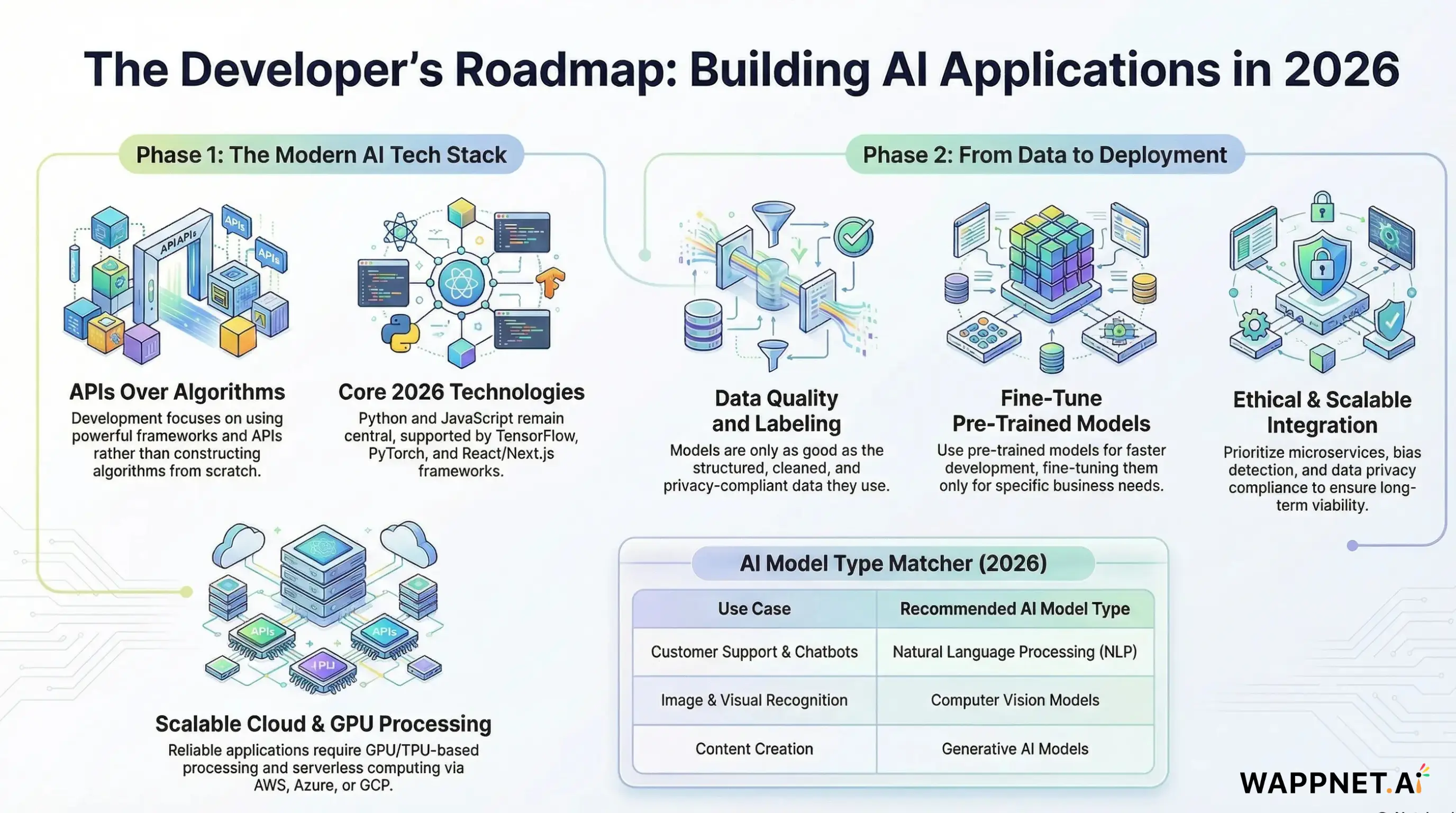
The current state of AI programming is less about constructing algorithms and more about using powerful frameworks and APIs to speed up the creation of applications.
2. Choosing the Right Tech Stack for AI Application Development
By 2026, a developed ecosystem of tools will be available to developers. The choice of the stack makes the development of an AI application successful.
Core Technologies:
- Programming Languages: Python, JavaScript
- Frameworks: TensorFlow, PyTorch
- AI APIs & Platforms: OpenAI, cloud AI services
- Backend: Node.js, Django
- Frontend: React, Next.js
Cloud & Infrastructure:
- Scalable cloud platforms (AWS, Azure, GCP)
- Serverless computing
- GPU/TPU-based processing
To create stable and scalable solutions, a trusted AI development company would usually use a combination of these tools.
3. Data Collection and Preparation
The quality of AI models is no better than the data upon which they are trained. Among the most important AI development services, data preparation remains one of the most critical steps.
Best Practices:
- Collect high-quality, relevant datasets
- Clean and preprocess data
- Ensure data privacy and compliance
- Use data labeling tools for supervised learning
Even the most sophisticated AI programming approaches cannot produce results without structured data.
4. Model Selection and Training
Choosing the right model depends on your use case:
- Chatbots → NLP models
- Image recognition → Computer vision models
- Predictive analytics → Machine learning models
- Content generation → Generative AI models
Modern Approach in 2026:
- Use pre-trained models (faster development)
- Fine-tune models for specific business needs
- Leverage APIs instead of building from scratch
This is a key way of saving on development time and is used extensively by major AI development service providers.
5. Building Scalable AI Applications
Any successful project in the development of an AI application should embrace scalability.
Key Considerations:
- Microservices architecture
- API-first development
- Real-time processing functions.
- Integration with the existing systems (CRM, ERP, and others).
An AI development company will make sure that the applications are developed to support growth, high traffic, and changing user requirements.
6. AI Integration in Real-World Applications
AI is being integrated into various industries:
- Healthcare → Diagnosis and patient data analysis
- Finance → Fraud detection and risk management
- Retail → Personalized recommendations
- Real Estate → AI-driven listings and content generation
- Customer Support → AI chatbots and automation
To apply these solutions successfully, business organizations turn more and more to AI development services.
Read More: How Conversational AI Improves Customer Experience
7. Testing and Optimization
The use of AI needs constant testing and enhancement.
Focus Areas:
- Model accuracy and performance
- Bias detection and fairness
- Latency and response time
- User experience
A reputable AI development firm provides a complete package, including implementation and future servicing.
8. Deployment and Maintenance
Deployment strategies in 2026 include:
- Cloud-based deployment
- Edge AI for real-time processing
- Continuous integration and deployment (CI/CD)
Ongoing Maintenance Includes:
- Model retraining
- Performance monitoring
- Security updates
A reputable AI development firm provides a complete package, including implementation and future servicing.
9. Security and Ethical AI Development
As AI adoption grows, so do concerns around ethics and security.
Best Practices:
- Ensure data privacy compliance
- Avoid biased datasets
- Maintain transparency in AI decisions
- Implement secure APIs and encryption
Right AI developmental services are concerned not just with performance but with ethical implementation as well.
Conclusion
By 2026, AI applications can be built more than ever before, but they need the appropriate strategy, tools, and expertise. To develop effective AI solutions, developers should consider scalable architecture, quality data, and effective integration of models.
Regardless of being an individual developer or an AI development firm, adopting the current AI programming practices will enable you to develop intelligent, future-ready applications to create real business value.
Ankit Patel
Ankit Patel is the visionary CEO at Wappnet, passionately steering the company towards new frontiers in artificial intelligence and technology innovation. With a dynamic background in transformative leadership and strategic foresight, Ankit champions the integration of AI-driven solutions that revolutionize business processes and catalyze growth.