
Multi-Agent Architecture Development Services
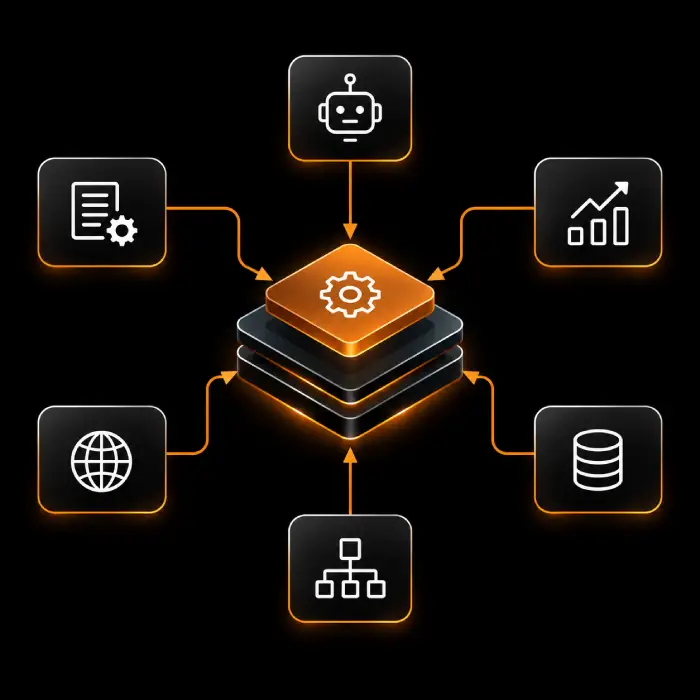
Our multi-agent architecture development services design systems where specialized AI agents, each with a defined role, coordinate through an orchestration layer, share context, and connect securely to your tools. These multi-agent AI development services are built for CTOs, CIOs, Chief AI Officers, enterprise architects and AI engineering leaders structuring workflows that span more than one task or team. We're equally direct when a single agent is the better fit, and you leave with a working architecture, not just a diagram.
What Do Multi-Agent Architecture Development Services Include?
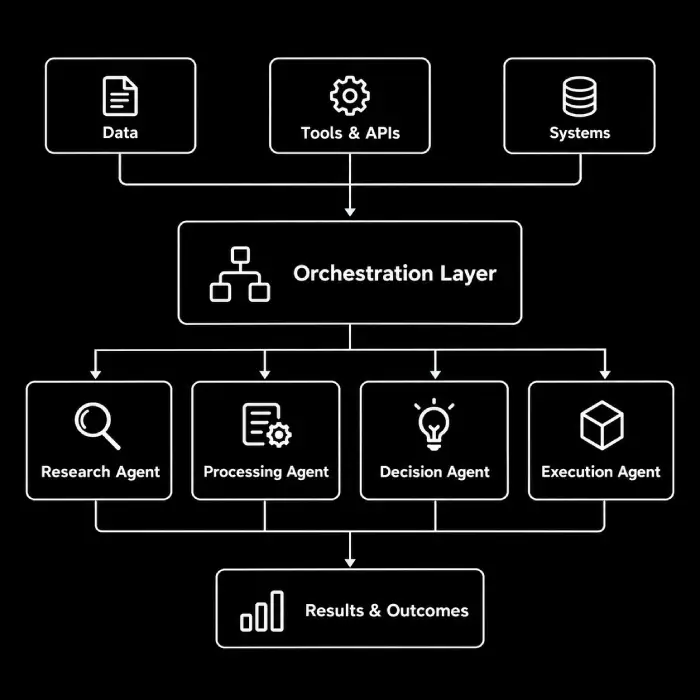
Multi-agent architecture is the design of a system where several specialized AI agents each own part of a task, communicate through a defined structure, and are coordinated by an orchestration layer so the whole system behaves predictably. Our multi-agent AI architecture work moves from decomposition to design to implementation, scoped to how many agents your workflow genuinely needs.
Our multi-agent architecture development services cover the complete coordination and engineering lifecycle:
- We start with multi-agent system architecture design, deciding how many agents a workflow genuinely needs and how they relate to each other.
- We handle agent role definition and specialization, scoping what each agent is responsible for and, just as importantly, what it is not.
- We design AI agent orchestration and task delegation, choosing and implementing a coordination pattern such as hierarchical, supervisor-based, sequential, parallel or decentralized suited to the workflow.
- We build agent communication, shared context and memory so agents can pass tasks, results and context to one another while keeping what should stay private to one agent.
- We handle multi-agent system integration, connecting agents to the business systems, data sources and external APIs they need to act on with scoped permissions.
- We run testing, evaluation and observability to validate agent behavior and give your team visibility into what the system did and why.
- We build in security, permissions, human oversight and governance, with access boundaries, approval points for consequential actions and audit visibility.
Why Businesses Invest in Multi-Agent Architecture
Multi-agent architecture earns its complexity when a workflow genuinely spans more than one specialized skill or decision boundary, not by default. Done well, it turns manual, multi-person handoffs into a coordinated system. We describe the benefits below as what becomes possible, not guaranteed, and we're just as direct about the trade-offs.
Coordinating Complex, Multi-Step Workflows
When a process has distinct stages that need different skills or tools, dedicated agents per stage can be easier to build, test and reason about than one agent trying to do everything.
Dividing Work Across Specialized Agents
A research agent, an analysis agent and a drafting agent can each be scoped, tested and improved independently rather than as one large, harder-to-debug system.
Connecting Reasoning to Business Tools and Systems
Agents with well-defined tool access can pull from and act on the systems your workflow actually touches, instead of producing output someone still has to re-key.
Improving Monitoring and Control Over Agent-Based Processes
Defined roles and an orchestration layer make it easier to see which agent did what, and to add a human checkpoint exactly where one is needed.
Trade-Offs We Plan For
More agents isn't automatically better. Coordination adds latency, cost and new failure points, so we size the architecture to the workflow and tell you when a single agent or simple automation is the smarter call.
Multi-Agent Architecture AI Solutions Built for Your Business
Explore our multi-agent AI solutions designed around your business needs and workflows. Our AI consulting services help determine the right approach, while our agentic AI development services support building single-agent and multi-agent systems.
Multi-Agent Orchestration Systems
A supervisor or router agent delegates work to specialist agents and assembles the result, so each stage of a workflow can be built, tested and improved independently. This AI agent orchestration approach fits workflows that break down cleanly into distinct stages, not every task.
Collaborative AI Agent Workflows
Agents with different roles, such as drafting, verification and synthesis, pass work to each other with shared context, giving a workflow a built-in review step without a person checking every output. Works best where the handoff logic between agents is clearly definable.
Supervisor-and-Specialist Agent Architectures
A supervisor agent plans and routes tasks while narrow, well-defined specialist agents handle each part and report back. This supervisor-based agent architecture makes it easier to add a new specialist later without redesigning the whole system.
Research, Analysis and Reporting Workflows
Agents gather information, analyze it and draft a report in sequence or in parallel, with a reviewer step before anything reaches a person, turning hours of manual research into a draft ready for review.
Enterprise Knowledge and Information-Processing Workflows
Retrieval-aware agents cross-reference multiple internal sources before responding, cutting down the dead-end answers that come from checking only one system. Result quality depends on how complete and accessible your knowledge base is.
AI-Assisted Operations and Decision-Support Systems
Agents monitor and gather data spread across multiple systems and surface a recommendation, while a person still makes the final call on consequential decisions. This kind of multi-agent AI implementation needs clear data access and a defined escalation point.
Multi-Agent Systems Integrated with Enterprise Tools
Scoped, permissioned connections from agents to your CRM, ERP, ticketing platform or internal APIs turn agent output into a completed action instead of a report someone still has to act on. This multi-agent system integration is limited by what your existing systems expose through an API.
Human-Supervised Agent Workflows
Agents handle routine cases on their own and escalate the rest, with approval gates on consequential actions, giving a workflow speed where it's safe and oversight where it matters.
Scaling From a Single Agent to a Coordinated System
When a single agent that worked well needs to cover more ground than it can handle alone, we assess whether the right next step is a second specialized agent, a better tool set, or a different multi-agent architecture solution, based on evidence from how the existing agent actually performs.
Not Sure If Your Workflow Needs Multiple Agents?
Tell us about the workflow, the systems it touches, and where it currently breaks down or takes too long. We'll help you work out whether a multi-agent architecture, a single agent, or a simpler automation is the right starting point.
Our Multi-Agent Architecture Development Process
We assess your workflows, design the right multi-agent architecture, and build, integrate, and validate the solution before deployment. Timelines depend on system complexity, integrations, and infrastructure, with a clear plan agreed upon after discovery.
- 1
Business Use Case and Requirements Discovery
We map the workflow end-to-end, the systems and data it touches, and the decision points that matter, giving you a clear picture of whether multi-agent architecture actually fits and why.
- 2
Workflow Decomposition and Agent Role Design
We break the workflow into the distinct responsibilities it actually needs and define what each agent owns, producing an agent role map rather than a guess at how many agents sound right.
- 3
Architecture, Orchestration and Integration Planning
We select the orchestration pattern, whether hierarchical, sequential, parallel or decentralized, and plan how agents connect to your existing systems, resulting in an architecture design your engineering team can review before build starts.
- 4
Agent Development and System Integration
We build the agents, the orchestration layer and the tool and API connections, working inside your existing stack rather than asking you to adopt a new platform, so you end up with a working system in a test environment.
- 5
Testing, Evaluation, Security and Performance Validation
We test against real and edge-case scenarios, validate access controls and human-approval points, and check for the coordination failures multi-agent systems are prone to, leaving you with an evaluated system and documented limitations.
- 6
Deployment, Monitoring and Continuous Improvement
We deploy with observability in place from day one, set up the monitoring your team needs to see what each agent is doing, and agree a plan for ongoing review as usage and requirements change.
Multi-Agent Architecture Development Services: Use Cases
Explore how multi-agent AI architecture can address complex business workflows, improve coordination, and automate tasks. The right approach depends on your existing processes and business requirements.
Enterprise Research and Knowledge Synthesis
A question needs answers pulled from several internal and external sources, structured, and checked before anyone acts on it. Agents gather, cross-reference and draft; a person reviews before the output is used for a decision.
Document Analysis and Information Extraction
Contracts, reports or forms need data extracted and validated against business rules. One agent extracts, another validates against policy, and low-confidence cases route to a person rather than being auto-approved.
Customer Service Workflows Requiring Multiple Specialized Tasks
A single support request may need account lookup, policy checking and response drafting. Specialized agents handle each step and hand off, with escalation to a person for anything outside agreed boundaries.
Business Reporting and Data Analysis
A recurring report pulls from multiple systems, needs consistent formatting, and should flag anomalies. Agents gather and analyze on schedule; a person reviews flagged items rather than the whole report every time.
Software Development Support Workflows
Code review, test generation and documentation can be split across agents with different scopes, with a developer approving anything that touches production code.
Sales and Operational Workflow Coordination
A lead or order moves through enrichment, qualification and routing steps that touch different systems. Agents handle the repeatable parts; a rep or operator makes judgment calls that affect revenue or commitments.
Enterprise Search and Knowledge Assistance
Finding the right answer across scattered internal documentation often means checking several sources before trusting the result. Coordinated agents can check multiple sources and flag disagreement between them instead of returning the first match.
Cross-System Process Coordination
A process that currently requires a person to check one system, then act in another, can be coordinated by agents with scoped, permissioned access to each, with approval required for actions that can’t be easily undone.
Single-Agent AI vs. Multi-Agent AI vs. Traditional Workflow Automation
Each approach serves different business needs. The right choice depends on workflow complexity, required capabilities, task predictability, and coordination requirements.
Technologies We Use to Build Multi-Agent AI Systems
We select technologies based on your business requirements, existing infrastructure, security needs, and deployment goals to build scalable and reliable multi-agent AI systems.


















Industries We Help With Multi-Agent Architecture
Why Choose Wappnet AI as Your Multi-Agent Architecture Development Company?
A diagram with boxes and arrows is not an architecture. As a multi-agent architecture development company that also builds the agents, the integrations and the infrastructure underneath, we treat architecture decisions as decisions your engineering team has to live with, not a slide deck handed off at the end of a workshop.
Business-First Architecture Planning
We start from the workflow, not from a preference for multiple agents. If a single agent or a simpler automation solves it, that’s what we recommend.
Integration With Existing Enterprise Systems
We connect agents to the CRM, ERP, ticketing and internal systems you already run, through agentic AI development practices built for production, not prototypes.
Reliability, Observability and Evaluation by Design
Monitoring and evaluation are part of the architecture from the start, so your team can see what each agent did, not just the final result.
Security, Permissions and Human Oversight
Access boundaries between agents and approval gates for consequential actions are designed in, not bolted on after a review flags a gap.
Real-World Multi-Agent Architecture Development Solutions We've Delivered
Coordinated multi-agent systems, supervisor-specialist workflows, and enterprise tool integrations delivering production reliability at scale.
Multi-Agent Enterprise Due Diligence & Research Engine
Implemented a hierarchical multi-agent architecture with a supervisor delegating financial, legal, and operational analysis to specialist agents, reducing report turnaround from 3 days to 45 minutes.
Autonomous Multi-System Order Fulfillment & Exception Handling
Designed a collaborative agent network connecting CRM, inventory, and logistics platforms with human approval gates for high-value orders and exception resolution.
Multi-Agent Software Engineering & Automated Code Review System
Built a specialized multi-agent pipeline splitting static analysis, security testing, documentation generation, and PR review across dedicated agents.
Ready to Design Your Multi-Agent Architecture?
Bring your workflow, the systems it needs to touch, and your current pain points. We'll talk through whether multi-agent architecture fits, what the orchestration pattern should look like, and what a practical first step is, with no obligation.
Latest AI Insights & Industry Trends
 RAG
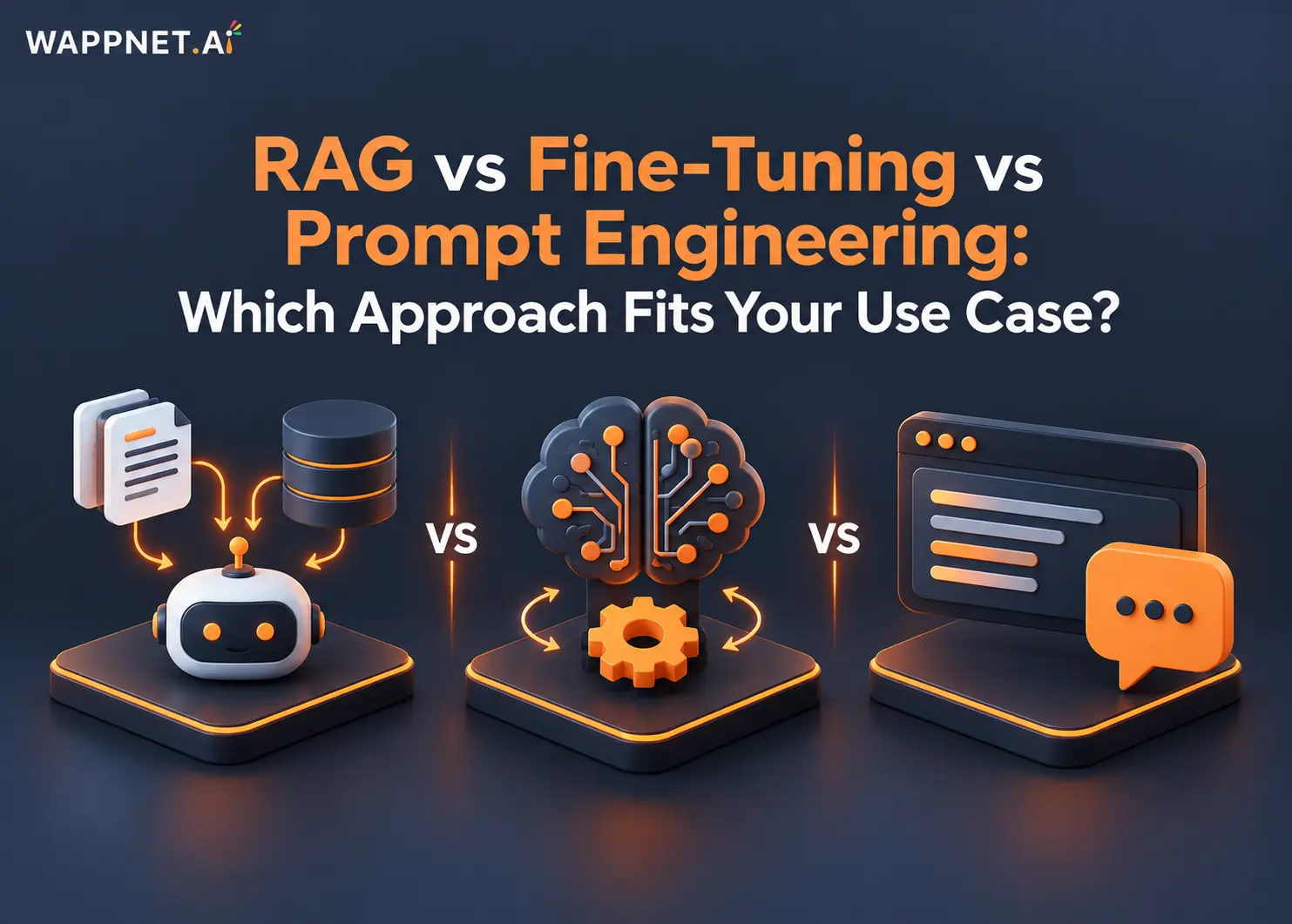
RAG vs Fine-Tuning vs Prompt Engineering: Which Approach Fits Your Use Case?
Compare RAG, fine-tuning, and prompt engineering to explore costs, use cases, and the best approach for enterprise AI.
 AI Copilot
What is an AI Copilot? Use Cases & Build Guide
What is an AI Copilot? Learn how it works, how it differs from AI agents, key use cases, and how to build one for your business.
 RAG
What Is RAG? A Complete Guide to Retrieval-Augmented Generation
Learn what RAG is, how Retrieval-Augmented Generation works, reduces AI hallucinations, and powers smarter enterprise AI.
Frequently Asked Questions
Multi-agent architecture is the design of a system in which multiple specialized AI agents each handle part of a task and are coordinated through defined roles, a communication structure and an orchestration layer, so the system behaves predictably as a whole, rather than as several agents acting independently.
They’re the design and development work needed to build that kind of system: decomposing a workflow into agent roles, choosing an orchestration pattern, implementing agent communication and shared state, integrating tools and APIs, and adding the testing, security and oversight a production system needs.
Specialized agents each handle a defined part of a task. An orchestration layer, whether a supervisor agent, a fixed sequence, or a decentralized coordination protocol, routes work between them, while shared context and memory keep each agent aware of what’s already happened so handoffs don’t lose information.
A single agent handles a task on its own using its own tools and reasoning. A multi-agent system splits a task across several specialized agents that coordinate with each other. Multi-agent systems can handle more complex, multi-skill workflows, but add coordination overhead, cost and failure modes a single agent doesn’t have.
The most common patterns are hierarchical or supervisor-based (one agent delegates to and coordinates specialists), sequential (agents act one after another in a defined order), parallel (independent agents work at the same time), and decentralized (agents coordinate directly with each other without a single controller). Most real systems combine elements of more than one pattern.
Agents typically pass structured messages, task results or shared state to one another, often through the orchestration layer rather than directly. The specifics, including what’s shared, what stays private, and how conflicts or disagreements are resolved, are architecture decisions, not something that works the same way by default across every system.
An orchestrator routes tasks to the right agent, sequences or parallelizes work, and often holds the shared context the system relies on. It’s the component most responsible for whether the overall system behaves predictably.
When a workflow genuinely spans multiple distinct specializations, tools or decision boundaries that benefit from being built, tested and scaled independently. If a single agent with the right tools already covers the workflow, or the process is predictable enough for traditional automation, those are usually the better starting point.
Benefits include clearer task division, independent testing and scaling of each agent, and the ability to parallelize independent work. Limitations include added coordination overhead, higher cost and latency from more model calls, more complex debugging, and new failure modes like dropped handoffs or agents acting on stale shared context.
Common orchestration frameworks include LangGraph, Microsoft AutoGen, CrewAI and Semantic Kernel, typically paired with a foundation model, a vector database for retrieval, and observability tooling. The right combination depends on your requirements; we select rather than default to one stack.
Through scoped, permissioned API connections to the systems each agent needs, such as a CRM, ERP, ticketing platform or internal database, so agent output becomes a completed action in the system of record rather than a report someone has to act on manually.
Through tracing and logging at the agent and system level, evaluation against real and edge-case scenarios before release, and ongoing monitoring once deployed, so a team can see what each agent did and why, not just the final output.
Through scoped permissions per agent, approval gates on consequential or hard-to-reverse actions, audit logging of what each agent did, and clear ownership of each agent’s behavior, designed into the architecture, not added after a security review.
It depends on how many agents the workflow needs, how many systems it integrates with, and how much testing and validation the risk level requires. We propose a phased plan after discovery rather than quoting a fixed timeline upfront.
Cost depends on the number of agents, integration complexity, the orchestration pattern chosen, and the level of testing, security and oversight the workflow requires. We give an estimate once requirements are clear rather than quoting a figure before we understand your workflow.