Phone:(+1) 312-698-3083
Email:
info@wappnet.ai
Introduction
Retrieval-Augmented Generation (RAG) is an AI architecture that connects a large language model to an external knowledge source, so it retrieves relevant, up to date information before generating a response. Instead of relying only on facts frozen into the model at training time, a RAG system pulls in real documents, then writes an answer grounded in what it just found.
Meta AI researchers introduced the concept in a 2020 paper led by Patrick Lewis. Since then, RAG has become one of the most practical ways for businesses to make AI assistants factual, current, and traceable to a source. This guide explains what RAG is, how it works, and how it compares to fine-tuning.
RAG (Retrieval-Augmented Generation) is an AI method that retrieves relevant information from an external knowledge base and feeds it to a language model before it generates a response. This grounds answers in real, current documents instead of only the model’s training data, which reduces hallucinations and keeps responses up to date without retraining the model.
Key Takeaways
- RAG pairs a retrieval system with a language model so answers are grounded in real documents, not just training data.
- Meta AI researchers introduced the technique in a 2020 paper led by Patrick Lewis.
- RAG updates instantly when source documents change, with no model retraining required.
- It reduces hallucinations but does not guarantee zero errors, since retrieval quality still matters.
- Core components: an embedding model, a vector database, a retriever, and a generator LLM.
- RAG and fine-tuning solve different problems and are often used together in production.

11 minute(s) read
September 28, 2026
What Is Retrieval-Augmented Generation?
Retrieval-Augmented Generation pairs a large language model with a retrieval system, usually built on a vector database, so the model can look up relevant information before answering. The name describes exactly what happens: retrieve relevant content, augment the prompt with it, then generate a response.
A standalone LLM only knows what it learned during training. It cannot see your company’s latest policy update or a document uploaded five minutes ago. RAG closes that gap, which is why many teams pair it with broader generative AI solutions rather than treating retrieval as a separate experiment.

How Does RAG Work? Step by Step
1. Indexing
Documents such as manuals or support tickets are broken into chunks, converted into numerical vectors called embeddings, and stored in a vector database.
2. Retrieval
A user’s question is also converted into an embedding, and the system searches the database for the chunks most semantically similar to it.
3. Augmentation
The retrieved chunks are inserted into the prompt sent to the language model, alongside the original question.
4. Generation
The large language model reads that context and generates an answer grounded in it, often citing the source. Teams building this in house often use dedicated LLM development support to tune retrieval and prompts.
RAG vs Fine-Tuning vs a Standalone LLM
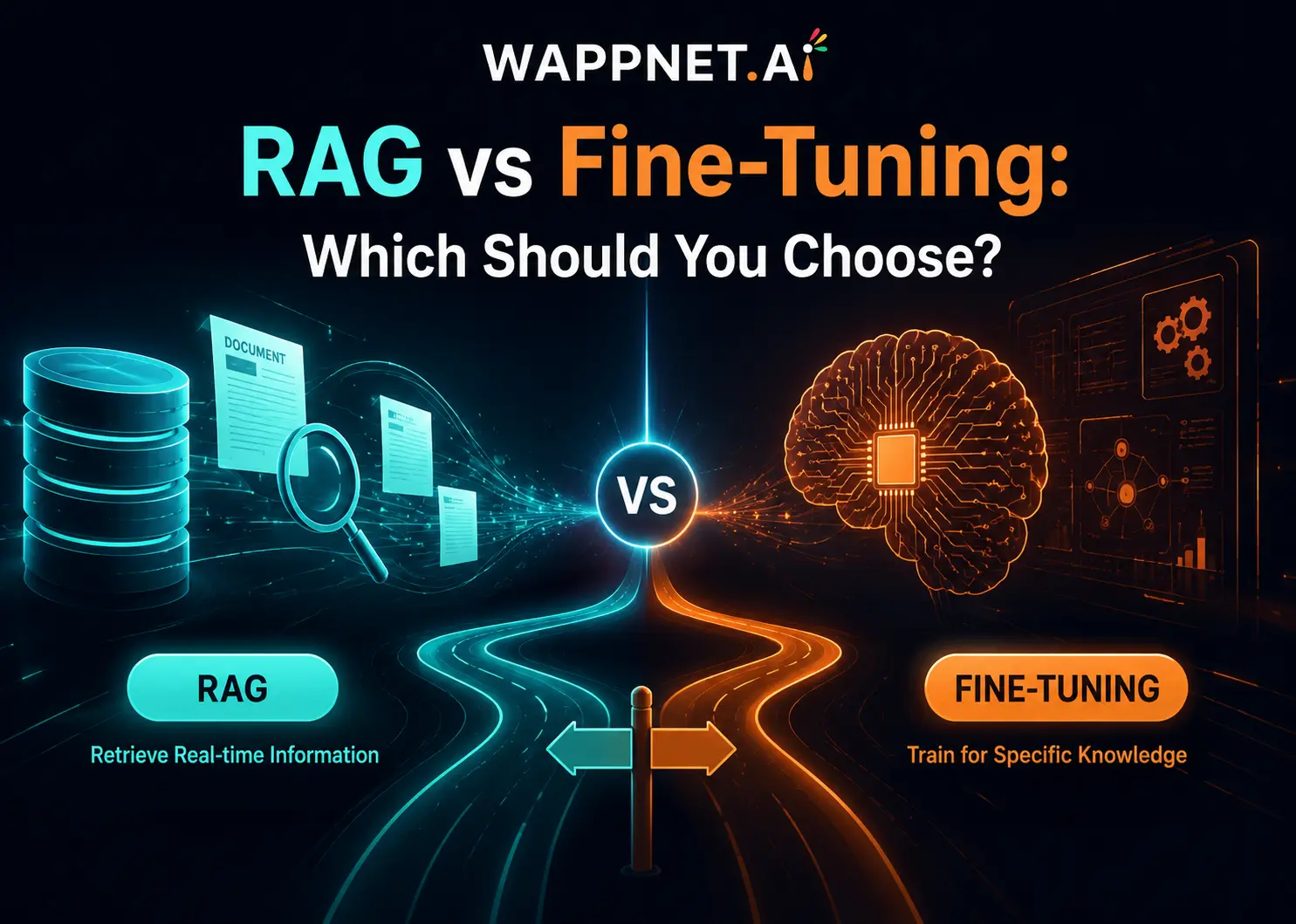
These three approaches solve different problems, and choosing the wrong one is a common source of wasted engineering time. For a deeper breakdown, see this comparison of RAG vs fine-tuning.
| Approach | Knowledge Source | Update Speed | Best For |
|---|---|---|---|
| Standalone LLM | Training data only | Requires full retraining | General reasoning, no company-specific facts |
| RAG | External documents, updated live | Instant, no retraining needed | Fact-heavy, frequently changing knowledge |
| Fine-Tuning | Retrained model weights | Slow, requires new training run | Changing tone, format, or specialized behavior |
Why Enterprises Use RAG
Interest in RAG has grown with enterprise AI adoption. Per Precedence Research, the global RAG market was valued at USD 1.85 billion in 2025 and is projected to reach USD 67.42 billion by 2034, a 49.12 percent CAGR, driven by demand for AI outputs grounded in proprietary data. Many businesses turn to RAG as a service to deploy this capability without building the retrieval stack from scratch.
Grounding also builds trust. In a peer-reviewed clinical study on radiology consultations, RAG eliminated hallucinated responses entirely, versus 8 percent for the same model without retrieval. Results vary by domain, but the direction holds.
Common Mistakes When Implementing RAG
- Chunking documents too large or too small, weakening retrieval accuracy.
- Skipping retrieval evaluation, so poor matches go unnoticed until users complain.
- Treating RAG as a one-time setup instead of an ongoing update process.
- Assuming RAG alone prevents every hallucination without testing edge cases.
RAG Best Practices
- Test multiple chunk sizes against real user questions first.
- Monitor retrieval quality separately from generation quality.
- Keep the knowledge base current with an automated refresh process.
- Cite retrieved sources in the response so users can verify it.
Expert Insight
Teams that treat RAG as a data problem first, not a model problem, get better results. Retrieval quality is usually the biggest lever for accuracy, more than swapping to a larger language model.
Ready to Build a RAG System That Actually Works?
Wappnet’s AI team designs and deploys production-ready RAG pipelines, from document ingestion to grounded, cited answers.
Conclusion
Retrieval-Augmented Generation gives language models access to real, current information the moment a question is asked, instead of relying only on frozen training data. It reduces hallucinations, keeps answers traceable to a source, and updates instantly, which is why it is now standard in enterprise AI architecture. Start by identifying which knowledge needs to stay current and searchable. Want help scoping a RAG pipeline? Talk to Wappnet’s AI team.
Frequently Asked Questions
What is RAG in AI?
RAG, or Retrieval-Augmented Generation, connects a large language model to an external knowledge source so it retrieves current information before answering, instead of relying only on its training data.
How does Retrieval-Augmented Generation work?
RAG retrieves relevant documents using semantic search, augments the user’s prompt with that content, then generates a response grounded in the retrieved facts rather than the model’s memory alone.
What is the difference between RAG and fine-tuning?
RAG adds external knowledge at query time without retraining, so it updates instantly when documents change. Fine-tuning retrains the model on new examples to change its behavior, which takes longer and costs more.
Does RAG eliminate AI hallucinations completely?
No. RAG significantly reduces hallucinations by grounding answers in retrieved documents, but it does not guarantee zero errors, since the model can still misread content or fail if retrieval returns poor matches.
What are the core components of a RAG architecture?
A typical RAG system includes a document store, an embedding model, a vector database for semantic search, a retriever that fetches relevant chunks, and an LLM that generates the final answer.
Is RAG expensive for enterprises to implement?
Cost depends on data volume and infrastructure. Cloud-based RAG with managed vector databases is the common starting point since it lowers upfront cost, while on-premises deployments need more investment.
Ankit Patel
Ankit Patel is the visionary CEO at Wappnet, passionately steering the company towards new frontiers in artificial intelligence and technology innovation. With a dynamic background in transformative leadership and strategic foresight, Ankit champions the integration of AI-driven solutions that revolutionize business processes and catalyze growth.
Related Post
RAG vs Fine-Tuning: Which Should You Choose?
July 09th , 2026