Big Data Analytics Services & Solutions
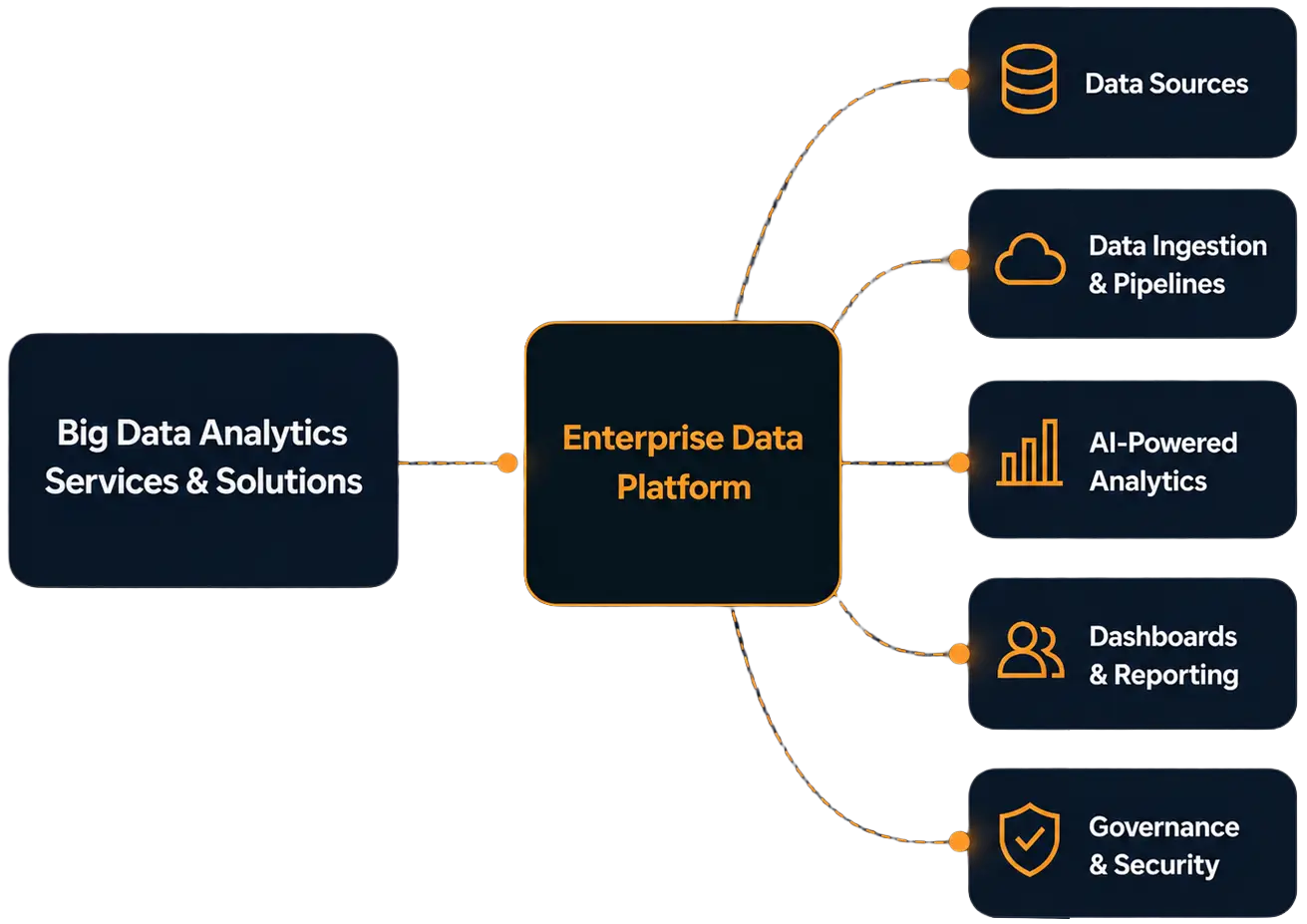
Every enterprise generates more data than it can act on. Transactions, sensors, clickstreams, support tickets, and third-party feeds now arrive faster than legacy systems can process them. Wappnet AI's Big Data Analytics Services and Enterprise Big Data Solutions turn that raw, fragmented data into governed, real-time intelligence: unified pipelines, modern lakehouse architecture, and AI-powered analytics that help CIOs, CTOs, and analytics leaders make faster, evidence-based decisions at enterprise scale.
What is Big Data Analytics?
Big Data Analytics is the process of collecting, storing, and analyzing extremely large, fast-moving, and varied datasets. It uses distributed computing, cloud platforms, and AI to uncover patterns, predict outcomes, and support real-time business decisions that traditional databases and BI tools cannot handle.
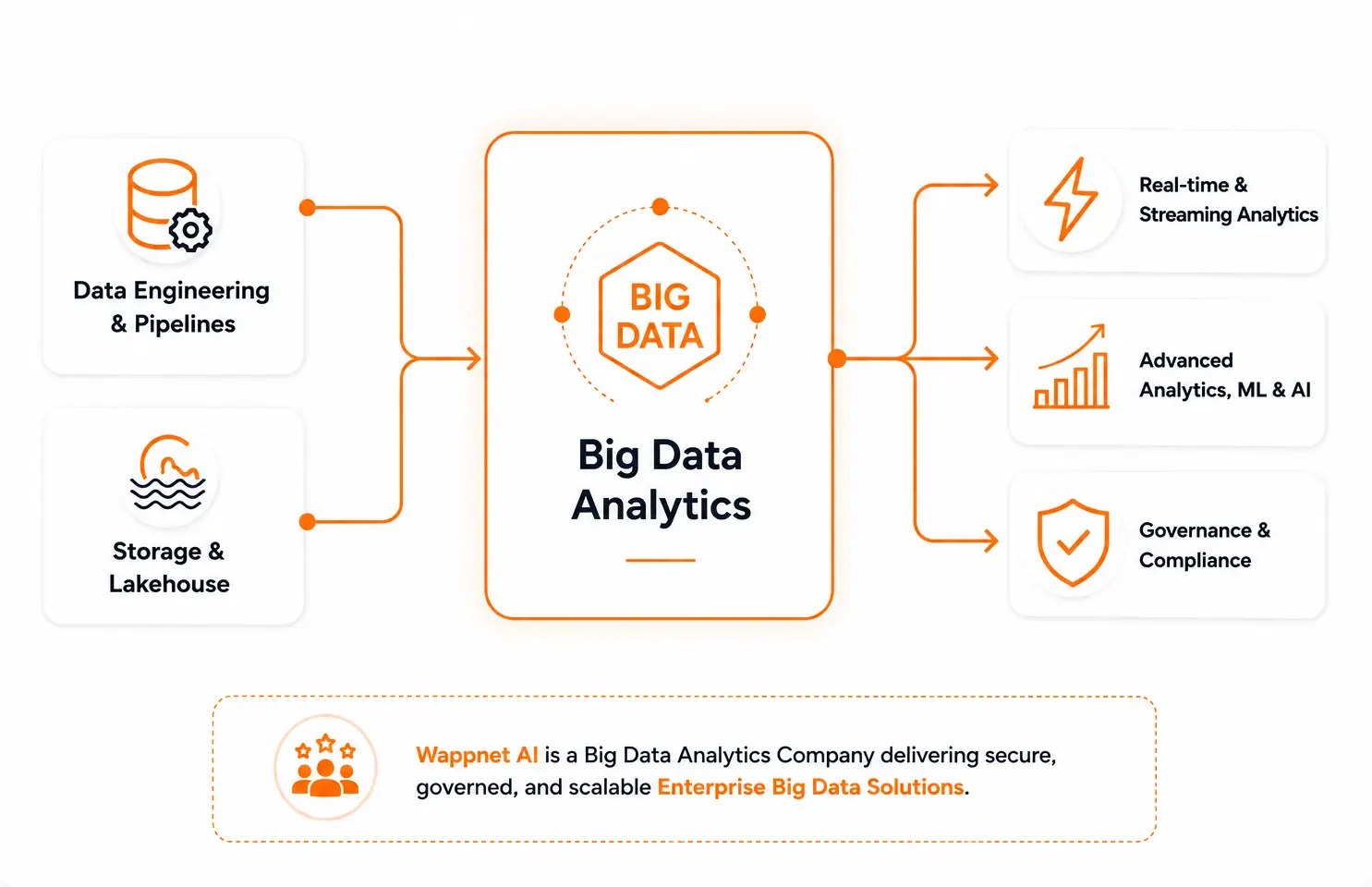
A modern Big Data Analytics stack includes:
- Data engineering and pipelines ingest data at scale.
- Storage and lakehouse architecture unify lakes and warehouses.
- Real-time and streaming analytics process events instantly.
- Advanced analytics, ML, and AI turn data into predictions.
- Governance and compliance keep data trustworthy.
Why Businesses Need Big Data Analytics
Faster, Evidence-Based Decisions
Lower Operating Costs
Reduced Fraud & Risk Exposure
Sharper Customer Insights
Improved Data Trust
Scalable Competitive Advantage
Our Big Data Analytics Services
Big Data Strategy & Consulting
Data Engineering & Pipeline Development
Data Lake, Warehouse & Lakehouse Architecture
Real-Time & Streaming Analytics
BI, Dashboards & Data Visualization
Predictive Analytics, ML & AI Integration
Data Governance, Security & Compliance
Managed Big Data Services & Support
How Big Data Analytics Works
Discovery & Data Assessment
Architecture & Roadmap Design
Pipeline & Platform Engineering
Analytics & Model Development
Testing & Validation
Deployment & Optimization
Big Data Analytics Use Cases
Healthcare
- Flagging high-risk patients for early intervention before a costly ER visit.
- Cutting report-generation time for hospital administrators from days to minutes.
Finance & Banking
- Spotting a fraudulent transaction pattern within seconds of it occurring.
- Stress-testing loan portfolios against multiple economic scenarios overnight.
Retail & eCommerce
- Recommending the next product a shopper is most likely to buy, in real time.
- Automatically reordering fast-moving SKUs before they go out of stock.
Manufacturing & Logistics
- Cutting unplanned downtime by catching equipment anomalies days in advance.
- Rerouting shipments in real time as weather or traffic conditions change.
Telecom & Media
- Detecting network congestion hotspots before customers notice a slowdown.
- Bundling personalized offers based on a subscriber's real-time usage patterns.
Government & Public Sector
- Detecting benefits fraud before a payment goes out the door.
- Giving citizens a real-time view of their permit or service request status.
Big Data Analytics vs Traditional BI & Reporting
| Factor | Big Data Analytics | Traditional BI & Reporting |
|---|---|---|
| Data Volume & Variety | Handles structured, semi-structured, and unstructured data at petabyte scale. | Optimized for structured, relational data in limited volumes. |
| Processing Speed | Real-time and streaming analysis as events occur. | Batch processing, typically refreshed daily or weekly. |
| Decision-Making | Enables predictive and prescriptive decisions. | Primarily descriptive, backward-looking reporting. |
| Scalability | Scales elastically across distributed cloud infrastructure. | Constrained by fixed database and server capacity. |
| Predictive Capability | Native support for ML/AI-driven forecasting. | Limited to historical trend visualization. |
Traditional BI still has a place for standardized reporting, but it cannot keep pace with streaming data, unstructured formats, or the predictive modeling enterprises now need. Big Data Analytics doesn't replace BI. It gives BI a faster, more complete data foundation to report from.
Technology Stack
Industries We Serve
Healthcare
- Patient risk stratification and readmission prediction.
- Interoperable data pipelines across EHR, claims, and IoT devices.
Finance, Banking & Insurance
- Real-time fraud detection and AML monitoring.
- Risk, underwriting, and claims analytics.
Retail & eCommerce
- Customer 360 and personalization engines.
- Demand forecasting and inventory optimization.
Manufacturing & Logistics
- Predictive maintenance from IoT sensor data.
- Supply chain visibility and route optimization.
Telecommunications & Media
- Network performance and churn analytics.
- Content and campaign personalization.
Government & Public Sector
- Citizen service analytics and resource planning.
- Fraud, waste, and compliance monitoring.
Why Choose Wappnet AI for Big Data Analytics
- End-to-end ownership of strategy, engineering, analytics, and support under one team.
- Unbiased platform expertise across AWS, Azure, Google Cloud, and Hadoop/Spark.
- Security and compliance built into the architecture from day one.
- Domain-aware engineering for healthcare, BFSI, and retail data.
- Full transparency into decisions, costs, and progress at every stage.
- Post-launch optimization for performance and cost after go-live.

Results You Can Expect
Ready to Turn Data Into Decisions?
Frequently Asked Questions
Big Data Analytics is the process of collecting, storing, and analyzing extremely large, fast-moving, and varied datasets using distributed computing, cloud platforms, and AI. It uncovers patterns and supports real-time decisions at a scale traditional databases and BI tools can't handle.
We provide end-to-end Big Data Analytics Services and Big Data Consulting Services: data engineering, lakehouse and warehouse architecture, real-time analytics, BI and visualization, predictive analytics and AI/ML, data governance, and managed support.
The 5 V's are Volume (the scale of data), Variety (structured, semi-structured, and unstructured formats), Velocity (the speed data is created and processed), Veracity (data accuracy), and Value (the business insight extracted). A mature Big Data Analytics strategy addresses all five.
Cost depends on data volume and complexity. Focused pipeline or dashboard projects typically start in the tens of thousands of dollars; enterprise-wide lakehouse implementations and managed services scale higher. We provide a fixed-scope estimate after a discovery assessment.
A focused pipeline or dashboard project typically takes 6–12 weeks. Enterprise-wide lakehouse implementations with governance and multiple integrations usually run 3–6 months, delivered in phased releases so you see working data products early.
We work with Apache Hadoop, Spark, Kafka, and Flink for processing; Snowflake, BigQuery, Redshift, Azure Synapse, Microsoft Fabric, and Databricks for Lakehouse Architecture; Power BI, Tableau, and Looker for visualization; and AWS, Azure, and Google Cloud for infrastructure.
We build role-based access control, encryption, and data lineage tracking into the architecture from day one, aligned with GDPR, HIPAA, and SOC 2 where applicable. Governance is designed alongside the pipelines, not added after launch.
Healthcare, finance and insurance, retail, manufacturing, logistics, telecommunications, and government see the strongest returns, but any organization generating high-volume transactional, sensor, or behavioral data, including education, energy, travel, and SaaS, benefits from a well-architected Big Data Analytics platform.
A data warehouse stores structured, processed data for reporting. A data lake stores raw data of any type at low cost. A lakehouse, such as Delta Lake, combines both: the scale of a lake with the governance of a warehouse.
Yes. We connect pipelines to your existing ERPs, CRMs, databases, and SaaS applications using APIs, change-data-capture, or orchestration tools like Apache Airflow, so your current systems keep working while new analytics capabilities layer on top.
Yes. We build streaming pipelines using Apache Kafka, Flink, and Spark Streaming to process transactions, sensor readings, and clickstreams as they happen, enabling fraud detection, live dashboards, and instant alerting that batch processing can't support.
Machine learning models are embedded directly into the analytics pipeline to power forecasting, anomaly detection, churn prediction, and recommendations. Because the platform is already governed and unified, models train on clean data, improving accuracy and speed to deployment.
Yes. We migrate on-premise Hadoop clusters, legacy warehouses, and fragmented databases to cloud-native platforms like Snowflake, Databricks, BigQuery, and Redshift, using a phased approach that keeps existing reporting running throughout the transition.
Returns typically show up as faster decisions, lower infrastructure costs, reduced fraud and operational risk, and improved customer retention. Exact figures depend on your starting data maturity, which is why we begin every engagement with a discovery assessment.
Yes. Our Managed Big Data Services include performance monitoring, pipeline maintenance, cost optimization, and platform upgrades after go-live, so your analytics environment keeps pace with growing data volume and new requirements.