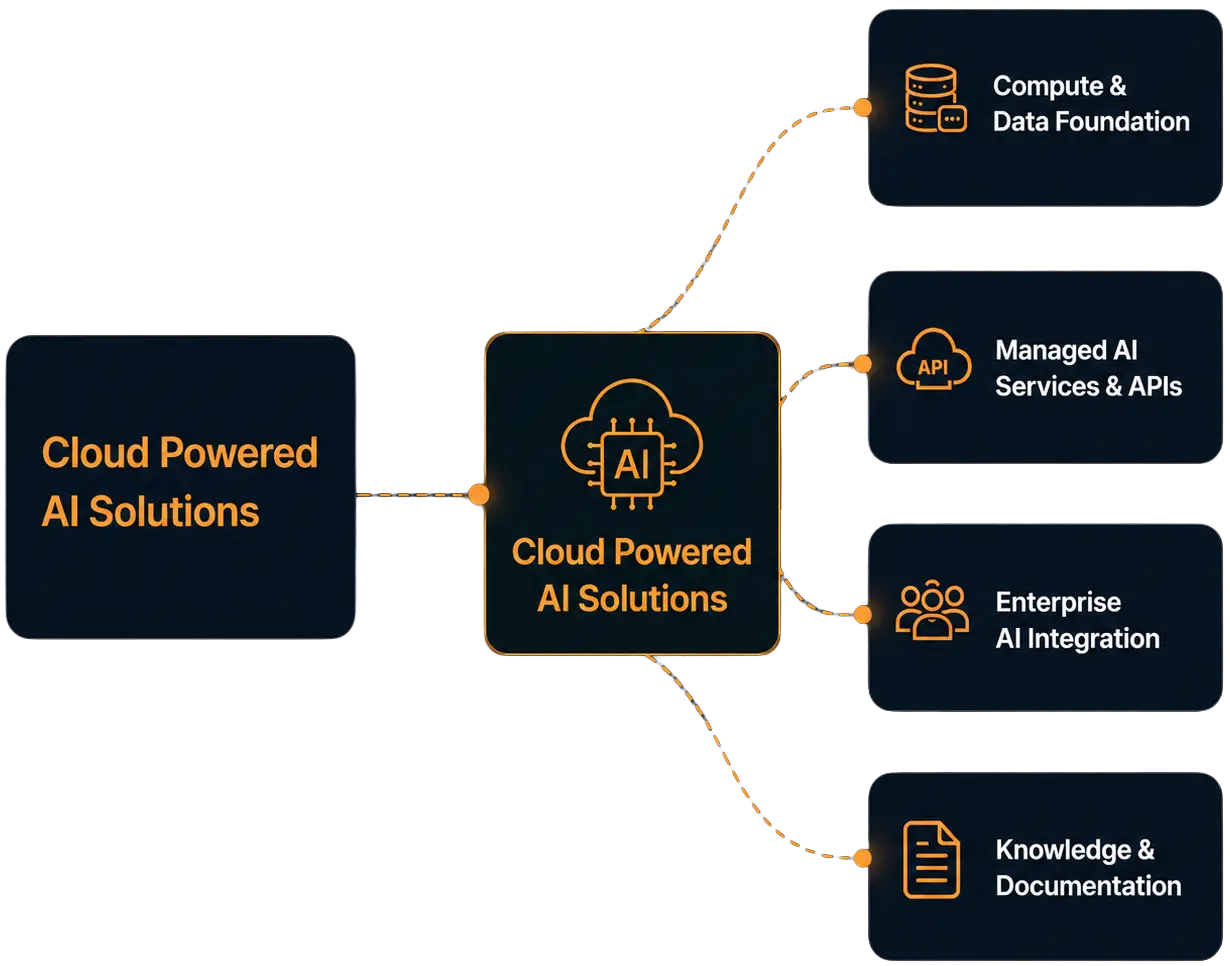
Cloud Powered AI Solutions
Cloud Powered AI Solutions give enterprises the compute, data pipelines, and MLOps foundation to train, deploy, and scale AI without owning a single GPU. Wappnet.ai designs and runs AI infrastructure on AWS, Microsoft Azure, Google Cloud, and Oracle Cloud, so your models go from pilot to production without the six-month procurement cycle or the compliance gaps that stall most enterprise AI initiatives.
What is Cloud Powered AI?
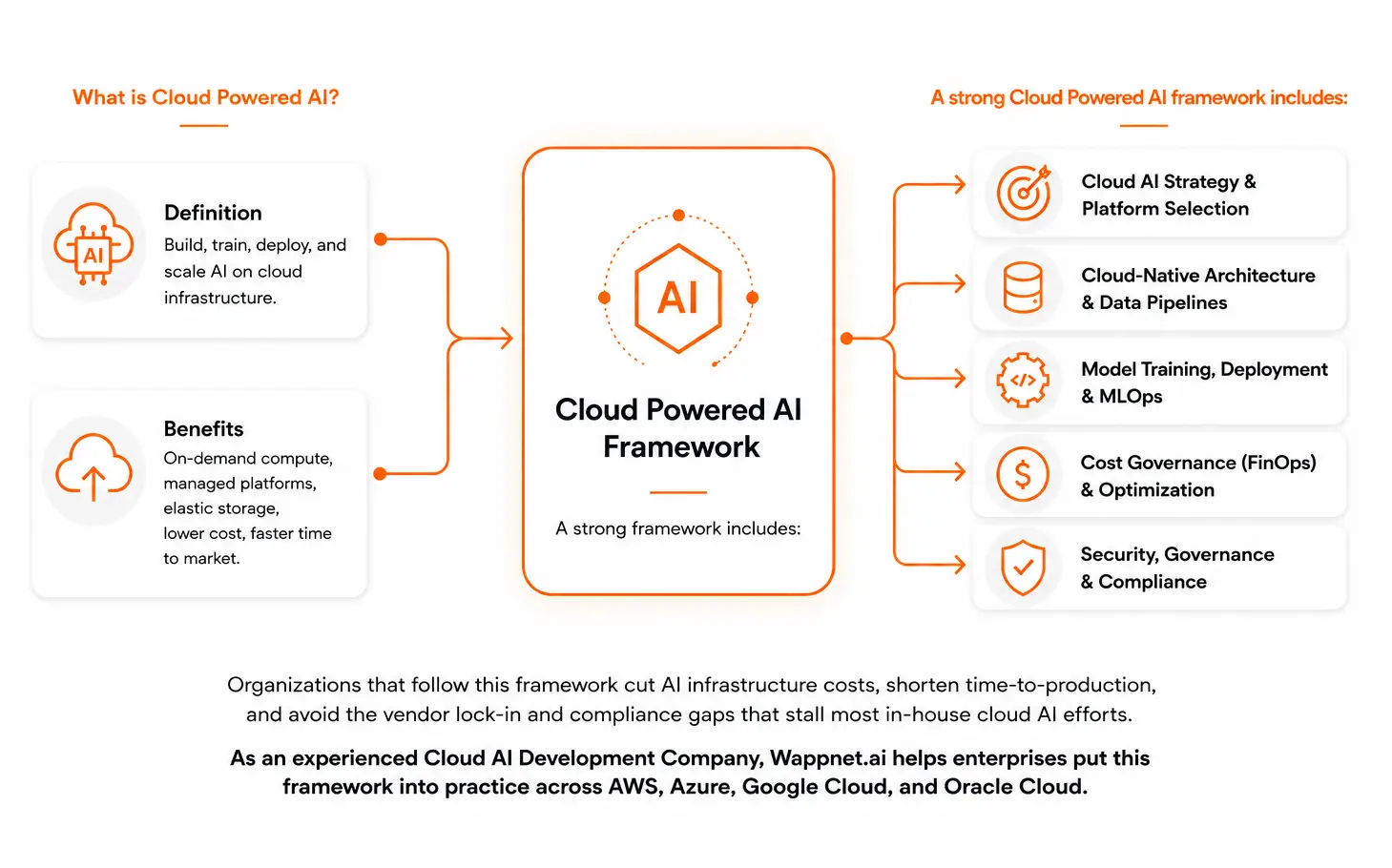
Cloud Powered AI is the practice of building, training, deploying, and scaling artificial intelligence systems on public, private, or hybrid cloud infrastructure instead of on owned, on-premise hardware. It gives enterprises on-demand access to GPU and TPU compute, managed AI/ML platforms, and elastic storage, so teams can move from prototype to production without the capital cost or lead time of buying and maintaining physical infrastructure.
A strong Cloud Powered AI framework includes:
- Cloud AI Strategy & Platform Selection
- Cloud-Native Architecture & Data Pipelines
- Model Training, Deployment & MLOps
- Cost Governance (FinOps) & Optimization
- Security, Governance & Compliance
Why Businesses Need Cloud Powered AI
Scale Without Infrastructure Overhead
Cut Total Cost of Ownership
Accelerate Time-to-Production
Strengthen Security & Compliance
Avoid Vendor Lock-In
Improve Reliability & Disaster Recovery
Our Cloud Powered AI Solutions Services
Cloud AI Strategy & Readiness Consulting
Multi-Cloud & Cloud-Native AI Architecture
AI Model Training & Deployment
MLOps & AI Infrastructure Management
Generative AI & LLM Hosting on Cloud
Cloud AI Migration & Modernization
Cloud Cost Optimization & FinOps for AI
Cloud AI Security, Governance & Compliance
Cloud AI Integration & API Development
How Cloud Powered AI Development Works
Discovery & Cloud Readiness
Cloud Architecture
Data Engineering & Migration
Model Development & Training
Deployment & Integration
Monitoring & FinOps
Cloud Powered AI Use Cases
Healthcare
- Cloud-hosted diagnostic imaging models with elastic compute for peak loads
- HIPAA-aware patient data pipelines across hybrid cloud
Finance & Banking
- Real-time fraud detection scaled through cloud GPU clusters
- Regulatory reporting automation with audit-ready cloud logging
Retail & E-commerce
- Cloud-based demand forecasting that scales with seasonal traffic
- Personalization engines hosted on managed AI platforms
Manufacturing & Logistics
- Predictive maintenance models fed by cloud-connected IoT sensor data
- Supply chain optimization running on elastic cloud compute
Travel & Hospitality
- Dynamic pricing engines hosted on auto-scaling cloud infrastructure
- Multilingual AI chatbots deployed across global cloud regions
Real Estate
- Cloud-hosted property valuation and forecasting models
- Document intelligence pipelines for lease and title processing at scale
Cloud Powered AI vs. On-Premise AI Infrastructure
| Factor | Cloud Powered AI | On-Premise AI Infrastructure |
|---|---|---|
| Upfront Cost | Pay-as-you-go, no hardware purchase | High capital expenditure on GPUs/servers |
| Scalability | Elastic: scale compute up or down on demand | Fixed capacity; scaling requires new hardware |
| Time to Deployment | Days to weeks using managed AI platforms | Months for procurement, setup, and configuration |
| Compute Access | On-demand GPU/TPU access from hyperscalers | Limited to owned hardware and its refresh cycle |
| Maintenance | Provider-managed patching, security, and uptime | Fully owned by internal IT/infrastructure teams |
| Disaster Recovery | Multi-region redundancy built into the platform | Requires separate, self-funded DR infrastructure |
Our Cloud Powered AI Technology Stack
Industries We Serve
Healthcare
- Cloud-hosted clinical AI with HIPAA-aligned data handling
- Elastic compute for imaging and diagnostics workloads
BFSI
- Fraud detection and risk models scaled on cloud GPU clusters
- Compliance-ready audit logging across cloud environments
Retail & E-commerce
- Cloud-native personalization and demand forecasting
- Auto-scaling infrastructure for seasonal traffic spikes
Manufacturing & Logistics
- Cloud-connected predictive maintenance pipelines
- Supply chain optimization on elastic compute
Travel & Hospitality
- Auto-scaling pricing and recommendation engines
- Multi-region cloud deployment for global customer bases
Real Estate
- Cloud-hosted valuation and forecasting models
- Document intelligence pipelines for high-volume transaction processing
Why Choose Wappnet AI for Cloud Powered AI Solutions?
- Multi-cloud fluency across AWS, Azure, Google Cloud & Oracle Cloud
- FinOps built in from day one, not bolted on later
- One team for strategy, architecture, MLOps & security
- Generative AI and LLM hosting under the same engineering team
- Migration built for minimal downtime, not lift-and-shift
- Ongoing monitoring & cost optimization after go-live

Results You Can Expect
Build AI Infrastructure That Scales With You
Frequently Asked Questions
Cloud powered AI solutions are artificial intelligence systems built, trained, and deployed on cloud infrastructure such as AWS, Microsoft Azure, or Google Cloud instead of owned, on-premise hardware. This gives businesses on-demand access to GPU compute, managed AI platforms, and elastic storage without large upfront hardware investment.
Cloud computing supplies the compute, storage, and managed AI/ML services that training and running AI models require, including GPU and TPU access, data pipelines, and pre-built AI APIs. This removes the need to buy and maintain physical infrastructure for AI workloads.
AWS, Microsoft Azure, and Google Cloud all offer mature AI platforms; the right choice depends on your existing infrastructure, compliance requirements, and which generative AI services you plan to use. Many enterprises adopt a multi-cloud strategy rather than committing to a single provider.
Cost depends on workload complexity, data volume, and the cloud services required. Most engagements start with a scoped readiness assessment before a fixed-price or consumption-based proposal, so you know the investment before committing to a full build.
Yes, when implemented correctly. Cloud powered AI solutions can meet GDPR, HIPAA, and SOC 2 requirements through encryption, identity and access management, and audit logging. Security depends on how the architecture and access controls are configured, not just the underlying cloud provider.
Cloud AI runs on provider-managed, elastic infrastructure with pay-as-you-go pricing and fast deployment, while on-premise AI infrastructure requires upfront hardware purchases, fixed capacity, and in-house maintenance. Many enterprises use a hybrid approach, keeping sensitive workloads on-premise while scaling elastic AI workloads on the cloud.
MLOps is the set of practices for deploying, monitoring, and maintaining machine learning models in production on the cloud, including CI/CD pipelines, model registries, and drift detection. It matters because model performance can degrade over time without ongoing monitoring.
FinOps is the practice of forecasting, monitoring, and optimizing cloud spend. For AI workloads specifically, it prevents runaway GPU and compute costs by right-sizing resources and automating scaling policies as usage grows.
Yes. Multi-cloud AI architecture lets you run workloads across AWS, Azure, and Google Cloud simultaneously, reducing dependence on a single vendor and letting you choose the best-fit platform for each specific workload.
Most cloud AI migration projects take 6 to 16 weeks, depending on data volume, the number of models and pipelines being moved, and whether the target architecture is single-cloud, multi-cloud, or hybrid.
Yes. We deploy generative AI and large language models through Amazon Bedrock, Azure OpenAI Service, and Google Vertex AI, paired with retrieval-augmented generation (RAG) and vector databases so responses stay grounded in your current data.
Healthcare, banking and financial services, retail and e-commerce, manufacturing and logistics, travel and hospitality, and real estate benefit most, since these industries handle large data volumes and variable workloads that are expensive to support with fixed, on-premise infrastructure.
Yes. We provide continuous MLOps monitoring, drift detection, performance audits, and FinOps cost reviews after deployment, scoped to match your internal team's capacity, from light-touch monitoring to fully managed operation.
We evaluate your data residency requirements, existing infrastructure, latency needs, and budget, then benchmark AWS, Azure, and Google Cloud against your specific workloads before recommending a single-cloud or multi-cloud architecture.
If your architecture is built cloud-natively with containerization (Docker, Kubernetes) and infrastructure-as-code (Terraform), moving workloads between providers later requires far less rework than a proprietary, single-vendor setup.