Enterprise LLM Development Services
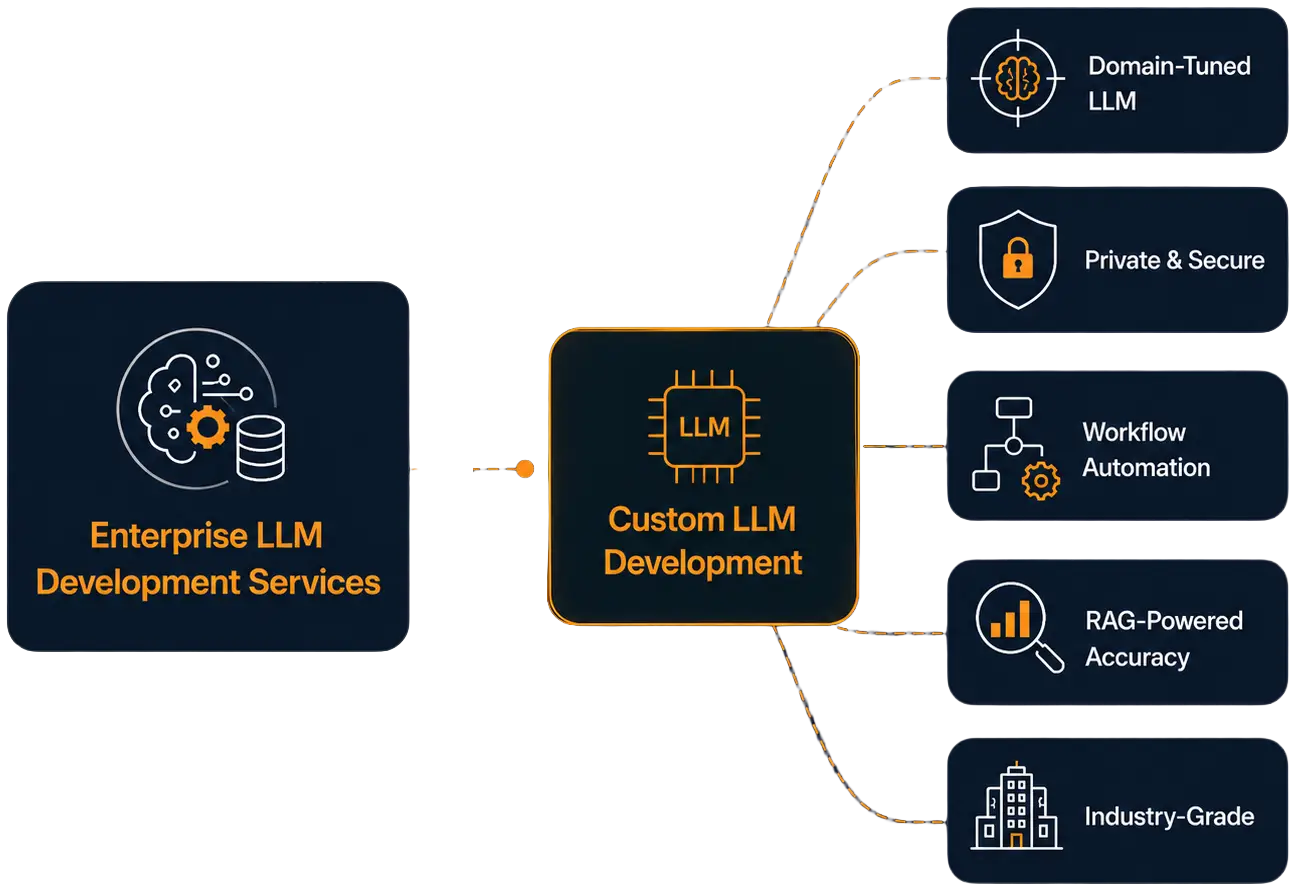
Custom LLM Development turns a general-purpose model into a private, domain-tuned system that understands your business, your data, and your compliance requirements. Enterprises in healthcare, finance, retail, and SaaS trust our LLM Development Company to build fine-tuned, RAG-powered LLMs that automate high-value workflows without exposing proprietary data to public models.
What is LLM Development?
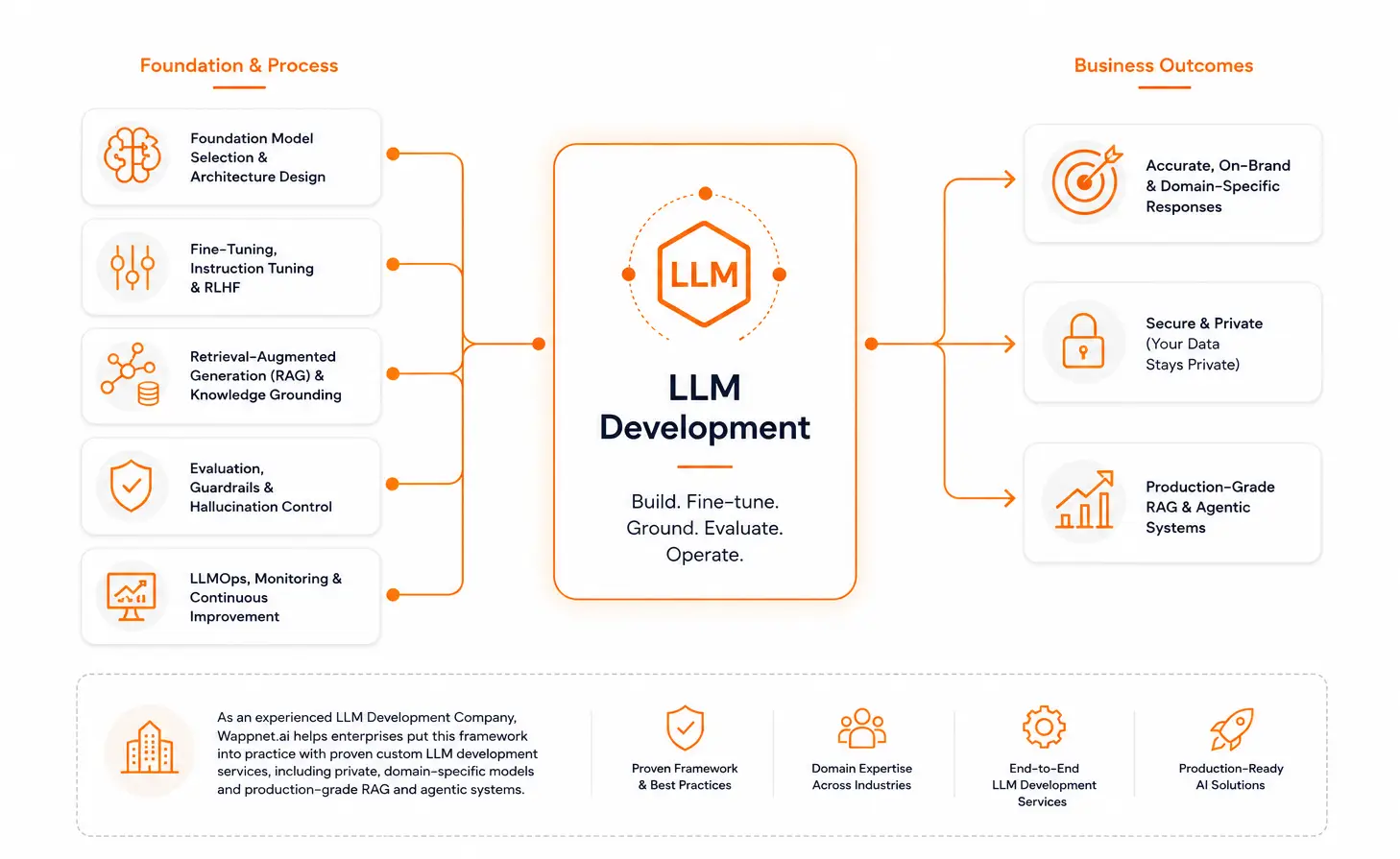
Large Language Model (LLM) Development is the process of building, fine-tuning, and deploying custom AI models that generate accurate, secure, and domain-specific responses using enterprise data, retrieval-augmented generation (RAG), and modern LLMOps practices.
A strong LLM development framework includes:
- Foundation Model Selection & Architecture Design
- Fine-Tuning, Instruction Tuning & RLHF
- Retrieval-Augmented Generation (RAG) & Knowledge Grounding
- Evaluation, Guardrails & Hallucination Control
- LLMOps, Monitoring & Continuous Improvement
Why Businesses Need Custom LLM Development
Reduce Hallucinations
Cut Inference Costs
Protect Proprietary Data
Improve Domain Accuracy
Accelerate Time-to-Market
Ensure Enterprise Compliance
Our LLM Development Services
LLM Strategy & Consulting
Custom & Domain-Specific LLM Development
Fine-Tuning & Instruction Tuning
RAG & Knowledge Integration
Agentic AI & Workflow Automation
LLM Evaluation & Guardrails
LLMOps, Deployment & Monitoring
Model Context Protocol (MCP) Integration
LLM Security, Privacy & Compliance
How LLM Development Works
Discovery & Assessment
Model & Architecture
Data & Fine-Tuning
RAG & Integration
Evaluation & Guardrails
Deploy & Optimize
LLM Development Use Cases
Healthcare
- Clinical documentation summarization
- HIPAA-aware patient support assistants
Finance & Banking
- Automated research and compliance summarization
- Fraud-pattern explanation with explainable outputs
Retail & E-commerce
- Personalized product discovery assistants
- Automated catalog and content generation
Customer Support & SaaS
- Tier-1 support automation with RAG
- Internal knowledge-base copilots for support agents
Legal & Professional Services
- Contract review and clause extraction
- Case research summarization with citations
Insurance
- Claims processing and document summarization
- Underwriting risk-assessment copilots
Custom LLM vs. Off-the-Shelf AI
| Feature | Custom / Fine-Tuned LLM | Off-the-Shelf General AI |
|---|---|---|
| Domain Accuracy | High: trained on your data and terminology | Generic: prone to domain-specific errors |
| Data Privacy | Data stays private, on-premise, or in your VPC | Routed through third-party public APIs |
| Cost at Scale | Optimized token cost with right-sized models | Expensive at high query volume |
| Hallucination Control | RAG, evaluation, and guardrails reduce errors | Limited grounding, higher hallucination risk |
| Compliance Readiness | Built for GDPR, HIPAA, SOC 2, data residency | Limited enterprise compliance controls |
Our LLM Development Technology Stack
Industries We Serve
Healthcare
- Clinical documentation and summarization LLMs
- Patient-facing conversational assistants
BFSI
- Compliance-aware financial copilots
- Fraud and risk explanation models
Retail & E-commerce
- Product discovery and merchandising copilots
- Customer service automation at scale
Manufacturing & Logistics
- Technical documentation Q&A assistants
- Supply chain knowledge copilots
Education & EdTech
- Personalized tutoring and content-generation LLMs
- Automated grading and feedback assistants
Government & Legal
- Policy and document summarization systems
- Citizen-service chatbots with audit trails
Why Choose Wappnet AI for LLM Development?
- End-to-end Enterprise AI Solutions delivery, from strategy to production monitoring
- Deep expertise across GPT, Claude, Gemini, Llama, Mistral, and open-source models
- Fine-tuning, RAG, and agentic AI delivered under one engineering team
- Enterprise-grade security, data privacy, and compliance-ready deployments
- Rigorous evaluation and hallucination-reduction methodology before every launch
- Ongoing LLMOps monitoring and optimization after go-live, not just at delivery

Results You Can Expect
Build a Custom LLM That Works Like Your Business
Frequently Asked Questions
LLM development is the process of building, fine-tuning, and deploying large language models tailored to your business domain. It benefits companies by automating natural-language workflows such as customer support, document summarization, and internal knowledge search with higher accuracy and lower cost than generic AI tools.
We offer LLM strategy and consulting, custom and domain-specific LLM development, fine-tuning and instruction tuning, RAG and knowledge integration, agentic AI and workflow automation, LLM evaluation and guardrails, and LLMOps, deployment, and monitoring.
Fine-tuning updates a model's internal parameters using your training data so it permanently learns your domain's style and knowledge. RAG (retrieval-augmented generation) keeps the base model unchanged and retrieves relevant information from your live data at query time. Most enterprise LLM systems combine both for accuracy and freshness.
Our team works with GPT-5, GPT-4.1, Claude, Gemini, Llama, Mistral, DeepSeek, Qwen, and Phi, along with open-source models. We help you choose the model that best fits your accuracy, cost, and data-privacy requirements.
Yes. We fine-tune models for specific tasks through supervised fine-tuning, instruction tuning, and RLHF, adjusting training data, model parameters, and evaluation criteria until the model reaches the accuracy and behavior your use case requires.
We reduce hallucinations by grounding responses in verified data through RAG, applying guardrails that constrain outputs to approved sources, and running structured evaluation against real business scenarios before and after deployment.
Yes. We support private and on-premise deployment options, encrypted data handling, and access controls so your proprietary data is never exposed to public model providers unless you choose to use their APIs directly.
Yes. We support cloud, on-premise, and hybrid deployment models depending on your data residency, latency, and compliance requirements.
Cost depends on model complexity, data readiness, fine-tuning scope, and integration requirements. Most engagements start with a scoped discovery assessment before a fixed-price or milestone-based proposal.
Most LLM development engagements take 6 to 16 weeks, depending on data preparation, fine-tuning complexity, and the number of systems being integrated through RAG or APIs.
LLMOps is the set of practices for deploying, monitoring, and maintaining LLMs in production. It matters because model performance can drift over time; without monitoring, accuracy and safety can degrade silently after launch.
A standard LLM generates text in response to a single prompt. An agentic AI system uses one or more LLMs to plan, reason, and execute multi-step tasks, such as calling APIs, updating records, or coordinating with other agents, with minimal human intervention.
We provide continuous LLMOps monitoring, drift detection, performance audits, bug fixes, and model updates to keep your LLM system accurate and secure over time.
Healthcare, finance and banking, retail and e-commerce, manufacturing and logistics, education, and government benefit most, since their workflows involve high volumes of domain-specific documents, compliance requirements, and customer interactions.
We evaluate your accuracy requirements, data sensitivity, latency needs, and budget, then benchmark candidate models such as GPT, Claude, Gemini, or Llama against your real use cases before recommending a final architecture.