AI-Powered App Development Services
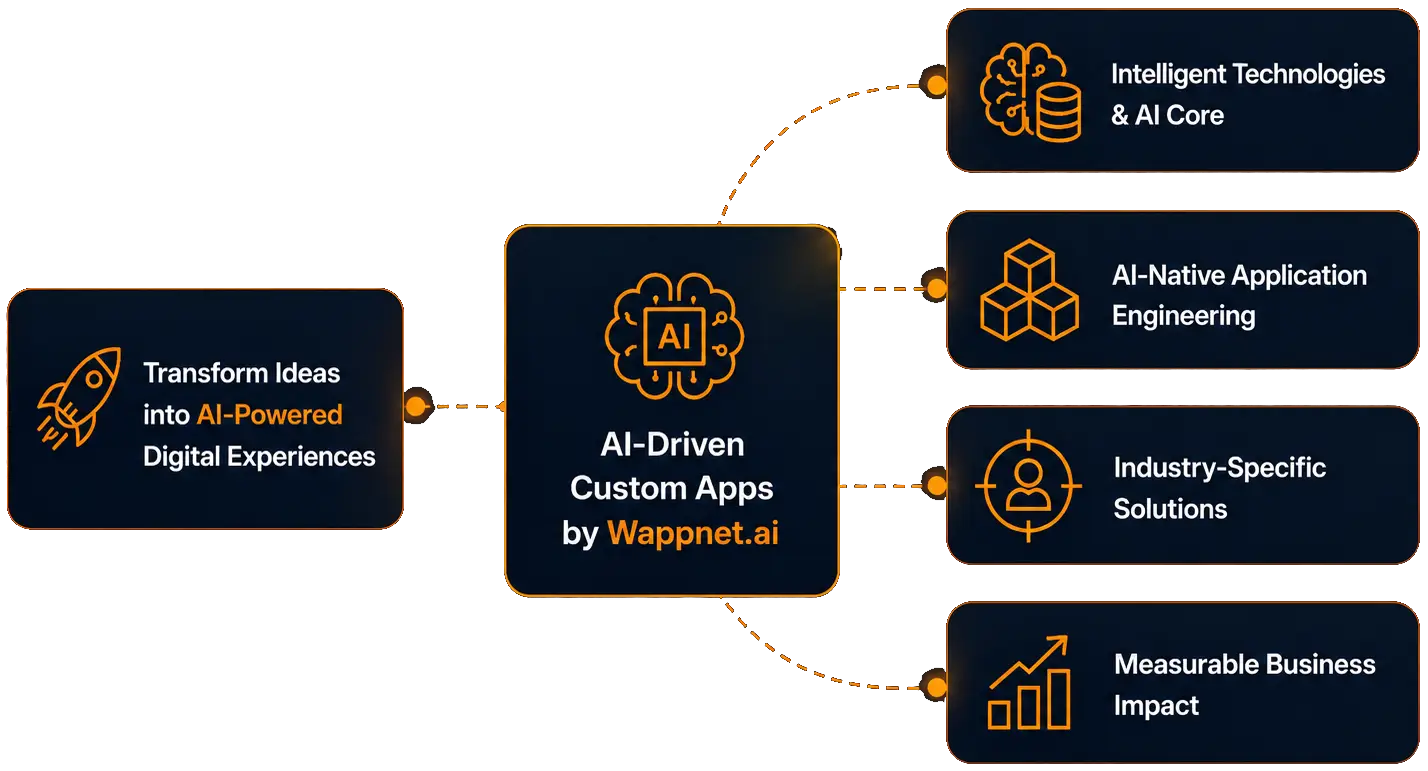
AI-powered app development means building web, mobile, and enterprise applications with machine learning, LLMs, computer vision, and AI agents embedded into the core product experience, not bolted on as an afterthought. As an AI-Powered App Development Company, Wappnet.ai helps businesses in retail, healthcare, finance, and logistics build AI-native apps that compete on personalization, automation, and decision speed.
What Is AI-Powered App Development?
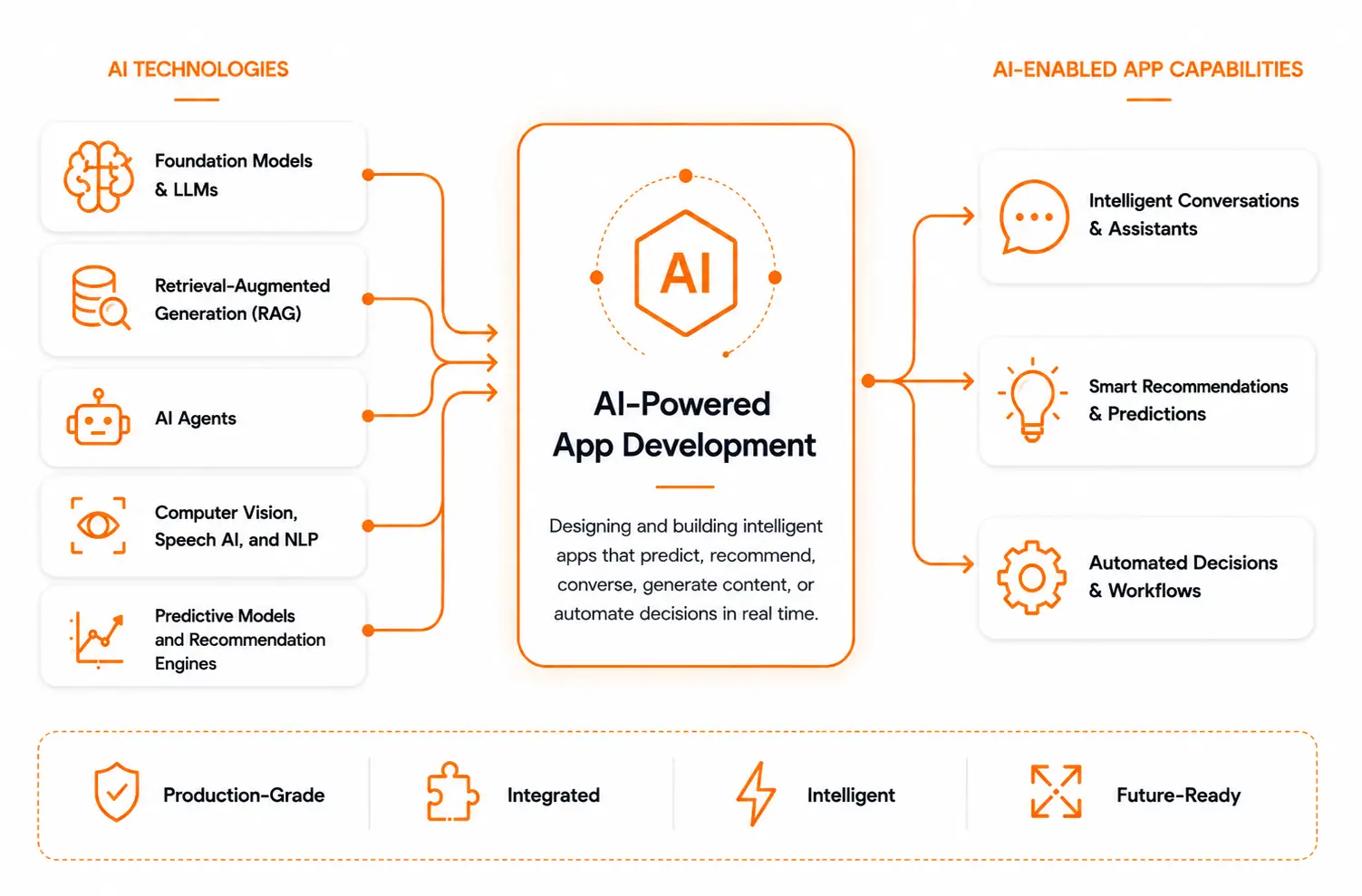
AI-powered app development is the process of designing and building software (web, mobile, or enterprise) that uses artificial intelligence as a core function rather than an add-on, so the app can predict, recommend, converse, generate content, or automate decisions in real time.
A production-grade AI-powered app typically combines:
- Foundation Models & LLMs (GPT, Claude, Gemini, Llama, Mistral, DeepSeek)
- Retrieval-Augmented Generation (RAG) and vector search over your data
- AI agents and multi-agent orchestration
- Computer vision, speech AI, and NLP
- Predictive models and recommendation engines
- MLOps for deployment, monitoring, and improvement
Why Businesses Need AI-Powered Apps
Increase User Engagement
Automate Manual Workflows
Improve Decision Speed
Reduce Operating Costs
Unlock New Revenue Streams
Future-Proof Your Product
Our AI-Powered App Development Services
End-to-End Web & Enterprise App Development
AI Consulting & Solution Architecture
LLM & Generative AI App Integration
AI Agent & Agentic Workflow Development
RAG & Enterprise Knowledge Apps
Computer Vision, NLP & Speech AI
AI Integration, MLOps & Optimization
Custom AI-Powered Mobile App Development
AI App Modernization & Upgrade
How AI-Powered App Development Works
Discovery & Use Case Mapping
Architecture & Model Selection
Data & Integration Planning
Build & Model Integration
Testing & Bias Checks
Deploy & Monitor
AI-Powered App Development Use Cases
Predictive Analytics Apps
- Demand forecasting and churn prediction
- Predictive maintenance alerts
Generative AI Apps
- Content, image, and code generation
- AI copilots embedded in workflows
Conversational AI & AI Agents
- Multi-turn support and sales agents
- Autonomous, agentic workflows
Computer Vision Apps
- Visual search and quality inspection
- Real-time object and anomaly detection
IoT + Edge AI Apps
- On-device inference for low latency
- Real-time sensor data automation
Speech & Voice AI Apps
- Voice assistants and real-time transcription
- Voice-driven search and commands
AI-Powered Apps vs Traditional Apps
| Factor | AI-Powered App | Traditional App |
|---|---|---|
| Personalization | Real-time, model-driven | Static, rule-based |
| Decision-Making | Predictive and automated | Manual and reactive |
| User Interaction | Conversational and agentic | Form-based, linear |
| Data Usage | Continuously learns from new data | Fixed logic, no learning |
| Intelligence at Scale | Improves with more data and usage | Requires manual re-coding |
| Competitive Differentiation | High: built on proprietary data | Low: feature parity is easy to copy |
Traditional apps run on fixed logic that must be manually rewritten as requirements change. AI-powered apps learn from usage and data, improving without a full rebuild.
Technology Stack
Industries We Serve
Healthcare
- AI-powered patient engagement
- Predictive diagnosis support
BFSI
- Fraud detection & risk scoring
- Automated claims workflows
Retail & E-commerce
- Personalized recommendations
- Visual search & forecasting
Manufacturing
- Predictive maintenance
- Quality inspection apps
Real Estate
- AI property valuation
- Lead qualification assistants
Education
- Personalized learning
- Automated grading apps
Why Choose Wappnet AI for AI-Powered App Development?
- End-to-end AI app delivery, from architecture to production monitoring
- Deep bench across LLMs, agentic AI, computer vision, and predictive ML
- Proven integrations with OpenAI, Claude, Gemini, Azure OpenAI, and Bedrock
- Responsible AI practices built into every model
- Flexible options to hire AI app developers on a project, dedicated, or milestone basis
- Post-launch MLOps support and monitoring, not just a one-time build

Results You Can Expect
Turn Your App Idea Into an AI-Native Product
Frequently Asked Questions
AI-powered app development is the process of building web, mobile, or enterprise applications that use machine learning, LLMs, computer vision, or NLP as a core function, so the app can predict, recommend, converse, or automate decisions rather than relying only on fixed logic.
Traditional apps run on fixed, rule-based logic that must be manually updated as requirements change. AI-powered apps use models that learn from data, so personalization, predictions, and automation improve over time without a full rebuild.
Common types include machine learning for predictions, LLMs and generative AI for content and copilots, computer vision for images and video, NLP and speech AI for language and voice, and AI agents for multi-step task automation.
AI app development costs depend on project complexity, AI features, integrations, and customization. We provide a tailored estimate based on your requirements.
A focused AI feature or MVP typically takes 8 to 16 weeks. Enterprise-grade applications with multiple AI models, RAG pipelines, or agentic workflows usually take 4 to 9 months.
Yes. AI features such as recommendations, chat, or predictive alerts can be added through APIs or embedded models, without a full rebuild, as long as the underlying data and infrastructure can support it.
Retrieval-augmented generation (RAG) connects an LLM to your own documents and data through a vector database, so responses are grounded in accurate, current information instead of the model's general training data.
AI agents are AI systems that plan and execute multi-step tasks with limited human input, automating workflows that previously required manual coordination across multiple tools.
The right model depends on the use case, latency and cost requirements, and data privacy needs. GPT and Claude suit general reasoning and content tasks, Gemini integrates well with Google Cloud data, and open-source models like Llama or Mistral suit teams needing self-hosting or tighter data control.
Data safety depends on the deployment model. Enterprise options such as Azure OpenAI Service and Amazon Bedrock keep data within your cloud tenancy and do not use it for model training.
Most AI-powered apps use existing foundation model APIs combined with your own data through RAG or fine-tuning. A custom or fine-tuned model is usually only needed for highly specialized or regulated use cases.
Healthcare, banking and insurance, retail and e-commerce, manufacturing, real estate, education, and legal services see the strongest returns from AI-powered apps.
MLOps is the set of practices for deploying, monitoring, and retraining AI models in production. It matters after launch because model accuracy can drift as real-world data changes.
Wappnet AI combines certified AI developers, proven experience across LLMs, agentic AI, RAG, and computer vision, and responsible AI practices in every build, delivering AI app development services from architecture through post-launch monitoring.