Phone:(+1) 312-698-3083
Email:
info@wappnet.ai
Introduction
Every vendor now claims to sell “AI,” leaving CTOs, founders, and product leaders confused about the real AI agent vs chatbot distinction. The terms get used interchangeably, but the AI chatbot and the AI agent solve different problems and produce different ROI.
Picking the wrong one matters. A scripted chatbot deployed where autonomous decision-making was needed automates very little. A complex AI agent built for a task a simple bot could handle overspends on infrastructure. The right choice shapes your customer experience and automation roadmap.
An AI chatbot follows predefined rules or scripts to answer questions and handle simple conversational tasks. An AI agent uses LLMs to reason, plan, remember context, and execute multi-step actions autonomously, calling tools and systems to complete a goal with minimal human input.
Key Takeaways
- An AI chatbot answers questions using scripts or single-turn LLM responses; an AI agent reasons, plans, and executes multi-step tasks autonomously.
- The core differentiators are memory, autonomous decision-making, and tool usage; chatbots largely lack all three.
- Intelligent AI agents can call APIs, update CRMs, and complete real workflows without constant human input.
- Chatbots remain the better fit for high-volume, low-complexity interactions like FAQs and lead capture.
- Autonomous AI agents deliver the most value in multi-step processes: customer support escalations, sales workflows, HR screening, and finance reconciliation.
- Most enterprises don’t choose one over the other; mature AI automation stacks combine chatbots and agents.
- Gartner projects up to 40% of enterprise applications will include task-specific AI agents by the end of 2026, up from under 5% in 2025.
- Evaluate your automation goals (conversation vs. multi-step execution) before investing in either technology.

14 minute(s) read
July 15, 2026
Table of Contents
What is an AI Chatbot?
An AI chatbot is a conversational program that simulates human dialogue through text or voice. Most chatbots for business run on decision trees, keyword matching, or a generative AI chatbot layer for more natural replies, but they operate within a fixed scope.
How it works: a user sends a message, the chatbot matches intent against a script or trained model, and returns a reply. It cannot act outside that conversation.
Benefits: fast, low-cost deployment for FAQs and lead capture; consistent 24/7 AI customer support for routine questions; easy integration with websites and messaging apps.
Limitations: struggles with multi-step or ambiguous requests, can’t execute cross-system tasks without heavy scripting, and has limited memory of past interactions.
Common use cases: FAQ bots, appointment scheduling, order lookups, and basic conversational AI for lead qualification often marketed as an AI virtual assistant. Many businesses start with a managed AI chatbot development engagement rather than building a bot from scratch in-house.
What is an AI Agent?
An AI agent is a software system, usually LLM-based, that can perceive a goal, plan the steps to reach it, and act autonomously using tools, APIs, and data sources. Building one typically requires more than an out-of-the-box tool; most enterprises pair specialized AI agent development with their internal engineering team to design the reasoning and orchestration layer correctly.
Four capabilities separate intelligent AI agents from chatbots:
- Autonomous decision-making – chooses its own next step based on context
- Memory – retains information across sessions to personalize actions
- Multi-step reasoning – breaks a goal into sub-tasks and executes them in sequence
- Tool usage – calls CRMs, databases, and APIs to complete real work, not just answer questions
Modern autonomous AI agents layer orchestration logic and tool-calling APIs over foundation models like GPT-4 or Claude, the core of real AI workflow automation.
AI Agent vs Chatbot: Key Differences
| Factor | AI Chatbot | AI Agent |
|---|---|---|
| Purpose | Answer questions, guide conversation | Complete tasks and goals autonomously |
| Intelligence | Rule-based or single-turn LLM response | Multi-step reasoning and planning |
| Memory | Minimal or session-only | Persistent, contextual memory |
| Learning capability | Limited, needs retraining | Improves through feedback and context |
| Decision making | Scripted or narrow | Autonomous, context-driven |
| Automation | Conversational only | End-to-end process automation |
| Multi-step tasks | Not supported | Core capability |
| Integrations | Basic (website, messaging) | Deep (CRM, ERP, APIs, databases) |
| Personalization | Generic responses | Context-aware, adaptive |
| Business value | Faster response, lower cost support | Operational efficiency, workflow automation |
When Should You Use a Chatbot?
Chatbots make sense when the interaction is short, predictable, and doesn’t require system-level action. A chatbot for business fits pricing FAQs, lead capture, ticket routing, or appointment confirmations. If a task takes one or two conversational turns, a chatbot delivers the automation you need without the cost of an agentic system.
When Should You Use an AI Agent?
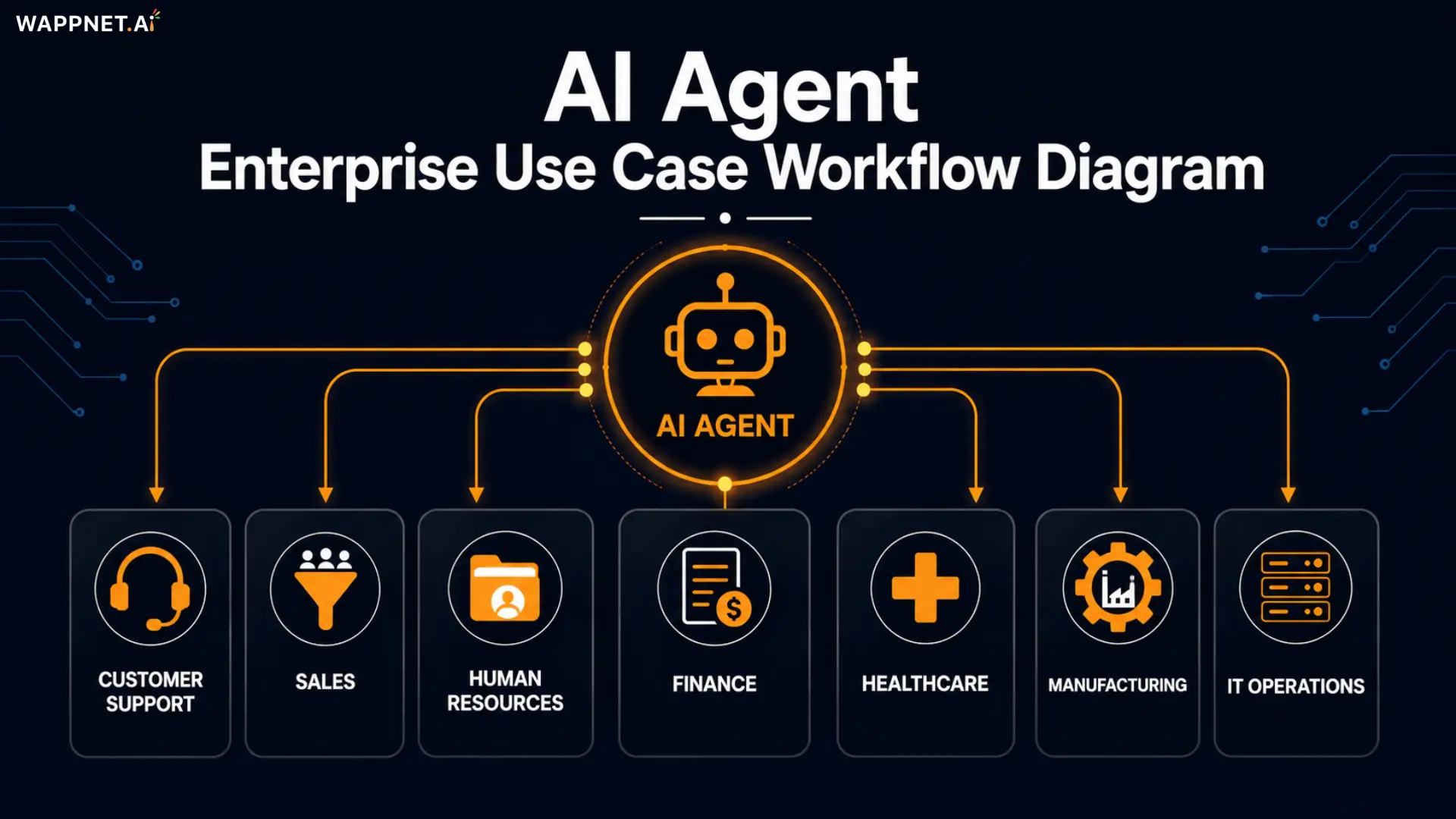
Reach for an AI agent when the task involves multiple steps, decisions, or system integrations. Real-world AI agent examples span every department:
- Customer support – checking order history, applying refunds, updating the CRM
- Sales – qualifying leads, enriching CRM records, scheduling demos
- HR – screening resumes, scheduling interviews, answering policy questions
- Finance – reconciling invoices, flagging anomalies, routing approvals
- Healthcare – scheduling, insurance verification, patient follow-ups
- Manufacturing – monitoring production data, triggering maintenance
- IT Operations – detecting incidents, running diagnostics, remediation
Benefits of AI Agents for Businesses
Enterprise AI solutions built around agents deliver measurable gains: higher productivity through parallel task execution, lower costs from fewer manual handoffs, and faster response times since agents act the moment a trigger occurs. They also improve customer experience, optimize workflows across siloed systems, and scale elastically when paired with cloud-powered AI infrastructure built for variable demand, making AI business automation a durable investment.
Can AI Agents Replace Chatbots?
Not entirely, and for most businesses, that’s not the goal. Chatbots and AI agents typically complement each other: a chatbot serves as the conversational front door, while an AI agent works behind the scenes to execute the resulting task. Mature AI automation stacks use both together.
How Wappnet Helps Businesses Build AI Solutions
Wappnet helps CTOs, founders, and product teams design and deploy the right mix of conversational and agentic AI. Our AI implementation services span custom AI development, AI agent development, and AI chatbot development, backed by experience in enterprise automation and cloud integration.
As an AI software development company, we start with your workflows, not a template, then bring in our AI consulting and development team to connect an agent or chatbot to your CRM, ERP, and internal APIs.

Conclusion
The real difference comes down to autonomy: chatbots converse, agents act. Chatbots remain the right tool for fast, scripted interactions, while AI agents handle complex, multi-step work across systems. Most businesses eventually need both. Read more automation breakdowns on the Wappnet AI blog before deciding.
Looking to build an intelligent AI chatbot or autonomous AI agent? Wappnet AI helps businesses design, develop, and deploy scalable AI solutions tailored to their unique needs.
Ready to Build Your AI Solution?
Whether you need a conversational chatbot, an autonomous AI agent, or both working together, Wappnet AI’s team can help you design, develop, and deploy the right solution for your business.
Frequently Asked Questions
What is the difference between an AI agent and a chatbot?
A chatbot follows scripts or single-turn LLM responses to answer questions and guide conversations. An AI agent uses reasoning, persistent memory, and access to tools to plan and execute multi-step tasks autonomously across systems, going beyond conversation to real workflow execution and decision-making.
Can an AI agent replace a chatbot?
Not fully. They serve different purposes and typically work together rather than compete. A chatbot handles the front-end conversation, while an AI agent executes the resulting task behind the scenes. Most mature enterprise AI stacks combine both technologies instead of replacing one with the other.
Which is better for customer support?
It depends on complexity. Chatbots suit routine FAQs, order status checks, and ticket routing. AI agents are better suited to support requests that require account lookups, refunds, or actions across multiple systems. Many companies deploy both in tiers, escalating complex cases from chatbot to agent.
Are AI agents more expensive than chatbots?
Generally yes, upfront. AI agents require more sophisticated architecture, persistent memory, orchestration logic, and deep system integrations, so development and infrastructure costs run higher than a standard chatbot. However, they often deliver greater long-term automation value and lower operating costs over time.
Can small businesses use AI agents?
Yes. Small businesses can start with a narrow, single-workflow AI agent such as automated lead follow-up, invoice processing, or appointment scheduling rather than a full enterprise deployment. This keeps cost and complexity manageable while still delivering measurable automation benefits.
Kishan Patel
Kishan Patel is the Co-Founder and CTO of Wappnet Systems with over 12 years of experience in technology leadership and product engineering. He leads the company’s engineering strategy, focusing on AI-driven applications, scalable architecture, and modern DevOps. Kishan has built and scaled high-performance platforms across healthcare, fintech, real estate, and retail, delivering secure and scalable solutions aligned with business growth.
Related Post
The Complete Guide to AI Agent Development in 2026
September 07th , 2026

How Much Does It Cost to Build an AI Agent?
August 06th , 2026
AI Agents for Enterprise Automation: Use Cases That Deliver ROI
March 17th , 2026