Phone:(+1) 312-698-3083
Email:
info@wappnet.ai

Introduction
Building a generative AI application in 2026 means making one critical architectural decision early on: should you use RAG vs fine-tuning to give your model the domain knowledge it needs? Both approaches solve the same surface-level problem: making an LLM smarter about your specific data, but they work very differently and serve distinct purposes. Choose the wrong one, and you’ll spend weeks rebuilding.
Retrieval-Augmented Generation (RAG) dynamically fetches relevant documents from an external knowledge base at query time, feeding them into the model’s context window. Fine-tuning, on the other hand, retrains the model’s own weights using domain-specific examples, permanently altering how it thinks and responds. One changes what the model sees; the other changes who the model is.
In this guide, you’ll get a clear, practical breakdown of RAG vs fine-tuning, including key differences, real-world use cases, cost implications, hallucination risks, and a decision framework to help your team choose the right approach (or combination of both) for your AI project.
Key Takeaways
- RAG retrieves knowledge at query time; fine-tuning bakes it permanently into model weights.
- RAG is faster to deploy and update, ideal for dynamic, frequently changing data.
- Fine-tuning is better for consistent tone, format, and stable domain-specific reasoning.
- RAG generally reduces hallucinations better by grounding answers in retrieved, verifiable facts.
- Fine-tuning has higher upfront costs but lower per-query costs at high volumes.
- The RAG market is projected to grow from $1.94B (2025) to $9.86B by 2030 at a 38.4% CAGR.
- Hybrid RAG + fine-tuning architectures are the production standard for enterprise AI in 2026.
- In 2026, frontier models support 1M+ token context windows if your knowledge base fits; full-context prompting may be simpler than RAG.

19 minute(s) read
July 9, 2026
Table of Contents
- What Is Retrieval-Augmented Generation (RAG)?
- What Is Fine-Tuning?
- RAG vs Fine-Tuning: Head-to-Head Comparison
- When to Use RAG vs Fine-Tuning: Use Case Decision Guide
- The Hybrid Approach: RAG + Fine-Tuning in Production
- Cost Comparison: RAG vs Fine-Tuning
- Common Mistakes When Choosing Between RAG and Fine-Tuning
- Conclusion
- Frequently Asked Questions
What Is Retrieval-Augmented Generation (RAG)?
Retrieval-Augmented Generation (RAG) is an AI architecture pattern where an LLM retrieves relevant documents or data chunks from an external knowledge base, typically a vector database, and uses them as context to generate a response. The model itself is not modified; its knowledge is extended at inference time through retrieval.
A typical RAG pipeline works in three steps:
(1) a user submits a query
(2) the system searches a vector store (such as Pinecone, FAISS, Weaviate, or Elasticsearch) for semantically relevant documents
(3) those documents are injected into the LLM’s context window along with the original query, and the model generates a grounded, cited response. Businesses looking to deploy this architecture can leverage a managed RAG as a Service solution to accelerate time-to-production.

Key Advantages of RAG
- Data freshness: Update the knowledge base without retraining the model.
- Source attribution: Responses can cite which document they came from, improving transparency.
- Lower barrier to entry: No GPU compute required; works on top of any hosted LLM API.
- Privacy-friendly: Sensitive data stays in your controlled knowledge base, not in model weights.
- Hallucination reduction: Grounding in retrieved facts significantly reduces fabricated responses.
What Is Fine-Tuning?
Fine-tuning is the process of continuing to train a pre-trained LLM on a curated, domain-specific dataset to update its weights. The model learns new behavioral patterns, terminology, tone, and domain reasoning from the training examples you provide. After fine-tuning, the model responds differently — even without any additional context provided at query time. Wappnet AI’s LLM Development service covers the full fine-tuning lifecycle from dataset preparation to deployment.
Techniques like LoRA (Low-Rank Adaptation), QLoRA, and PEFT (Parameter-Efficient Fine-Tuning) have reduced compute requirements significantly, making fine-tuning more accessible for smaller teams. Still, it requires a well-prepared dataset, compute resources, and careful evaluation to avoid overfitting.
Key Advantages of Fine-Tuning
- Behavioral consistency: The model always responds in the expected tone and format.
- Lower inference latency: No retrieval step means faster responses.
- Domain reasoning: The model internalizes domain logic and terminology, not just facts.
- Reduced prompt engineering overhead: Less work needed to elicit the right behavior at runtime.
- Cost efficiency at scale: High-volume, stable-task scenarios eventually cost less per query without retrieval overhead.
RAG vs Fine-Tuning: Head-to-Head Comparison
| Dimension | RAG | Fine-Tuning |
|---|---|---|
| Core Mechanism | Retrieves external documents at inference time | Updates model weights through training |
| Data Freshness | ✔ High – Update knowledge base anytime | ✘ Low -Requires retraining for new data |
| Setup Time | Hours to days | Days to weeks |
| Upfront Cost | Low (~under $10,000 for basic setup) | Medium -High ($5,000–$50,000+ for GPT-3 class) |
| Per-Query Cost | Higher (retrieval + extended context tokens) | Lower at volume (no retrieval overhead) |
| Hallucination Control | ✔ Strong – Grounded in retrieved facts | ~ Moderate – Depends on training data quality |
| Inference Latency | Higher (retrieval adds a step) | Lower (no retrieval step) |
| Behavioral Consistency | ~ Moderate – Depends on prompt design | ✔ High – Behavior baked into weights |
| Source Attribution | ✔ Yes – Cites retrieved documents | ✘ No – Responses from internal weights |
| Data Privacy | ✔ High – Data stays in controlled KB | ~ Lower – Data embedded in model weights |
| Requires GPU Compute | ✘ No | ✔ Yes |
| Works With Any LLM | ✔ Yes | ~ Depends (open-source models, or paid APIs) |
When to Use RAG vs Fine-Tuning: Use Case Decision Guide
✔ Use RAG When
- Your data changes frequently (product docs, policies, news)
- You need source citations in responses
- You want to keep sensitive data in a private knowledge base
- You’re building AI chatbots for customer support, legal, or medical assistants
- You need rapid deployment without retraining
- You’re working with a hosted LLM API (GPT-4, Claude, Gemini)
- Budget is limited upfront
✔ Use Fine-Tuning When
- You need strict tone, brand voice, or output format
- Domain reasoning patterns are complex and stable
- You’re running high-volume, repetitive, narrow tasks
- Latency is critical (no retrieval step)
- Your knowledge is static and well-curated
- You’re customizing an open-source model (Llama, Mistral) or using OpenAI Model Fine-Tuning
- Training data is available and properly labeled
The Hybrid Approach: RAG + Fine-Tuning in Production
The most capable enterprise AI systems in 2026 don’t choose between RAG vs fine-tuning; they use both, each handling the layer it was designed for.
The division of responsibilities is clean: fine-tuning handles behavior, and RAG handles knowledge. Fine-tune your model on domain terminology, communication style, and output format so it responds consistently and on-brand. Then layer RAG on top to retrieve current, verified information from your knowledge base at query time.

Research from the UC Berkeley RAFT (Retrieval-Augmented Fine-Tuning) study demonstrates that models trained to reason over retrieved documents combining both paradigms outperform either approach alone across multiple benchmarks. This is increasingly the standard for medical, legal, financial, and enterprise AI deployments.
When to Adopt the Hybrid Approach
- Your use case requires both factual accuracy (RAG) and specialized reasoning (fine-tuning)
- You need consistent brand voice while answering questions from a live knowledge base
- High-stakes domains (healthcare, legal, finance) where both hallucination and tone errors are costly
- You’re scaling from prototype to production and your team has ML engineering capacity
Cost Comparison: RAG vs Fine-Tuning
| Cost Factor | RAG | Fine-Tuning |
|---|---|---|
| Initial Setup | Low – under $10,000 for basic pipeline | Medium to High – $5,000–$50,000+ for GPT-3 class models |
| Ongoing Maintenance | Vector DB storage + embedding costs | Retraining costs when data changes |
| Per-Query Cost | Higher – retrieval + longer context tokens | Lower at stable, high-volume workloads |
| GPU Required | No | Yes (or cloud training API) |
| Best ROI Scenario | Low-to-medium volume, dynamic knowledge | High-volume, narrow, stable tasks |
According to SoftwareLogic’s cost analysis, fine-tuning costs range significantly by model; GPT-4o was priced at $25/1M training tokens (OpenAI). Note: as of May 2026, OpenAI has wound down the GPT-4o fine-tuning platform for new users; the current recommended path is GPT-4.1 fine-tuning at ~$3/1M tokens. RAG adds recurring retrieval costs but avoids all upfront training expense. The math favors RAG for early-stage projects and fine-tuning for scaled, specialized workloads.
Common Mistakes When Choosing Between RAG and Fine-Tuning
1. Using fine-tuning for dynamic facts
Fine-tuning cannot keep up with changing information. Teams that try to fine-tune a model on frequently updated data end up in constant retraining cycles.
2. Expecting RAG to fix behavioral issues
If the model gives responses in the wrong tone or format, RAG won’t help. That’s a behavioral problem requiring fine-tuning or prompt engineering.
3. Building RAG before the knowledge base is ready
A poorly chunked or indexed knowledge base will produce irrelevant retrievals and worse hallucinations than no retrieval at all.
4. Ignoring the hybrid option
Many teams treat this as a binary choice. In practice, combining both at the right layer resolves the trade-offs entirely.
Ready to Build Your AI Application the Right Way?
Whether you need a production-grade RAG pipeline, a fine-tuned domain model, or a hybrid AI architecture, Wappnet AI’s AI consulting and development team can help you design, build, and deploy the right solution for your business.
Conclusion
The RAG vs fine-tuning decision is not about which technique is better in absolute terms; it’s about which one is right for your specific use case, data characteristics, and team capabilities.
Use RAG when your knowledge changes frequently, data privacy matters, or you need rapid deployment with source attribution. Use fine-tuning when you need consistent behavior, tone, and domain reasoning baked into the model. And consider the hybrid approach: fine-tuning for behavior, RAG for knowledge when you’re building production-grade AI systems where both accuracy and consistency are non-negotiable.
The enterprise AI landscape in 2026 is firmly hybrid-first. With the RAG market growing at a 38.4% CAGR and practitioners increasingly adopting layered architectures, the teams that understand when and how to combine these tools will consistently outperform those treating it as a binary choice.
If you’re evaluating RAG vs fine-tuning for your next AI project, start with a clear definition of what “smart” means for your model: does it need to know more, or does it need to behave better? That single question will point you to the right architecture.
Frequently Asked Questions
1. What is the main difference between RAG and fine-tuning?
RAG dynamically retrieves external knowledge at query time without changing the model itself, while fine-tuning permanently updates the model’s weights by training on domain-specific data. RAG changes what the model sees; fine-tuning changes how the model behaves.
2. When should I use fine-tuning instead of RAG?
Use fine-tuning when you need to teach the model a specific tone, output format, or domain-specific reasoning pattern; when your data is stable; when you need lower latency; or when you’re running high-volume, repetitive queries where recurring retrieval costs exceed training costs.
3. Does RAG reduce hallucinations better than fine-tuning?
Generally yes, RAG grounds responses in retrieved, verifiable facts from your knowledge base. Fine-tuning can reduce hallucinations in stable domains but cannot reference updated information after training.
4. Is RAG cheaper than fine-tuning?
RAG has lower upfront costs; a basic setup can be implemented for under $10,000 while fine-tuning a GPT-3 class model can cost $5,000 to over $50,000. However, RAG adds recurring retrieval and token costs per query, so at very high volumes, fine-tuning may become more cost-effective over time.
5. Can I use RAG and fine-tuning together?
Yes, and this hybrid approach is the production standard for enterprise AI in 2026. Fine-tune the model for consistent behavior and style, then layer RAG on top for real-time knowledge retrieval. Research confirms hybrid systems outperform either approach alone.
6. Which approach is better for data privacy?
RAG is generally better for data privacy because sensitive documents remain in a controlled, private knowledge base and are retrieved on demand; they are never baked into model weights. Fine-tuning risks embedding proprietary data permanently into the model.
Ankit Patel
Ankit Patel is the visionary CEO at Wappnet, passionately steering the company towards new frontiers in artificial intelligence and technology innovation. With a dynamic background in transformative leadership and strategic foresight, Ankit champions the integration of AI-driven solutions that revolutionize business processes and catalyze growth.
Related Post
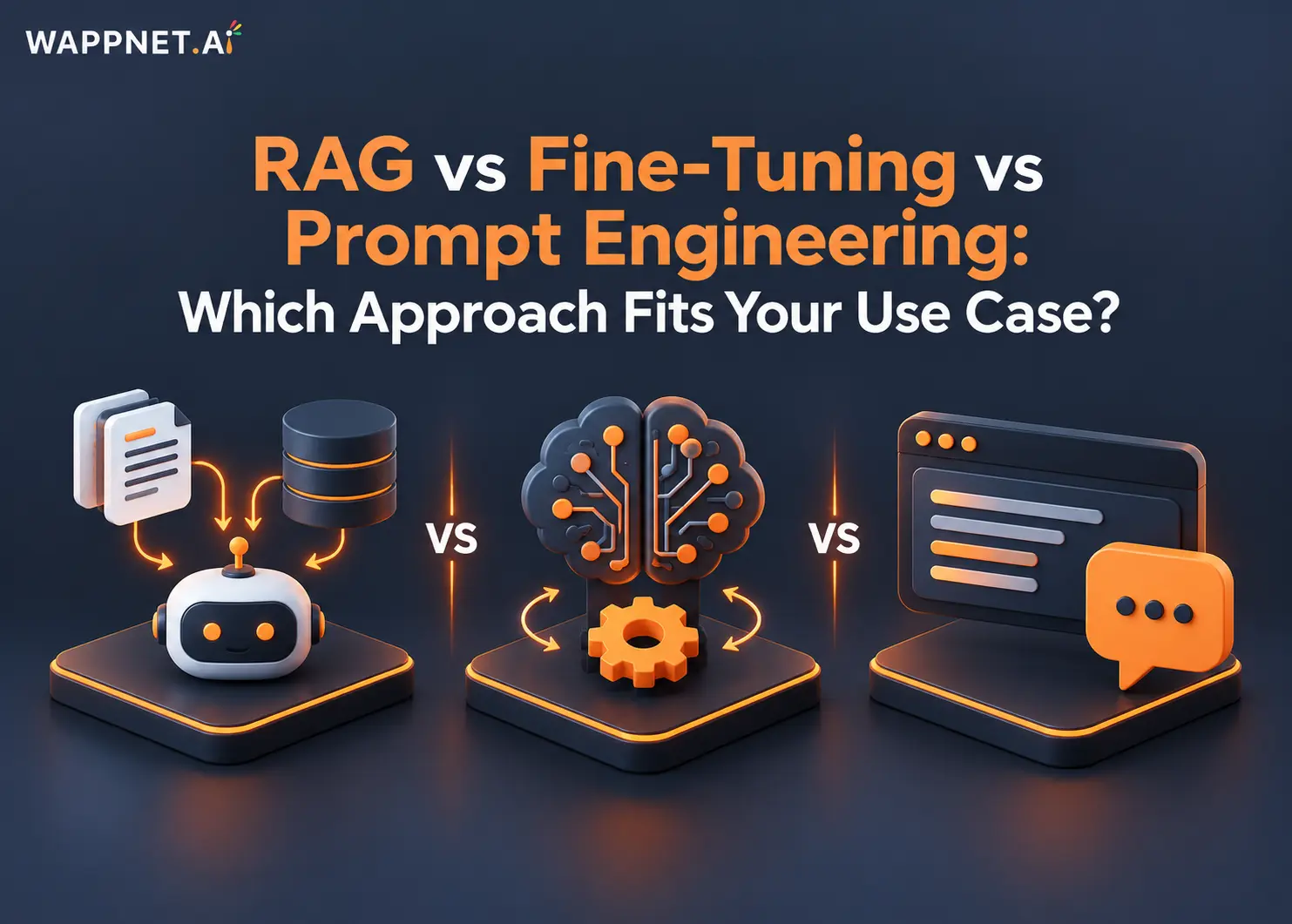
RAG vs Fine-Tuning vs Prompt Engineering: Which Approach Fits Your Use Case?
October 09th , 2026
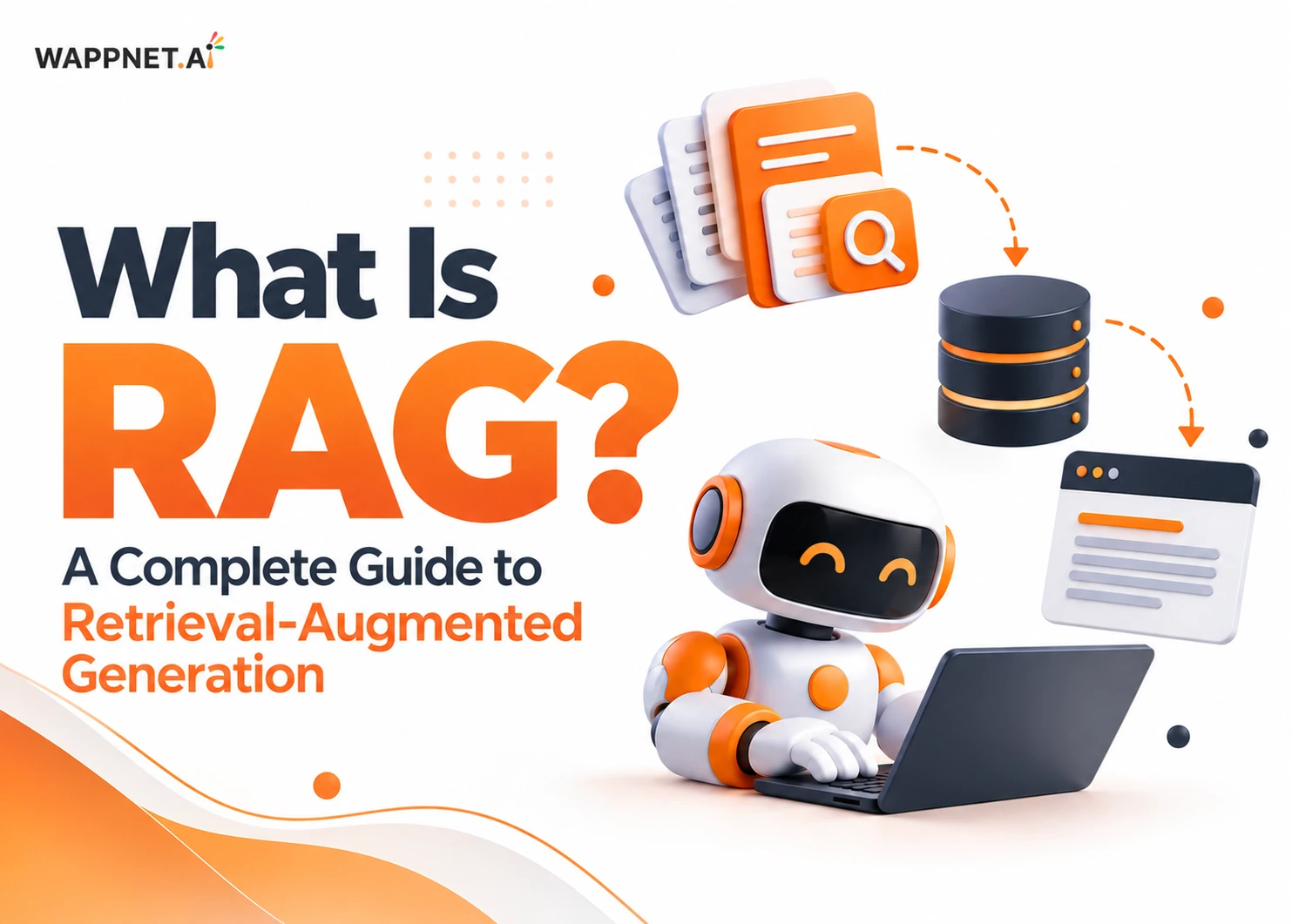
What Is RAG? A Complete Guide to Retrieval-Augmented Generation
September 28th , 2026