
PoC to Production Services
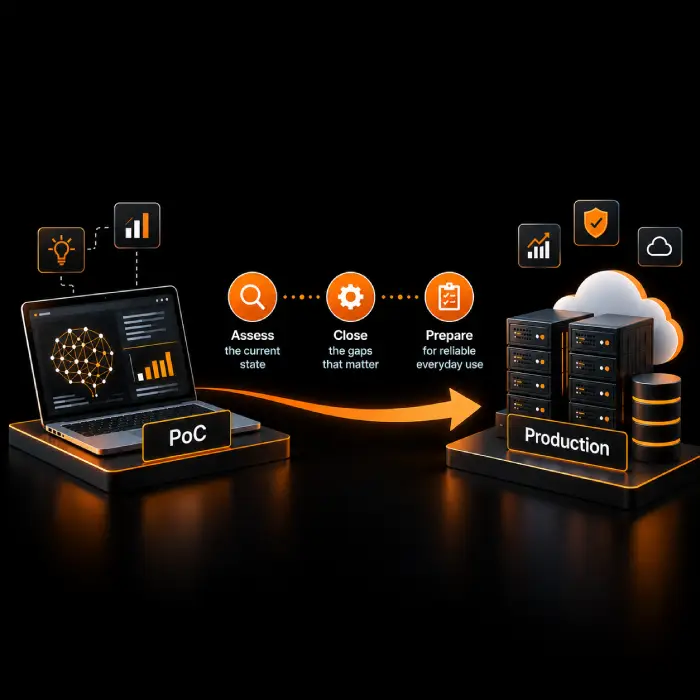
Your AI prototype has shown that the idea works. Our PoC to Production Services help you take it the rest of the way: we assess where it stands, close the gaps that matter, and prepare it for reliable everyday use. Whether you are moving an AI PoC to Production or taking an AI prototype to production, you get a clear view of what it will take before you commit.
What Do PoC to Production Services Include?
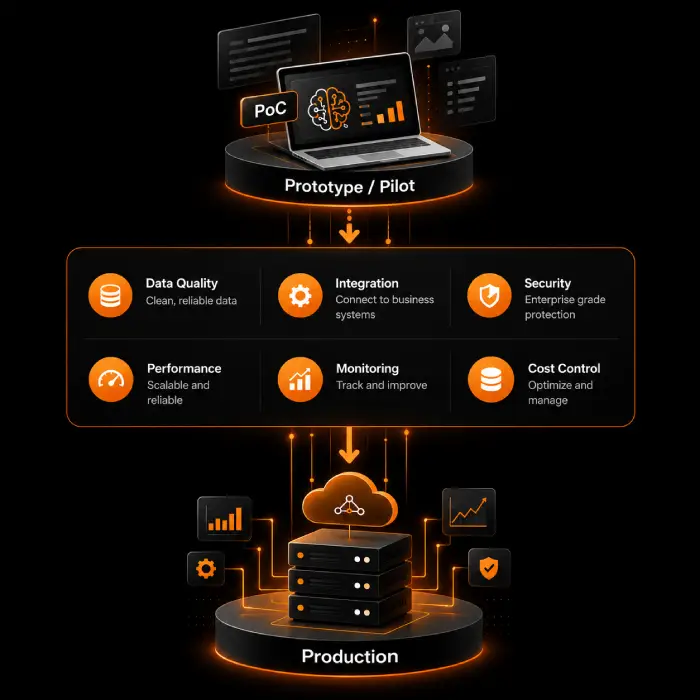
PoC to Production is the work of making an existing AI proof of concept, prototype, or pilot dependable enough for real business use. Our PoC to Production services cover the engineering between a promising demo and a system your business can rely on. AI productionization goes beyond deploying a model. Production adds data quality, integration, security, performance, monitoring, and cost control.
A typical engagement helps you:
- Assess what the existing prototype or pilot proves, and what it does not, through an AI Production Readiness Assessment.
- Define the production requirements and acceptance criteria it must meet.
- Identify technical, data, security, and operational gaps before they surface after launch.
- Strengthen the architecture, data handling, integrations, and testing the solution needs.
- Prepare deployment, monitoring, rollback, and operational handover.
- Reach a clear decision: proceed, rework first, or stop.
Why Businesses Invest in PoC to Production Services
AI rarely stalls because the idea was wrong. It stalls when a working demo meets real data, real systems, and real users. That is when businesses bring in an AI PoC to Production company to close the gap.
Your Prototype Wasn't Built to Run in Production
Notebooks, scripts, and hard-coded settings proved the idea, but they are rarely ready for testing, versioning, or a small pilot growing into daily use.
Your Test Data Doesn't Match Real Data
A clean sample behaves differently from live data with gaps and duplicates. Without a clear test set, nobody can say whether quality is good enough.
It Doesn't Connect to Your Systems Yet
The prototype works alone, but your real workflow needs integration with business applications, plus access control and data rules that experiments often skip.
Cost and Speed Are Unproven at Scale
Cost per request and response time may suit ten testers and fail for ten thousand users, so budgets and performance need checking before launch.
No One Owns It After Launch
Without monitoring, a release process, and a way to roll back, quality drift and failures go unnoticed, and every update feels risky.
PoC to Production Solutions Built for Your Business
Our AI PoC to Production Solutions are scoped to the gaps your prototype actually has, from a single pilot to an enterprise-wide rollout. Activities such as data pipeline work or custom integrations depend on what the assessment finds and are not part of every engagement.
Production-Readiness Assessment
A structured readiness assessment of the prototype against production requirements, producing a gap list and a recommendation on how to proceed.
Architecture Review and Refinement
Reviewing how the prototype is built and recommending the changes needed for reliability, maintainability, and scale.
Data Validation and Pipeline Preparation
Checking the prototype against representative data and preparing the data handling it needs. Larger pipeline builds may involve our Data Engineering team.
Model and Application Evaluation
Measuring output quality against acceptance criteria defined with you, using test sets that reflect real usage.
Functional, Integration, and Performance Testing
Testing the behavior, connections, and responsiveness of the whole system, not only the model.
API and Enterprise System Integration
Connecting the solution to the applications, data sources, and workflows it must operate within.
Security and Access-Control Validation
Reviewing identity, permissions, secrets handling, and data boundaries against the requirements of your environment.
Deployment Preparation
Preparing environments, release steps, and a rollback approach so the first release is a planned event.
Cost and Latency Review
Estimating cost per request and response times at expected volumes, and flagging where the design needs to change.
Monitoring and Logging Setup
Defining what to track, such as errors, latency, cost, and output quality, and setting up the signals and alerts for it.
Release Planning
Choosing an appropriate rollout approach, for example, a limited release before wider use, based on risk.
Documentation and Operational Handover
Runbooks and documentation so your team, or an operations partner, can own the system after launch.
Have an AI Pilot That Needs a Clearer Route to Production?
If you already have a prototype or pilot and are unsure what stands between it and reliable production use, share where it stands today. We offer deployment consulting to help you work out which gaps matter first.
Our PoC to Production Process
The sequence behind our AI PoC to Production Services, adapted to each project. Not every prototype needs every step in the same depth, and the assessment may change the order or the scope.
- 1
Assess the PoC and Define Production Requirements
We review what was built, what it was tested on, and what it actually showed. Then we agree what production-ready means for you: quality thresholds, latency and cost limits, security needs, and failure behavior.
- 2
Identify Technical, Data, Security, and Operational Gaps
We compare the prototype against those criteria and produce a prioritized gap list, including a clear view on whether the project should proceed, be reworked, or stop.
- 3
Refine Architecture, Data Handling, and Integration
We decide what to keep, rework, or rebuild, then prepare the data flows and system connections the solution needs to run on real inputs inside your workflows.
- 4
Test Behavior, Functionality, and Performance
We evaluate model output, application behavior, integrations, and load against the agreed criteria, so readiness is measured, not assumed.
- 5
Prepare and Deploy Through a Controlled Release
We set up the release path, monitoring signals, and a way to reverse changes, then release in a way that matches the risk, such as a limited rollout first.
- 6
Monitor, Improve, and Hand Over
We watch the agreed signals after launch, resolve early issues, and hand over documentation and ownership to the team that will run the system long term.
PoC to Production Services: Use Cases
Situations where an existing prototype needs AI Prototype to Production Services. These are illustrative scenarios, not descriptions of completed Wappnet.ai engagements.
Internal AI Assistant After a Pilot
An assistant that worked well for one team needs company-wide access control, cost visibility, and answer quality checks. We add permission-aware access, evaluation, and monitoring before the wider rollout.
Predictive Model Needing Operational Integration
A model that performed well offline still needs a live data feed and a decision workflow. We connect it to your operational systems and monitor it as the data changes.
Document-Processing Prototype
A prototype that is accurate on sample documents has to cope with varied formats, higher volumes, and exceptions. We test on real documents, route low-confidence results to human review, and check throughput.
AI Feature for a SaaS Product
A feature demo becomes a product feature only once tenant data is separated, releases are safe, and per-request cost is known. We validate it, release it in stages, and track cost inside the product.
Computer Vision Prototype
A model trained on curated images often struggles with real lighting, devices, and edge cases. We test on field data, plan deployment, and set up performance monitoring.
AI Agent Needing Controlled Tool Access
An agent that works in a sandbox needs scoped permissions, approvals, and an audit trail before it touches business tools. We apply access limits and guardrails, informed by our AI Agents & Workflow Automation work.
Knowledge Assistant Built on a Document Set
A retrieval prototype built on sample files needs fresh content, access rules, and answer evaluation to be trusted. We build production-grade ingestion and testing, drawing on Enterprise RAG & Knowledge AI.
Machine Learning Model Awaiting Reliable Deployment
A trained model with no release path needs repeatable deployment, versioning, and monitoring. We prepare it for release, with deeper pipeline work handled by MLOps & AI Infrastructure.
Prototype vs. Pilot vs. Production: What Changes
Maturity stages vary across organizations, and some may skip a stage depending on their goals, resources, and readiness. Use this as a practical guide rather than a universal standard.
Technologies We Use to Build PoC to Production Solutions
The areas that usually need attention in our AI Prototype to Production Solutions, from smaller engagements to Enterprise AI Deployment Services.
Industries We Help With PoC to Production
Why Choose Wappnet AI as Your PoC to Production Company?
You have already invested in an AI prototype. As your PoC to Production Company, Wappnet.ai helps you find out what it will take to make it work reliably in your business, and whether it is worth doing. Our services span AI consulting, generative AI, agents, retrieval, data engineering, and MLOps, so you can work with one team through the whole transition.
Start From What Exists
We review the prototype you already have, including its code, data, and test results, rather than assuming a rebuild.
Clear Production Criteria
We agree acceptance criteria up front, so readiness is something you can check, not an opinion.
A Candid Assessment
If the gaps are large, we say so, and recommend rework, more experimentation, or stopping.
Specialist Depth Available
When a project needs deep work in LLMs, agents, retrieval, data, or MLOps, teams behind those published services can be brought in.
Real-World PoC to Production Solutions We've Delivered
Case studies of experimental AI prototypes transitioned into secure, high-availability production systems.
Hardening an Internal Knowledge Assistant for Enterprise Deployment
Transitioned a Python prototype into a microservice architecture with tenant data isolation, sub-second latency, and role-based permissions.
Productionizing an Automated Claims Triage Pipeline
Re-engineered a vulnerable script pipeline into an automated, fault-tolerant workflow handling 25k daily insurance submissions.
Scaling an Offline Recommendation Model into Live Production
Integrated batch-trained models with real-time streaming APIs, automated rollback routines, and continuous drift monitoring.
Not Sure Your AI Prototype Is Production-Ready?
Tell us where your proof of concept stands today. We will give you a clear read on what an AI Production Readiness Assessment would need to cover first.
Latest AI Insights & Industry Trends
 RAG
RAG vs Fine-Tuning vs Prompt Engineering: Which Approach Fits Your Use Case?
Compare RAG, fine-tuning, and prompt engineering to explore costs, use cases, and the best approach for enterprise AI.
 AI Copilot
What is an AI Copilot? Use Cases & Build Guide
What is an AI Copilot? Learn how it works, how it differs from AI agents, key use cases, and how to build one for your business.
 RAG
What Is RAG? A Complete Guide to Retrieval-Augmented Generation
Learn what RAG is, how Retrieval-Augmented Generation works, reduces AI hallucinations, and powers smarter enterprise AI.
Frequently Asked Questions
PoC to Production means taking an AI proof of concept, prototype, or pilot and making it reliable enough for real business use. It covers assessment, testing, integration, security validation, deployment preparation, and monitoring, not just deploying a model.
A proof of concept shows feasibility, often on limited data, with controlled inputs and a small group of users. Production adds requirements for data quality, integration, security, performance, cost, monitoring, and maintenance that the prototype was never built or tested to meet.
AI PoC to Production services typically include a readiness assessment, acceptance criteria, gap analysis, architecture refinement, evaluation and testing, integration, security validation, deployment and monitoring preparation, and operational handover. Data pipeline or custom integration work depends on what the assessment finds.
Through an AI Production Readiness Assessment: define acceptance criteria for quality, latency, cost, security, and failure behavior, then test the prototype against them using representative data. Reviewing ownership, monitoring, and rollback plans is part of the same exercise.
Often, but not always. The assessment may show that the prototype can be hardened, needs architectural changes, needs more data preparation or experimentation, or should not proceed. If you are moving from AI prototype to production, knowing which of these applies is the first outcome to aim for.
Duration depends on the existing system, technical gaps, data quality, security requirements, and integration complexity, so we do not quote a standard timeline. After launch, the system is monitored against the agreed measures, early issues are addressed, and responsibility passes to a named operational owner.
A prototype tests feasibility, a pilot checks value with a limited group of real users, and production serves all intended users with defined reliability, security, and monitoring. Organizations define these stages differently, so treat them as a guide, not a fixed standard.
AI PoC to Production starts from an existing prototype or pilot and focuses on making it production-ready. AI Product Engineering covers building a complete AI-powered product from discovery through delivery and evolution.
AI Deployment Services focus on releasing a system into an environment. AI Productionization Services cover the wider work needed to make it dependable, including testing, integration, security validation, monitoring, and handover. Many projects need both, and the assessment shows which parts apply.
Look for a provider that reviews your existing prototype before proposing a rebuild, defines acceptance criteria up front, explains how it handles evaluation, security, and monitoring, and will say plainly when a project should not proceed. A good AI Deployment Service Provider or PoC to Production Service Provider also hands over documentation and ownership clearly.