
Forward-Deployed AI Engineers
You know the problem you want AI to solve. Our forward-deployed AI engineers work alongside your team to learn how your business actually runs, then build AI that fits your applications, data, and workflows. You stay involved at every step, and we agree on scope, access, and working location with you up front, on-site or remote. The goal is enterprise AI implementation that works in the environment you already have.
What Do Forward-Deployed AI Engineering Services Include?
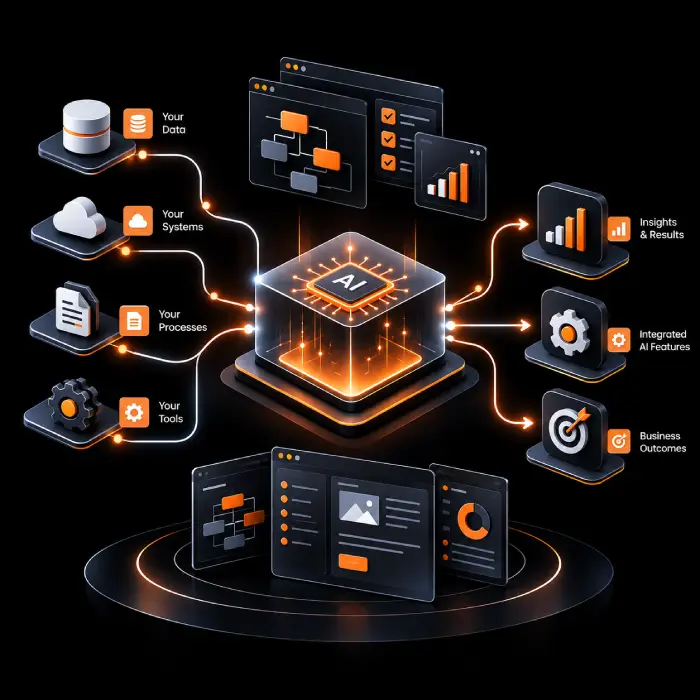
Forward-deployed engineering is a way of delivering software where engineers work close to the customer's people, data, and day-to-day processes instead of far from them. Our forward-deployed AI engineering services apply that approach to AI. Engineers learn your workflow first-hand, build inside your technical environment, and improve the result from real feedback. It describes how the work is delivered, not which AI technology is used, so it suits anything from a language-model feature to AI integration with existing systems.
A typical engagement helps you:
- Understand the real workflow behind the request, not only the written requirement.
- Review the applications, data, access rules, and integration points involved.
- Pick an AI opportunity that fits your environment and team.
- Build with your engineers and business owners through steady AI engineering collaboration.
- Test against real cases, refine from feedback, and document what was built.
Why Businesses Invest in Forward-Deployed AI Engineers
Many teams know which problem they want AI to help with, yet struggle to turn it into something that works inside their business. That gap is where enterprise AI implementation tends to slow down, and why companies look for an AI implementation company that works closely with them.
The Business Need and the Technical Plan Don't Meet
Requirements written in business language are hard to translate into engineering decisions, especially when the translation passes through several hand-offs.
Real Workflows Are Poorly Understood
Documented processes rarely match daily practice. Without seeing the work, AI features solve a tidier problem than the real one.
Applications and Data Sit in Silos
The information AI needs is spread across systems with different owners and access rules, and no single team sees all of it.
Feedback Arrives Too Late
When business and engineering teams meet only at milestones, misunderstandings surface late, and rework follows.
Your Team Needs More AI Depth
Your engineers know your systems well but may have little capacity for AI work, and a generic solution rarely fits your environment unchanged.
Forward-Deployed AI Engineering Solutions Built for Your Business
Our forward-deployed AI engineering solutions are the activities that make up the collaboration, and together they form our enterprise AI implementation solutions.
Business Workflow Discovery
Working with the people who run the process to see how work actually happens and where AI could help.
Requirements Clarification
Turning goals into specific, testable requirements, and revisiting them as understanding grows.
Technical Environment Assessment
Reviewing applications, APIs, data sources, and constraints that decide what is practical.
AI Use-Case Identification
Choosing the opportunity that fits your data and risk tolerance, including saying when AI is not the right tool.
Architecture and Integration Planning
Designing how the AI component connects to your systems, who owns each part, and what the first release covers.
AI Application Implementation
Building the capability alongside your team, within your engineering standards and review practices.
Integration with Business Systems
Connecting the solution to the applications and data your workflow depends on, using access you approve.
Iterative Testing and Refinement
Testing against real cases and adjusting in short cycles as users respond.
Work With Internal Teams
Collaborating through your engineers, product owners, and stakeholders so decisions stay close to the people affected.
Access and Data-Handling Alignment
Agreeing which systems and data engineers can reach, and under what controls, before work begins.
Feedback Capture and Prioritization
Collecting user feedback and turning it into a ranked list of changes.
Documentation and Knowledge Transfer
Records of decisions, integrations, and operating notes so your team can run and extend the work.
Need Engineers Who Work Close to Your Business?
If you know the problem but not yet how to build AI into your systems and workflows, tell us about it. We will talk through whether close collaboration is the right fit and what a first scope could look like.
Our Forward-Deployed AI Engineering Process
A typical sequence, adapted to each project. Roles, working location, and access depend on your requirements, and we never assume engineers are onsite or permanently embedded.
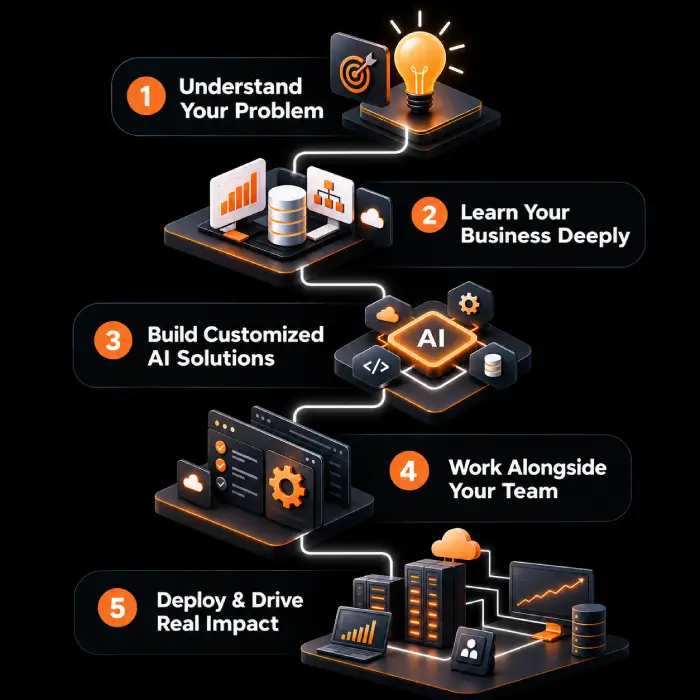
- 1
Understand Goals and Operational Challenges
We talk with the people who own the outcome and the people who do the work to learn what success means and what gets in the way today.
- 2
Review Systems, Workflows, and Constraints
We look at the applications, data, access rules, and technical limits involved, so proposals are grounded in your real environment.
- 3
Agree Scope, Roles, Access, and Success Criteria
We choose an implementation opportunity and define who does what, which systems engineers can reach, and how you will judge the result.
- 4
Design and Build Together
Engineers work with your technical and business contacts in short cycles, building inside your environment and sharing progress early.
- 5
Test Against Real Workflow Requirements
We evaluate the solution with real cases and users, then gather feedback on what works, what confuses, and what is missing.
- 6
Refine, Document, and Hand Over
We act on feedback, record how everything works, and agree whether ownership passes to your team or the collaboration continues.
Forward-Deployed AI Engineering Services: Use Cases
Situations where close collaboration helps most, with what you can measure. These are illustrative scenarios, not descriptions of completed Wappnet.ai engagements, and results depend on your data and team.
AI Inside an Existing Enterprise Application
Users already rely on the software. Engineers work within its codebase and release process. You can track adoption and defect rates.
AI Workflow Implementation
A multi-step process depends on manual hand-offs. Engineers learn the exceptions with the process owners. You can track cycle time and exception handling.
Intelligent Features for a Software Product
A product team lacks AI capacity. Engineers build beside them and share knowledge. You can track feature quality and how well the team can maintain it.
Connecting AI to Internal Business Systems
Useful data sits in separate systems. Engineers work with system owners on access and integration. You can track integration test results and data coverage.
Adapting AI to Domain-Specific Requirements
A general model misses your terminology and rules. Engineers adapt it with your domain experts. You can track accuracy on your own test cases.
Improving an Implementation From User Feedback
A first release is live but underused. Engineers watch real use and prioritize fixes. You can track task completion and stakeholder acceptance.
AI-Enabled Operational Tools
Operations staff need a tool shaped to their routine. Engineers co-design it with them. You can track adoption and reduced rework.
Removing Barriers to Enterprise AI Adoption
Identity, data quality, or legacy interfaces block progress. Engineers work through each constraint with your IT team. You can track which blockers have been cleared.
Forward-Deployed Engineers vs. Consulting vs. Staff Augmentation
These models overlap, and real responsibilities follow the engagement agreement. None is always better, so the right choice depends on your problem and your team.
Technologies We Use for Forward-Deployed AI Engineering
Our engineers tailor applied AI engineering and AI solution deployment to your systems, project goals, and infrastructure, from implementation to handover.
Industries We Help With Forward-Deployed AI Engineering
Why Choose Wappnet AI as Your Forward-Deployed AI Engineering Company?
As an enterprise AI engineering company and forward-deployed engineering partner, we pair this working style with published services in AI consulting, generative AI, LLM development, agents, retrieval, data engineering, and MLOps. You can reach the right depth without managing several vendors.
A Broad Published AI Range
Specialist teams behind our published services can join when a project needs depth in one area.
Remote-Capable Collaboration
Our Hire AI Developers service supports remote collaboration through time-zone alignment, regular communication, and standard collaboration tools.
Clear Roles and Access Upfront
We agree on responsibilities, access, and success criteria before building, so expectations are shared.
Built Around Your Goals
We start from the outcome you want to measure, not from a fixed package.
Real-World Forward-Deployed AI Engineer Solutions We've Delivered
Case studies of cross-functional AI engineering delivered directly inside enterprise production environments.
Co-Engineering an AI Underwriting Engine with FinTech Teams
Forward-deployed engineers worked alongside client domain experts to build and deploy a compliant, auditable risk scoring model directly into their core banking platform.
Integrating Custom LLM Workflows into Global Supply Chain Operations
Partnered with logistics operators to identify bottlenecks and engineer real-time exception-handling agents within existing ERP systems.
Accelerating Enterprise SaaS AI Roadmap in 90 Days
Embedded an AI engineering pod with a SaaS engineering organization, delivering multimodal search and document synthesis features while upskilling the internal team.
Not Sure This Model Fits Your Challenge?
Tell us what you want to achieve and which systems are involved. As your AI engineering service provider, we will help you decide whether forward-deployed AI engineers, a consulting engagement, or added developer capacity is the better first step.
Latest AI Insights & Industry Trends
 RAG
RAG vs Fine-Tuning vs Prompt Engineering: Which Approach Fits Your Use Case?
Compare RAG, fine-tuning, and prompt engineering to explore costs, use cases, and the best approach for enterprise AI.
 AI Copilot
What is an AI Copilot? Use Cases & Build Guide
What is an AI Copilot? Learn how it works, how it differs from AI agents, key use cases, and how to build one for your business.
 RAG
What Is RAG? A Complete Guide to Retrieval-Augmented Generation
Learn what RAG is, how Retrieval-Augmented Generation works, reduces AI hallucinations, and powers smarter enterprise AI.
Frequently Asked Questions
Forward-deployed AI engineers are engineers who work closely with a customer's teams to understand real business workflows and build AI that fits the customer's systems. They combine AI engineering with direct collaboration, feedback, and iteration inside the customer's environment.
They learn the workflow from the people who run it, agree requirements and success criteria with them, then build in short cycles while collecting feedback. Your engineers and business owners stay involved in decisions throughout.
Staff augmentation adds capacity to a team that already knows what to build. Forward-deployed engineering focuses on understanding your workflows and fitting a solution to them, often with shared ownership of the outcome. The two can overlap, and responsibilities follow the agreement.
Consulting usually centers on assessment and recommendations. Forward-deployed AI engineering centers on building and refining a working implementation alongside your team. Some projects begin with consulting and move into build work, so the two are not exclusive.
Yes, that is a core purpose of the model. Engineers review your applications, data, and constraints first, then design AI integration with existing systems using only the access you approve. What is feasible depends on your interfaces, data quality, and security requirements.
Consider them when fitting AI into your real workflows and systems is the hard part, or when your team needs hands-on AI engineering alongside it. If you only need added capacity or a recommendation, another model may suit you better. When comparing any forward-deployed AI engineering partner, ask how access, ownership, and handover will be agreed.
Not necessarily. Onsite work, remote work, or a mix is agreed per project, along with system access, responsibilities, and data handling. Many collaborations run inside your tools and under your security policies.