
EU AI Act Compliance Services
Not sure which of your AI systems the EU AI Act reaches, which role you play, or who owns the answer? Our EU AI Act compliance services help you take inventory, classify AI systems, find governance and documentation gaps, and plan the measures that apply to you, with readiness and implementation support rather than legal advice or certification. We work with technology, risk, compliance and legal teams together, so engineering and governance reach the same answer. You come away with a clear AI inventory, a prioritized roadmap and a practical view of what to tackle first.
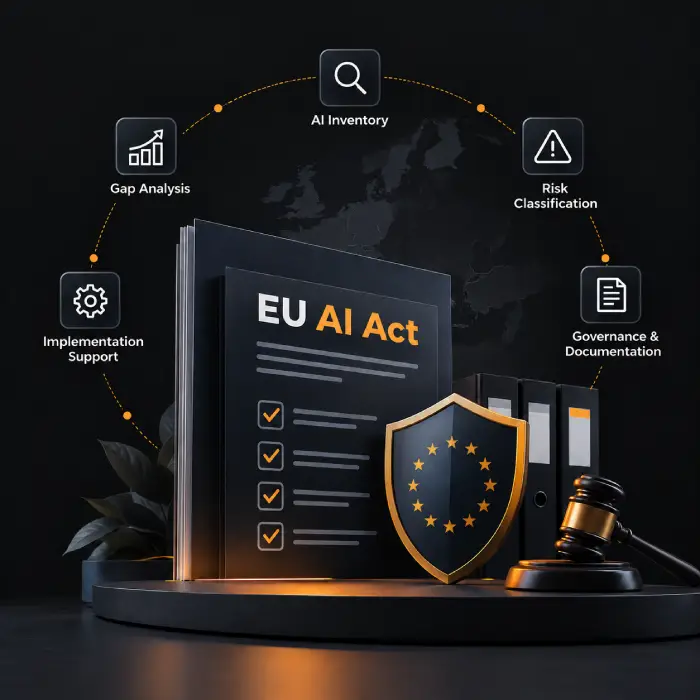

What Do EU AI Act Compliance Services Include?
EU AI Act compliance means meeting the obligations that Regulation (EU) 2024/1689 places on organizations that develop, supply, or use AI systems, to the extent those obligations apply to their role, their systems, and the risk category of each system. Our EU AI Act compliance consulting for enterprises turns that into practical work: finding out what applies, measuring where you stand, and planning what to change. What you need depends on your systems, your legal role, and your existing controls.
Our services cover the full path from applicability assessment to ongoing governance:
- We establish applicability and your role in the AI value chain through EU AI Act readiness assessment and other readiness assessment services.
- We build an AI inventory and run AI system classification against the Act's risk categories, including high-risk AI system compliance checks.
- We run an EU AI Act gap assessment (EU AI Act compliance gap analysis) against the requirements that may apply to each system.
- We provide AI risk assessment services and risk assessment and documentation support, including AI technical documentation.
- We plan transparency, human oversight, and data governance, and deliver AI regulatory compliance services that fit your existing risk and compliance workflows.
- We support AI policies and AI literacy, and hand over a prioritized roadmap. Where you need a legal opinion or a formal conformity assessment, we say so.
Why Businesses Invest in EU AI Act Compliance Services
Most organizations use more AI than their records show, and the Act's duties depend on your role and use case. The right support turns "we think this applies" into a clear, practical plan. It does not remove regulatory risk or legal liability.
Clarity on Potential Obligations
Understand which provisions may apply to which system, instead of assuming one program fits all.
Earlier Sight of Governance Gaps
Build one inventory of the AI you build, buy, and embed, then find missing owners, records, and review steps while there is time to fix them.
Defined Responsibilities
Assign who owns classification, documentation, oversight, and incident handling across legal, risk, security, and engineering.
Better Risk and Oversight Processes
Build testing, review, and escalation into delivery so evidence is created as work happens.
A Plan You Can Sequence
Turn findings into a prioritized roadmap linked to the dates that apply to your systems.
EU AI Act Compliance Solutions for Your Business
Whether you're identifying your AI systems, assessing regulatory obligations, or preparing documentation for high-risk AI systems, Wappnet.ai offers EU AI Act compliance solutions tailored to your needs. Choose the support that matches your current compliance stage or combine solutions to build a comprehensive approach.
AI Compliance Readiness Assessment
A first review for leaders who are unsure how far the Act reaches. We map your roles and AI systems and give you a readiness report with a preliminary classification and a prioritized list of gaps.
AI Risk Classification and Inventory
For teams that cannot yet list every AI system, including features built into third-party software. We build a maintained inventory and record why each system was classified as it was, ready for your counsel to review.
High-Risk AI Governance Support
For providers and deployers of systems that may be high-risk. We design how risk management, human oversight, and logging will work, and show where you stand against each requirement before the applicable date.
AI Documentation and Evidence Management
When records are scattered across teams, we create documentation templates, an evidence log, and an update routine tied to your releases, so proof is produced as the work happens.
Responsible AI Governance Framework
Good practice that supports compliance. We set up AI policies, owners, and review gates so decisions are consistent. See our AI governance consulting.
AI Compliance Gap Remediation
Findings only help if they are fixed. We turn your gap list into a backlog with owners and support the engineering work as part of our AI compliance implementation services and EU AI Act implementation support for businesses.
AI Transparency and Oversight Planning
For teams shipping chatbots, generated content or decision support. We plan how users are told they are dealing with AI and how a person can review or override an output, with acceptance tests to match.
Ongoing AI Governance and Monitoring
Good practice for live AI. We set a monitoring plan, review rhythm, and incident workflow so drift and change do not go unnoticed. Post-market monitoring is a specific duty for providers of high-risk systems.
General-Purpose AI Model Review
If you build on or supply a general-purpose AI model, your role can be unclear. We analyze whether you are a provider or a downstream user and prepare a documentation checklist for your counsel to review.
Understand Your EU AI Act Readiness Before Your Next AI Deployment
Tell us which AI systems you build, buy, or deploy and where they are used. Our EU AI Act compliance services start with an honest view of what may apply and what it would take.
Our EU AI Act Compliance Process
Our EU AI Act compliance process helps your organization identify AI systems, assess applicable requirements, document risks, and maintain up-to-date compliance records. We tailor each step to your AI systems, regulatory responsibilities, and existing controls. The process supports your compliance efforts, but completing these steps alone does not guarantee compliance.
- 1
Business and AI System Discovery
We talk to the teams that build, buy and use AI, walk through the systems and check vendors and unofficial tools. The result is a single inventory of your AI.
- 2
Regulatory Applicability and Role Assessment
We work out whether the Act may apply and whether you act as a provider, a deployer or both, including your EU exposure and any general-purpose AI use. Legal conclusions are left to your counsel.
- 3
AI System Risk Classification and Gap Analysis
We check each system for prohibited practices, transparency duties and high-risk criteria, then compare your current controls with the requirements that may apply. You receive a classification record and a gap report.
- 4
Governance, Documentation and Technical Review
We examine risk management, data governance, human oversight, logging, testing and validation, along with security and privacy touchpoints, and report findings against each requirement.
- 5
Remediation Roadmap and Implementation Planning
We rank the work by system, applicable date and effort, assign owners and plan delivery, so your teams know what to fix first and who is responsible.
- 6
Ongoing Governance and Readiness Review
We set up monitoring, change management, and a review calendar, so your records are updated when systems, guidance, or dates change.
EU AI Act Compliance: Business Use Cases
Organizations that develop, purchase, integrate, or deploy AI may face different EU AI Act obligations depending on their role and how each system is used. Explore common business scenarios where an assessment can help identify applicable requirements, potential risks, and the compliance steps to consider. Each AI system should be assessed based on its specific purpose and context.
Assessing an Enterprise AI Portfolio
Many teams use AI tools, but nobody holds a single list. We inventory and classify the systems, so you can see which ones need closer review first.
Reviewing an AI Customer Service System
A chatbot answers customers on your behalf. We check that people are told they are talking to AI and that a human can take over when needed.
Evaluating an AI Recruitment Workflow
Screening and ranking tools may count as high-risk, depending on what they do. We test the classification, the human oversight, and the bias checks, and your counsel confirms the result.
Reviewing an AI Decision-Support Application
Staff rely on model scores when making decisions. We review how clearly results are explained, how people can challenge them, and what is logged.
Assessing AI in Financial Services
Models support credit, fraud, and customer work, and only some uses may be high-risk. We separate them by use case and note the financial rules that also apply.
Evaluating AI-Enabled Healthcare Workflows
Tools that support triage or clinical notes may also fall under medical product rules. We map the route through the Act and sector rules with your regulatory specialists.
Reviewing AI Features in Enterprise Software
A software vendor adds AI to a tool you already use. We clarify your duties as a deployer and prepare the questions to put to the vendor.
Assessing a General-Purpose AI Integration
Your product calls an external model through an API. We work out who is the provider of what, and which duties pass to you.
Governing Internally Built AI Tools
Teams build their own assistants and automations. We add a light process for intake, risk review, and documentation that fits how you already deliver.
Preparing Documentation for High-Risk Requirements
A provider needs its evidence ready before the applicable date. We structure the technical documentation and testing records, then pass the draft to counsel for review.
AI Governance vs. EU AI Act Compliance vs. Responsible AI
AI governance, EU AI Act compliance, and responsible AI share common ground, but each has its own purpose and scope. A general AI governance framework is a strong foundation, though it does not, on its own, demonstrate compliance with the Act.
Frameworks, Tools and Technologies for AI Compliance
Effective AI compliance requires a combination of legal requirements, recognized frameworks, internal governance processes, and technical controls. We help organizations identify the right combination of legal sources, frameworks, governance processes, and technical controls for their AI systems and operational needs.
Industries We Help With EU AI Act Compliance
Why Choose Wappnet AI for EU AI Act Compliance Support?
Teams looking for an EU AI Act compliance company or EU AI Act compliance consulting firm want a partner that works across legal, risk, and engineering. We combine AI governance and compliance planning with hands-on AI engineering, and we involve your counsel for legal conclusions.
Governance Tied to Engineering
Documentation, oversight and monitoring designed with the people who build the systems.
Plain Division of Responsibility
We separate legal advice, technical implementation, and governance consulting, so you know who decides what.
Risk-Aware Planning
Findings are prioritized by system, applicable date, and effort, not by fear.
Works With Your Existing Stack
We integrate with the AI systems and risk workflows you already run. See AI consulting and development, and responsible AI.
Real-World EU AI Act Compliance Solutions We've Delivered
Discover how our compliance readiness, system classification, and technical documentation enable organizations to deploy AI responsibly across the European Union.
High-Risk HR AI Screening & Recruitment Assessment
Classification, human oversight mechanisms, and technical documentation readiness for an enterprise AI candidate ranking platform.
Clinical Decision Support Medical AI Dual-Compliance Alignment
Aligning diagnostic AI workflows across EU Medical Device Regulation (MDR) and EU AI Act Annex I high-risk requirements.
Credit Risk Model Transparency & Explainability Framework
Deploying SHAP and LIME model explainability pipelines and audit logs to satisfy deployer oversight duties.
Not Sure Whether an AI System Is High-Risk?
Share one system and how it is used. We will outline how we would classify it, which documents are likely missing, and what a gap assessment would involve.
Latest AI Insights & Industry Trends
 RAG
RAG vs Fine-Tuning vs Prompt Engineering: Which Approach Fits Your Use Case?
Compare RAG, fine-tuning, and prompt engineering to explore costs, use cases, and the best approach for enterprise AI.
 AI Copilot
What is an AI Copilot? Use Cases & Build Guide
What is an AI Copilot? Learn how it works, how it differs from AI agents, key use cases, and how to build one for your business.
 RAG
What Is RAG? A Complete Guide to Retrieval-Augmented Generation
Learn what RAG is, how Retrieval-Augmented Generation works, reduces AI hallucinations, and powers smarter enterprise AI.
Frequently Asked Questions
It means meeting the duties Regulation (EU) 2024/1689 sets for organizations that develop, supply or use AI systems, as far as they apply to your role, system and risk category. In practice, it starts with classifying your AI systems.
Organizations whose role and AI systems fall within the Act’s scope, such as providers, deployers, importers and distributors. Duties differ by role and risk category, and many AI systems carry no specific obligations. Confirm your position with qualified counsel.
It can. The Act may apply to providers placing AI systems or general-purpose AI models on the EU market, and to providers and deployers outside the EU whose system’s output is used in the EU. Seek legal advice for your case.
There are four: unacceptable risk (prohibited), high risk, transparency risk (such as chatbots and AI-generated content) and minimal risk. A system’s category follows its use and the Act’s criteria, not its industry. General-purpose AI models have separate rules.
It is an early review of your AI systems, roles, governance and documents against the requirements that may apply. It produces an inventory, a preliminary classification and a prioritized gap list. It is not legal advice, certification or a conformity assessment.
They include risk management, data governance, technical documentation, record-keeping, human oversight, and accuracy, robustness and cybersecurity. Providers also have quality management, conformity assessment and monitoring duties. Annex III systems apply from 2 December 2027 and Annex I products from 2 August 2028.
A provider develops an AI system, or has it developed, and places it on the market under its own name. A deployer uses an AI system in a professional capacity. Compliance requirements for AI providers and EU AI Act compliance for AI deployers differ, and one organization can be both.
For high-risk systems, providers may need technical documentation, logs, instructions for use, quality management records and a declaration of conformity. Deployers and general-purpose AI model providers have their own duties. What applies depends on your role and risk category.
They apply side by side. The AI Act does not replace GDPR, so AI systems that process personal data must still meet GDPR duties such as a lawful basis and transparency. The two overlap on data governance and documentation.
The Act entered into force on 1 August 2024. Prohibitions and AI literacy apply from 2 February 2025, general-purpose AI rules from 2 August 2025, and most transparency rules from 2 August 2026. High-risk rules apply from 2 December 2027 (Annex III) and 2 August 2028 (Annex I). Verified 24 October 2026.
Fines can reach EUR 35 million or 7% of worldwide turnover for prohibited practices, and EUR 15 million or 3% for most other duties, including transparency. These are maximums, set case by case, and SMEs face the lower of the two figures.
List every AI system you build, buy or embed, then identify your role for each. Check for prohibited practices and transparency duties, classify the rest and run a gap assessment. Then assign owners, build in documentation and oversight, and plan monitoring.