
Data Integration and Modernization Services
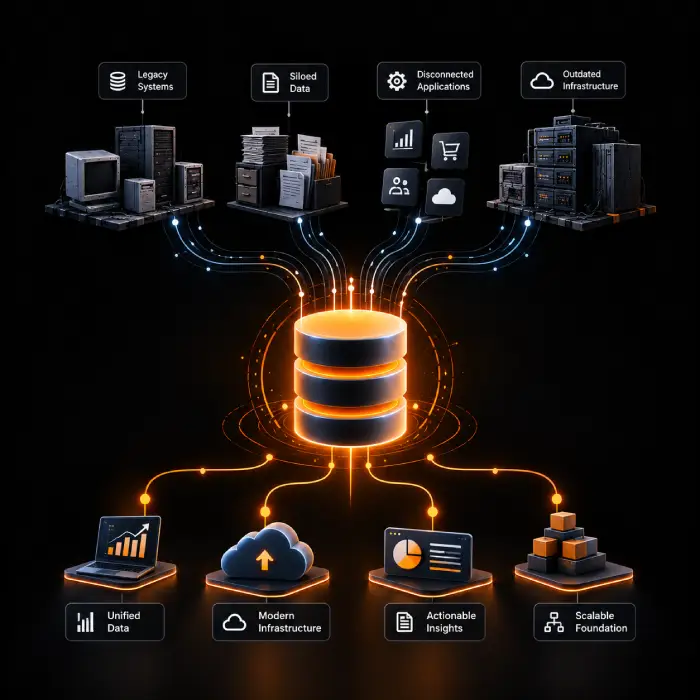
Most businesses don't have one data problem. They have two connected ones: fragmented systems that don't talk to each other and legacy infrastructure that is too old to scale or support AI. Wappnet.ai's data integration and modernization services fix both in one engagement, connecting your data and rebuilding the foundation underneath it.
What Do Data Integration and Modernization Services Include?
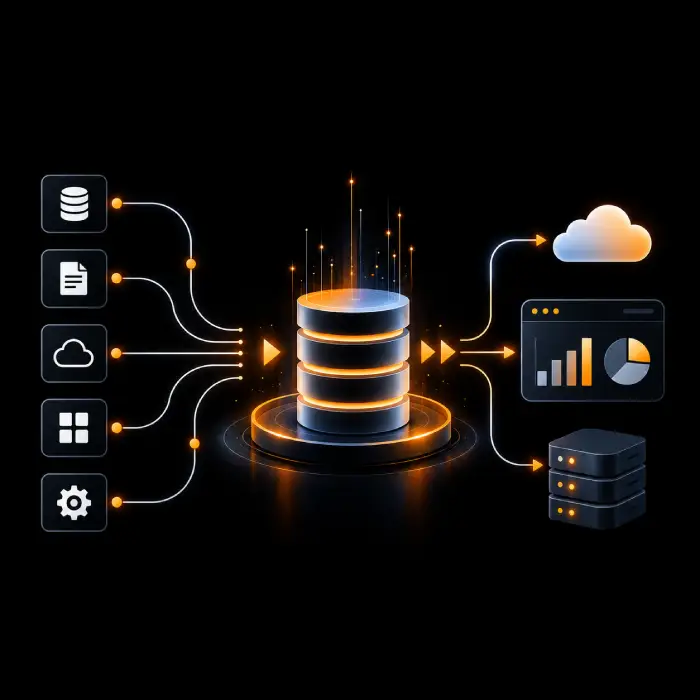
Data integration and modernization services turn scattered systems and aging infrastructure into one reliable, AI-ready data foundation. The goal is simple: connect every system that holds your data, then modernize the platform underneath it so that data stays fast, secure, and usable as the business grows.
A connected engagement moves through two disciplines:
- Connect every system that holds your data into one reliable, consistent flow
- Modernize the legacy infrastructure that's holding that data back
- Build data quality and governance into the architecture, not bolted on after
- Structure the result so it's ready for real-time analytics and AI
Why Businesses Invest in Data Integration and Modernization
Modernizing infrastructure while connecting data silos eliminates manual effort, reduces costs, and opens up real-time analytics and AI readiness.
Eliminate Legacy Data Silos
Disconnected systems force manual reconciliation before anyone can analyze anything. Integration removes the stitching.
Improve Data Accessibility
A unified, governed data layer puts the same trustworthy numbers in front of every team that needs them.
Reduce Infrastructure Costs
Cloud-native modernization moves cost from fixed infrastructure to usage that tracks actual demand.
Enable Real-Time Analytics
Batch jobs that run overnight can't support fraud alerts or live dashboards. Streaming closes that gap.
Prepare Data for AI & ML
Most stalled AI projects fail because the data underneath is inconsistent, not because of the model.
Data Integration & Modernization Solutions Built for Your Business
There's no universal architecture. The right combination of data integration and modernization services depends on what you already run and where your roadmap is headed.
Enterprise Data Integration
Our enterprise data integration connects CRM, ERP, and finance systems into one consistent data flow.
Cloud Data Integration
Cloud data integration linking cloud, SaaS, and on-premises systems into one hybrid environment.
Data Pipeline Development
Data pipeline development services that replace fragile, manual scripts and exports.
ETL & ELT Modernization
ETL and ELT services that rebuild older transformation jobs for cloud-scale data volumes.
Data Warehouse Modernization
Data warehouse modernization services migrating aging warehouses to cloud-native platforms.
Data Lake & Lakehouse
Data lake and lakehouse modernization for one governed environment across BI and AI/ML.
Legacy Data Modernization
Legacy data modernization services with phased migration and no disruptive cutover.
Real-Time Data Integration
Real-time data integration for fraud detection, live inventory and monitoring.
Ready to Modernize Your Data Infrastructure?
Fragmented systems cost more over time. Our data modernization services help you build a scalable, AI-ready data foundation.
Our Data Integration & Modernization Process
A six-step approach that sequences integration and modernization together, instead of treating them as separate projects.
- 1
Data & Architecture Assessment
We map your systems and limitations before recommending anything.
- 2
Integration & Modernization Strategy
A prioritized roadmap, sequenced to avoid redoing work later.
- 3
Architecture & Platform Design
A documented blueprint before a single pipeline is built.
- 4
Data Migration & Integration
Pipelines built and data migrated in validated phases.
- 5
Testing, Validation & Optimization
Tested against real volumes and tuned before anything goes live.
- 6
Deployment, Monitoring & Improvement
Monitoring from day one, tuned as your data needs evolve.
Data Integration & Modernization Use Cases
Every one of these started as a specific business problem, not a vague need for better data. Here's where our data integration and modernization work actually shows up.
Retiring an Aging Core System
Aging, on-premises infrastructure becomes a scalability and security risk the longer it's left alone. Our data modernization services move that environment to a cloud-native platform in validated phases, so the business keeps running while the upgrade happens underneath it.
Connecting CRM, ERP & Finance Systems
When CRM, ERP, and finance systems don't share data, every report starts with manual reconciliation. Our enterprise data integration solutions connect those systems into one consistent flow, so every team works from the same numbers.
Cloud Migration
On-premises infrastructure that can't scale becomes the ceiling on everything else the business wants to do. We plan and sequence migrations to AWS, Azure, or Google Cloud so infrastructure grows with demand instead of capping it.
Faster Reporting & BI
Slow batch loads and climbing storage costs are usually a sign the reporting stack was built for a smaller business than the one running on it today. Moving the underlying data to a cloud-native platform brings dashboards and queries back up to speed at a lower cost.
Real-Time Analytics
Decisions made on yesterday's batch run are already out of date by the time they reach a dashboard. Our data integration services stream events as they happen, so decisions are based on what's actually happening right now.
Customer 360
Customer data split across sales, support, and product systems means no single team ever sees the full picture. Our data integration solutions bring those sources together into one unified view every team can work from.
AI/ML Data Readiness
Most AI initiatives stall not because of the model, but because the underlying data is inconsistent or hard to access. We structure that data into a governed, feature-ready form so the layer underneath it doesn't block AI projects.
M&A Data Consolidation
A merger or acquisition usually leaves two companies running incompatible systems on different platforms. Our data integration consulting brings both environments into one consolidated architecture the combined business can run on.
Data Integration vs. Data Modernization
They solve different, related problems, and most enterprises eventually need both to build a data foundation that's reliable today and scalable tomorrow.
Technologies We Use to Build Data Integration and Modernization Solutions
Cloud platforms, warehouses, streaming, and modern transformation tools fitted to your enterprise architecture.






Industries We Help With Data Integration and Modernization
Why Choose Wappnet AI as Your Data Integration and Modernization Company?
Choosing a data integration and modernization company is a long-term decision. You need a team that understands your business goals, not just the technology. Here's what you can expect when you work with us.
Business-First Architecture
We assess your actual data environment and business goals before recommending an architecture, rather than fitting your problem to a fixed template.
Integration + Modernization, One Strategy
Rather than treating these as separate projects, we sequence them together so modernization doesn't inherit the same silos integration was meant to fix.
Minimal-Disruption Migration
Migrations are phased and validated at each step, so your existing reporting and operations keep running while the new environment is built.
AI-Ready Data Foundations
We build with your analytics and AI roadmap in mind from the outset, so a later AI initiative isn't blocked by decisions made earlier in the data layer.
Real-World Data Integration and Modernization Solutions We've Delivered
Production integration pipelines and cloud modernization architectures delivering reliable data foundations for leading enterprises.
Enterprise ERP & CRM Real-Time Integration
Unified CRM, ERP, and financial transaction data into a streaming pipeline with sub-second synchronization.
Legacy Data Warehouse Cloud Migration
Migrated legacy on-premise data warehouse to Snowflake with zero downtime and automated dbt transformations.
AI-Ready Lakehouse Architecture
Built unified Databricks lakehouse architecture supporting BI reporting and feature stores for AI model training.
Connect Fragmented Systems. Modernize the Foundation Underneath Them.
Whether the problem is disconnected systems or an aging data platform, our data modernization consulting team will help you fix both in the right order, so one doesn't undo the other.
Latest AI Insights & Industry Trends
 RAG
RAG vs Fine-Tuning vs Prompt Engineering: Which Approach Fits Your Use Case?
Compare RAG, fine-tuning, and prompt engineering to explore costs, use cases, and the best approach for enterprise AI.
 AI Copilot
What is an AI Copilot? Use Cases & Build Guide
What is an AI Copilot? Learn how it works, how it differs from AI agents, key use cases, and how to build one for your business.
 RAG
What Is RAG? A Complete Guide to Retrieval-Augmented Generation
Learn what RAG is, how Retrieval-Augmented Generation works, reduces AI hallucinations, and powers smarter enterprise AI.
Frequently Asked Questions
Data integration and modernization services combine two disciplines: integration, which connects data across your systems, and modernization, which rebuilds the infrastructure underneath so it can scale and support AI.
Data integration connects data across existing systems, while data modernization replaces or rebuilds the underlying infrastructure. Most enterprises eventually need both.
Legacy data modernization removes the scalability, security, and cost limits of on-premises systems, replacing them with cloud-native infrastructure that can grow with the business instead of capping it.
AI-ready data infrastructure is consistent, accessible, and governed. Modernization restructures legacy systems into that form, which is often the real blocker behind a stalled AI project, not the model itself.
Structured data from databases and ERPs, semi-structured data from APIs and SaaS platforms, and unstructured data from documents or logs can all be connected through enterprise data integration, depending on the source systems involved.
Common technologies include ETL/ELT tools, APIs, event-streaming platforms like Apache Kafka, and middleware. Our data pipeline development work picks the right combination based on your existing systems and data volume.
Timelines vary with scope: a focused integration can take a few weeks, while a full data modernization program spanning multiple systems typically runs several months. A realistic timeline follows an initial assessment.
Yes. Migration work is phased with validation at each stage, so existing reporting and operations keep running while the new architecture is built, rather than requiring one disruptive cutover.
Cost depends on the number of systems involved, data volume, and the scope of the engagement. Our data integration services are scoped after an initial assessment, not quoted upfront.
ETL transforms data before loading it, which suits smaller or more sensitive datasets. ELT loads raw data first and transforms it after, which suits larger volumes on modern cloud warehouses.
Data quality checks and validation rules are applied at each migration stage, and data is reconciled against source systems before a cutover is considered complete.
Access controls and data governance policies are designed into the architecture from the start, so who can access which data and how that access is tracked is defined before go-live.
It depends on the problem. Data integration consulting fits when systems just need to share data reliably. A full modernization program fits when the underlying infrastructure itself can't scale or support AI.
Yes. Real-time data integration streams events as they happen rather than waiting on overnight batch jobs, so dashboards and operational decisions reflect what's happening right now.
Healthcare, financial services, retail, manufacturing, and logistics see the most impact, since each depends on enterprise data integration solutions to unify fragmented systems while meeting strict compliance and uptime requirements.