
Autonomous Design Services
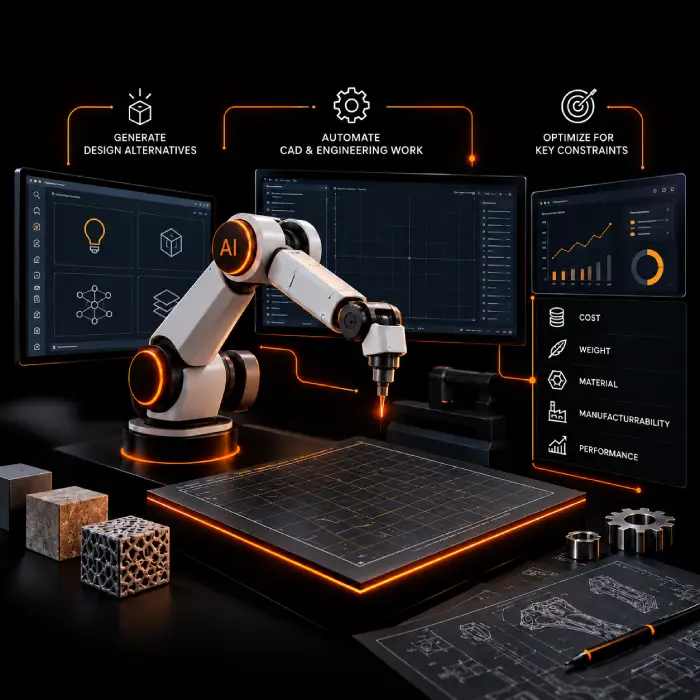
Our autonomous design services build AI systems that generate design alternatives, automate repetitive CAD and engineering work, and optimize concepts against the constraints that matter to your product cost, weight, material, manufacturability, or performance. This is AI design automation built on generative design, computational design, and simulation, for product development, engineering, and manufacturing teams who need to explore more design space without adding headcount. Generated designs still go through simulation, validation, and engineer sign-off before anything reaches production; we're direct about that from the first conversation.
What Do Autonomous Design Services Include?
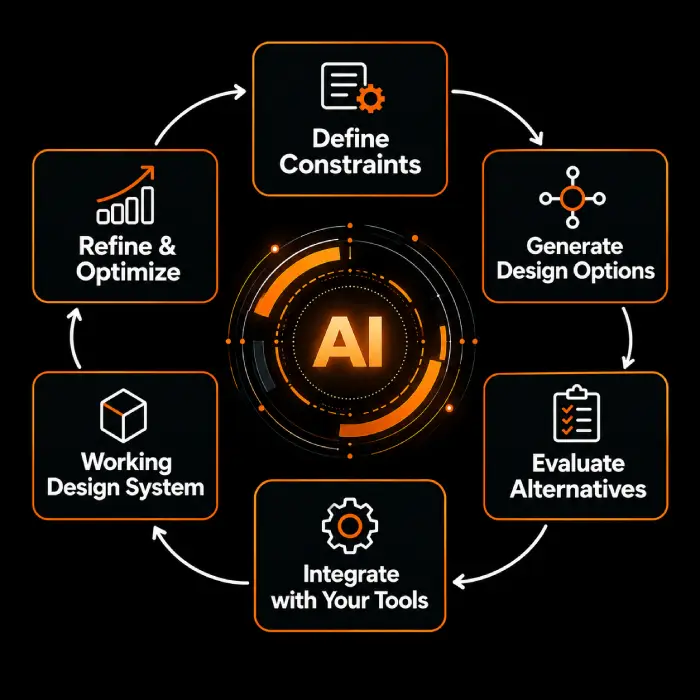
Autonomous design uses AI, generative algorithms, and simulation to create, evaluate, and refine design options against stated constraints, with far less manual modeling than a traditional CAD workflow. Our AI design automation work moves from your existing tools and constraints to a working, integrated system, not a generic AI demo disconnected from how your team actually designs.
Our autonomous design and engineering automation services cover the complete design-to-release lifecycle:
- We build autonomous design solutions scoped to the part of your design process that actually benefits from automation, not your whole pipeline by default.
- We implement AI-powered design automation, removing repetitive modeling and iteration work so engineers spend time on judgment calls, not redrawing variants.
- We develop generative design and concept generation capabilities that explore a wider design space than manual iteration allows within the same timeframe.
- We set up design workflow automation, connecting the steps between concept, review, and release so handoffs don’t stall in email or spreadsheets.
- We apply engineering design optimization, including topology and parameter optimization against cost, weight, material, or performance targets.
- We automate CAD workflows where appropriate, using parametric and rule-based modeling to cut manual drafting on repeatable geometry.
- We integrate simulation and design validation, so generated designs are checked against physics and design rules before an engineer reviews them.
- We handle enterprise design system integration, connecting the design environment to your PLM, ERP, or other engineering systems of record.
Why Businesses Invest in Autonomous Design Services
Design automation delivers value when manual iteration slows down the process. It helps teams explore more design alternatives in less time. The benefits depend on the workflow, constraints, and implementation.
Reducing Repetitive Manual Design Work
Generative and parametric design automate repetitive tasks such as creating similar variants, running recurring checks, and documenting minor changes.
Exploring More Design Alternatives, Faster
Generative design can produce and evaluate multiple design options against defined constraints, helping teams compare alternatives before making decisions.
Handling Complex, Multi-Variable Constraints
Optimization algorithms help evaluate trade-offs between weight, cost, load, and manufacturability more systematically than manual trial and error.
Reducing Design-to-Engineering Handoff Delays
Connecting concept generation, simulation, and review through automated workflows can reduce delays between design stages.
Trade-Offs We Plan For
Design automation requires reliable constraints, simulation models, and integration. Outputs still need engineering validation and approval where required. We recommend the simplest approach that meets your needs.
Autonomous Design Solutions Built for Your Business
Explore our autonomous design solutions tailored to your engineering needs and workflows. Our generative AI development services power intelligent design capabilities, while our AI consulting team helps identify the right automation opportunities for your business.
AI-Powered Design Automation
AI handles repeatable design tasks such as variant generation, rule checking, and documentation, allowing engineers to focus on decisions that require judgment. Best suited to workflows with clear, codifiable rules.
Generative Product Design
Given defined constraints, a generative design engine produces multiple candidate geometries for engineers to evaluate. This generative design approach expands the options available before a direction is selected.
Engineering Design Optimization
Optimization algorithms, including topology optimization, identify geometries or parameter sets that best meet weight, strength, cost, or material targets. Useful when trade-offs are too complex to evaluate manually.
Automated Design Iteration
The system automatically reruns design generation and evaluation as constraints change, reducing manual adjustments and shortening iteration cycles.
CAD and Design Workflow Integration
We integrate generative and automated design tools into your existing CAD environment and review processes, ensuring outputs reach engineers in their established workflows.
Simulation-Supported Design Optimization
Generated or optimized designs undergo structural, thermal, or performance simulation before review, helping identify unworkable candidates earlier.
Enterprise Design Process Automation
Permission-based connections between design tools and PLM, ERP, or document management systems turn approved designs into tracked, released data without manual re-entry.
Automated CAD Design Support
Parametric and rule-based CAD automation handles repetitive geometry and drafting tasks, freeing engineers to focus on complex design decisions. Effectiveness depends on how standardized your existing geometry and rules are.
Scaling From Pilot to Production Design Automation
After a pilot succeeds with one part family, we assess whether to expand deployment, add constraints, or adopt a different automation approach based on the results.
Not Sure Where Automation Fits in Your Design Process?
Tell us about your current design workflow, the constraints you design against, and the tools and systems it needs to work with. We’ll help you work out whether generative design, design workflow automation, or a simpler improvement is the right starting point.
Our Autonomous Design Development Process
We assess your design workflows, constraints, and existing CAD/PLM systems before planning implementation. Timelines depend on design complexity, integration requirements, and project scope, with a clear plan agreed upon after discovery.
- 1
Design Workflow and Requirements Discovery
We map your current design process end-to-end, identifying where time is spent, which steps are repetitive, and which constraints matter most, giving you a clear picture of whether design automation fits and where.
- 2
Design Constraints and System Assessment
We review your existing CAD, PLM and simulation tools, the data they hold, and the constraints a generative or automated system would need to respect, producing a feasibility view before any build starts.
- 3
Solution Architecture and Technology Selection
We select the generative, optimization, and integration approach suited to your geometry, constraints, and existing stack, resulting in an architecture your engineering team can review before development begins.
- 4
Development and Tool Integration
We build the design generation, automation and integration components inside your existing CAD and PLM environment where possible, so your team ends up with a working system, not a disconnected prototype.
- 5
Simulation, Testing and Design Validation
We validate generated or optimized designs against simulation and design-rule checks, test against real and edge-case constraints, and document what the system does and doesn’t handle well.
- 6
Deployment, Monitoring and Optimization
We deploy with review checkpoints and monitoring in place, and agree a plan for ongoing tuning as part geometries, materials or constraints change over time.
Autonomous Design Services: Use Cases
Explore how autonomous design services can streamline engineering workflows, automate repetitive tasks, and optimize designs. The right approach depends on your design requirements, constraints, and existing tools.
Product Concept Generation
Early-stage product development needs multiple viable concepts to evaluate against cost and manufacturability before committing to one direction. A generative design engine produces candidates; engineers select and refine.
Engineering Design Iteration
A part needs repeated refinement as requirements shift. Automated iteration re-runs generation and checks as constraints change, instead of a person re-modeling from scratch each time.
Manufacturing Design Optimization
A component needs to meet strength and weight targets within a manufacturing process’s limits. Topology and parameter optimization search the trade-off space; engineers validate manufacturability before release.
Automated CAD Workflow Support
Repeatable drafting and documentation tasks consume engineering time that could go to design decisions. Parametric CAD automation handles the repeatable geometry; a person reviews exceptions.
Material and Geometry Optimization
A design needs to use less material or a different material without losing structural performance. Optimization algorithms search for geometry that meets the performance target with reduced material use.
Design Rule Checking and Validation Support
Design rule violations caught late in a project are expensive to fix. Automated rule checking flags issues against your standards earlier in the design cycle, before they reach manufacturing.
Simulation-Supported Product Development
A new product needs structural or thermal performance confirmed before prototyping. Generated designs are run through simulation automatically, narrowing what goes to physical prototyping.
Design Workflow Integration Across Engineering Systems
Design data currently has to be re-entered across CAD, PLM, and ERP systems. Integration connects these systems so an approved design moves forward as tracked data, not a re-keyed file.
Traditional Design vs. Design Automation vs. AI-Powered Autonomous Design
Each approach suits different needs. The right choice depends on task complexity, design constraints, repeatability, and the setup and validation effort required.
Technologies We Use to Build Autonomous Design Solutions
We select technologies based on your design requirements, existing CAD/PLM systems, simulation needs, data availability, and deployment environment to build reliable and scalable autonomous design solutions.
Industries We Help With Autonomous Design
Why Choose Wappnet AI as Your Autonomous Design Services Company?
A generative model that produces interesting-looking geometry is not a design system. As an autonomous design company that also builds the integration, validation, and oversight around it, we treat automation decisions as decisions your engineering team has to live with, not a demo handed off at the end of a workshop.
Business-First Requirements Analysis
We start from your design workflow and constraints, not from a preference for full automation. If parametric tooling or a simpler improvement solves it, that’s what we recommend.
Design Workflows Aligned With Your Constraints
Generation and optimization are scoped to the material, cost, load, and manufacturing constraints you actually design against, not generic defaults.
Integration With Existing CAD and PLM Systems
We connect design automation into the CAD, PLM, and simulation tools your team already uses, through generative AI development practices built for production, not prototypes.
Design Validation and Testing Built In
Simulation and design-rule checks are part of the architecture from the start, so your team can see what a generated design was checked against, not just the final geometry.
Real-World Autonomous Design Solutions We've Delivered
Generative concept modeling, topology optimization, and automated CAD pipelines delivered for production engineering teams.
Automotive Component Lightweighting & Structural Optimization
Applied generative topology optimization and automated FEA validation to reduce structural bracket weight by 38% while maintaining safety factor targets.
Parametric CAD Variant Generation for Industrial Equipment
Built rule-based CAD generation integrated with Siemens NX, automating repetitive custom machinery drafting and shrinking variant turnaround from days to hours.
Consumer Hardware Concept Exploration & Thermal Simulation
Engineered a multi-variable generative design pipeline exploring 100+ thermal heat sink configurations, automatically simulated and ranked for tooling cost and efficiency.
Ready to Automate Part of Your Design Workflow?
Bring your current design process, the constraints it has to satisfy, and your existing CAD or PLM tools. We’ll talk through whether generative design, design workflow automation, or a simpler improvement fits, and what a practical first step looks like, with no obligation.
Latest AI Insights & Industry Trends
 RAG
RAG vs Fine-Tuning vs Prompt Engineering: Which Approach Fits Your Use Case?
Compare RAG, fine-tuning, and prompt engineering to explore costs, use cases, and the best approach for enterprise AI.
 AI Copilot
What is an AI Copilot? Use Cases & Build Guide
What is an AI Copilot? Learn how it works, how it differs from AI agents, key use cases, and how to build one for your business.
 RAG
What Is RAG? A Complete Guide to Retrieval-Augmented Generation
Learn what RAG is, how Retrieval-Augmented Generation works, reduces AI hallucinations, and powers smarter enterprise AI.
Frequently Asked Questions
Autonomous design services are the design and development work needed to build AI systems that generate design alternatives, automate repetitive CAD and engineering tasks, and optimize concepts against stated constraints using generative design, computational design and simulation, with validation and engineering review built into the workflow.
An AI system takes your design constraints, such as material, cost, load, geometry or manufacturing limits, and generates candidate designs, which are then evaluated and often simulated before an engineer reviews and selects the strongest options. The specifics depend on the generation method, the optimization algorithm and the simulation tools involved.
AI design automation uses AI and algorithmic tools to handle repeatable or constraint-driven parts of a design task, such as variant generation, rule checking and iteration, so engineers spend less time on repetitive modeling and more on decisions that need judgment.
Generative design is a specific technique: an algorithm generates many design alternatives from stated constraints. Autonomous design is the broader system built around that technique, including automation of the surrounding workflow, simulation, validation and integration with your CAD and PLM environment.
Traditional design relies on an engineer modeling and iterating by hand. Automated design uses rule-based or AI-driven tools to handle repeatable tasks or generate alternatives, while an engineer still sets the rules or constraints and reviews the output before it’s used.
Yes, when the CAD and PLM environment exposes the APIs or file formats an integration needs. The level of integration depends on your existing tools; we assess this during the discovery and system-assessment stages of an engagement.
Generated or optimized designs typically go through simulation, such as structural or thermal analysis, and automated design-rule checks, followed by engineering review before anything moves toward production. AI-generated designs are not assumed to be manufacturable, safe or compliant without that review.
Common building blocks include generative design algorithms, machine learning models, computational and parametric design tools, engineering simulation (FEA/CFD), optimization algorithms such as topology optimization, and integration with CAD, PLM and ERP systems. The right combination depends on your project; we select rather than default to one stack.
Manufacturing and industrial engineering, automotive, aerospace, architecture and construction, consumer product development, and energy and utilities are common fits, along with parts of medical device development where regulatory and clinical validation remain the responsibility of qualified specialists.
Generative and automated design still depend on accurately defined constraints, require simulation and engineering review to confirm a design is sound, and don’t remove the need for human judgment on manufacturability, safety or regulatory compliance. Setup and integration also take real engineering effort.
It depends on the complexity of the geometry, the number of constraints, and how much integration with your existing CAD, PLM or simulation tools is needed. We propose a phased plan after discovery rather than quoting a fixed timeline upfront.
Cost depends on the scope of automation, integration complexity, the simulation and validation requirements, and how many design iterations or constraints the system needs to handle. We give an estimate once requirements are clear rather than quoting a figure before we understand your workflow.
Yes. Generated and optimized designs are evaluated by the system against stated constraints and simulation results, but engineering review and sign-off remain part of the process, particularly for manufacturability, safety and regulatory requirements.