
AI Security, Guardrails & Observability Services
Shipping an LLM application is the easy part. Keeping it from leaking sensitive data, answering off-policy, or quietly getting worse after a model update is the part most teams haven't built for yet. Wappnet.ai's AI security, guardrails, and observability services add input and output controls, LLM evaluation, and end-to-end tracing to the AI applications you already run, so your team can see what a model did, why, and whether it stayed inside the lines, before a customer or an auditor has to point it out. We design these controls around your existing architecture and risk profile, not a one-size-fits-all policy file.
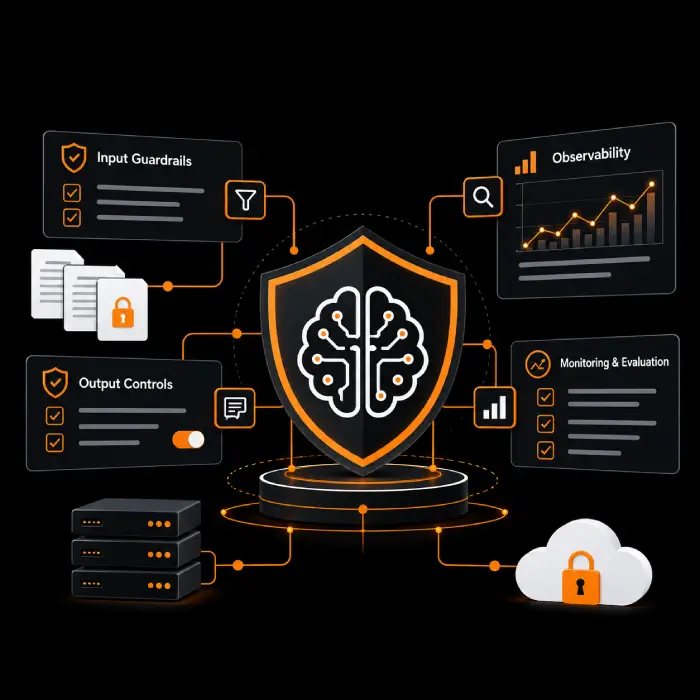
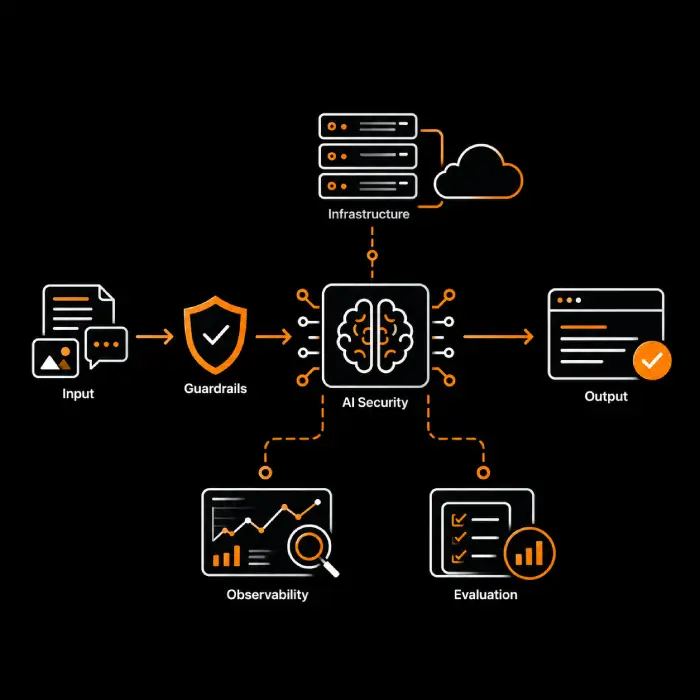
What Do AI Security, Guardrails & Observability Services Include?
AI security protects the application and its data from AI-specific threats like prompt injection. Guardrails check what goes into a model and what comes out. AI observability tracks how an application behaves in production: requests, latency, failures. AI evaluation tests whether outputs meet your quality and safety bar. None replace each other: a guardrail without observability can fail quietly. Our AI security consulting services start by scoping which layers you actually need, not selling a bundle by default.
A typical engagement covers:
- Assessing the AI application's architecture, data flows, and existing exposure to threats like prompt injection, data leakage, and unvalidated tool use.
- Designing input and output guardrails, policy checks, and sensitive-data controls scoped to what the application actually does and who uses it.
- Building evaluation sets and acceptance thresholds so quality, safety, and relevance are tested before and after every meaningful change.
- Implementing tracing, logging, and monitoring so requests, failures, costs, and quality regressions are visible once the application is live.
Why Businesses Invest in AI Security, Guardrails & Observability
These problems rarely announce themselves as a single incident. They tend to show up as a support ticket, a compliance question, or a cost report that doesn't add up.
Prompt Injection & Unsafe Inputs
A crafted input can try to override an AI application's instructions, extract hidden context, or trigger an action it was never meant to take. Without input validation, there's often no check standing between that input and the model.
Sensitive Information Exposure
An AI application can surface personal data, credentials, or internal business details it was never supposed to repeat, whether from training context, retrieved documents, or a careless prompt. AI guardrails exist to catch this before it reaches a user.
Inconsistent AI Responses
The same question can get a different, sometimes contradictory, answer depending on phrasing, timing, or a recent model update, and without evaluation in place, that drift is hard to even detect, let alone explain.
Limited Monitoring & Traceability
When a customer or an internal team flags a bad AI response, a team without request-level tracing has no easy way to reconstruct what the model actually saw, retrieved, or decided, which turns a five-minute investigation into a guessing game.
Rising Inference Costs & Latency
Token usage and response times tend to climb quietly as usage grows, and without LLM cost and latency monitoring, it's hard to tell which prompts, workflows, or retrieval calls are actually driving the spend.
AI Security, Guardrails & Observability Solutions Built for Your Business
Most engagements start small and grow into broader AI guardrails solutions as risk and usage increase. For LLM and RAG applications, this is often scoped as generative AI security services or LLM security services.
LLM Application Security Assessment
As part of our LLM application security services, we review an AI application's architecture, data flows, authentication, and tool access to identify where it's exposed to prompt injection, data leakage, and insecure integrations before anything gets built or changed.
Prompt Injection Risk Mitigation
We design layered defenses against direct and indirect prompt injection, including input sanitization, instruction isolation, and output checks, since no single filter catches every injection technique on its own.
Input & Output Guardrails
Our AI guardrails services apply LLM guardrails that validate what goes into a model and what comes back out, enforcing content-safety checks, restricted-topic rules, and policy-based response validation around the application's actual use case.
Sensitive Data Detection & Redaction
We build detection rules that flag or redact personal data, credentials, and other sensitive fields before they reach a model prompt or a user-facing response, reducing sensitive data exposure at both ends of the conversation.
Tool-Use & Function-Call Validation
For AI agents that call tools and APIs, we add validation, scoping, and human-approval steps for high-impact actions, so an automated workflow doesn't get the same blind trust a person's judgment would normally require.
LLM Evaluation & Testing
As part of our AI evaluation and monitoring services, we build evaluation sets with defined acceptance thresholds for quality, safety, and relevance, so a model or prompt change is tested against real scenarios before it reaches production, not judged after the fact.
Retrieval Quality & Groundedness Evaluation
For RAG-based applications, we evaluate whether retrieved content is actually relevant and whether a generated answer is grounded in it, which is where unsupported or fabricated answers most often originate.
AI Tracing & Observability
As part of our LLM observability services, we instrument AI applications with request-and-response tracing, so a team can reconstruct exactly what a model saw, retrieved, and returned for any given interaction during an investigation or a review.
Token, Cost & Latency Monitoring
We add visibility into token usage, model cost, and response latency by endpoint or workflow, so rising inference spend or slowing responses get traced to a specific cause instead of staying a mystery line item.
Logging, Auditability & Incident Analysis
We design logging and retention practices that support AI audit logging and incident investigation, including prompt and model version tracking, so a question about what changed and when has an answer.
Build More Trustworthy AI Workflows
If your AI application is live, or close to it, and nobody can tell you with confidence what it did last week, that's a visibility gap our AI observability services and LLM monitoring solutions are built to close, not a reason to pause the project. Tell us what's running today and what's keeping your team up at night.
Our AI Security & Observability Process
A discovery-first approach, starting with focused AI risk assessment services, since guardrails designed around the wrong threat model, or evaluation sets built on the wrong sample traffic, rarely hold up once real users show up.
- 1
AI Application & Risk Assessment
We review what the application does, what data it touches, who can reach it, and what's already at stake if something goes wrong.
- 2
Threat & Data-Flow Analysis
We map how inputs, context, and tool calls move through the system to identify where prompt injection, data leakage, or unsafe actions are most likely to occur.
- 3
Guardrail & Evaluation Design
We design the specific input/output guardrails, policy checks, and evaluation criteria the application needs, scoped to the risks found in the assessment, not a generic checklist.
- 4
Security & Observability Implementation
As AI safety and guardrails implementation work, we build the guardrails, tracing, and monitoring into the application and connect them to the logging and alerting your team already uses.
- 5
Testing & Validation
We test guardrails and evaluation sets against adversarial and real-world scenarios before launch, checking that controls catch what they're meant to without blocking legitimate use.
- 6
Production Monitoring & Improvement
We monitor quality, cost, and failure signals after launch and refine guardrails and evaluation criteria as usage patterns and model behavior change.
AI Security, Guardrails & Observability Use Cases
Common problems these capabilities solve across customer-facing, internal, and agentic AI applications.
Securing Enterprise LLM Applications
Adding input validation, access controls, and secure architecture to an LLM application before it's exposed to employees or customers at scale.
Protecting Sensitive Data in AI Interactions
Detecting and redacting personal data or credentials in prompts and responses so sensitive information doesn’t flow through an AI application unchecked.
Validating AI-Generated Customer Support Responses
Applying policy-based response validation so AI-generated answers stay within approved topics and tone before they reach a customer.
Evaluating RAG Relevance & Source Grounding
Testing whether a retrieval-augmented application returns relevant sources and whether its answers are actually grounded in them, not just plausible-sounding.
Monitoring AI Agents That Use Tools
Tracing which tools an agent called, with what inputs, and what the result was, so autonomous actions stay reviewable after the fact.
Tracking LLM Latency & Token Costs
Monitoring response time and token spend by endpoint or workflow to catch a cost spike or slowdown before it shows up in a budget review.
Testing AI Behavior Before Model or Prompt Releases
Running a defined evaluation set against a candidate model or prompt change so a release decision is based on measured quality, not a gut check.
Adding Human Approval to High-Impact AI Actions
Routing an AI agent's higher-risk actions, such as sending a payment or modifying a record, through a human approval step before execution.
Minimal Controls vs. Basic Logging vs. Layered Security & Observability
Each level has a real place. The right one depends on the application's risk profile, data sensitivity, and how much a failure would actually cost you.
Technologies We Use for AI Security & Observability
Technology choice depends on your providers, architecture, and monitoring stack, not a fixed set. These categories power our AI guardrails and LLM observability work, the backbone of our AI observability solutions.
Industries We Help With AI Security, Guardrails & Observability Services
Why Choose Wappnet.ai for AI Security, Guardrails & Observability?
Choosing an AI security company, an AI guardrails company, to secure your AI applications is a commitment to how those systems get operated going forward, not a one-off review. The same is true when choosing an AI observability company to monitor them. A build that skips straight to a guardrail library without understanding the application's actual data flows usually misses the risk that mattered. Here's what you can expect working with us instead.
Application-Specific Security Controls
We recommend guardrails and evaluation criteria based on your application's architecture, usage, and risk profile.
Integrated Security and Observability
We bring together guardrails, evaluation, and monitoring where they provide practical value.
Human Oversight by Design
We establish approval and escalation paths for high-impact AI actions, with clear review responsibilities.
Compatible with Existing AI Systems
Our solutions integrate with existing LLM, RAG, and AI agent applications without requiring a disconnected toolchain.
Real-World AI Security, Guardrails & Observability Solutions We've Delivered
Enterprise Financial Copilot Guardrails & PII Redaction
Deployed real-time input/output policy enforcement and regex/NER redaction, preventing sensitive financial context leaks across 50,000+ daily employee queries.
Full-Stack Request Tracing & Latency Optimization
Instrumented OpenTelemetry distributed tracing across a multi-agent RAG workflow, cutting p95 response latency by 42% and identifying runaway prompt costs.
Automated Tool-Use Sandboxing & Approval Routing
Implemented permission scoping and human-in-the-loop verification gates for customer service autonomous agents triggering database and ERP actions.
Not Sure What Your AI Application Is Actually Doing in Production?
Tell us which AI applications you're running today and what visibility or controls are missing, and we'll give you an honest read on what an AI security and observability engagement would need to address first.
Latest AI Insights & Industry Trends
 RAG
RAG vs Fine-Tuning vs Prompt Engineering: Which Approach Fits Your Use Case?
Compare RAG, fine-tuning, and prompt engineering to explore costs, use cases, and the best approach for enterprise AI.
 AI Copilot
What is an AI Copilot? Use Cases & Build Guide
What is an AI Copilot? Learn how it works, how it differs from AI agents, key use cases, and how to build one for your business.
 RAG
What Is RAG? A Complete Guide to Retrieval-Augmented Generation
Learn what RAG is, how Retrieval-Augmented Generation works, reduces AI hallucinations, and powers smarter enterprise AI.
Frequently Asked Questions
AI security services protect AI applications, their data, and their access paths against threats specific to AI systems, such as prompt injection, insecure tool access, and sensitive-data exposure, through architecture review, input/output controls, and secure access design.
AI guardrails are rules and validation checks applied to an AI application’s inputs and outputs, such as blocking a restricted topic, redacting sensitive data, or requiring approval before a tool call executes, so the application stays within defined policy.
LLM application security covers the specific risks of applications built on large language models, including prompt injection, insecure prompt construction, excessive tool permissions, and sensitive-data leakage through model responses.
AI observability is the practice of collecting and analyzing signals about how an AI application behaves in production, including request and response tracing, latency, token cost, and quality, so issues can be diagnosed instead of guessed at.
Through layered defenses: input sanitization and classification, isolating untrusted content from system instructions, output validation, and monitoring for unusual request patterns. No single control catches every prompt injection technique, which is why these are typically combined.
Guardrails can detect and redact personal data, credentials, and other sensitive fields in both the prompts sent to a model and the responses it returns, reducing the chance that sensitive information flows through an AI application unchecked.
Through structured LLM evaluation: defined test sets with acceptance thresholds for accuracy, relevance, and safety, run before a release and on an ongoing basis against production traffic, rather than relying on spot checks alone.
Monitoring typically tracks a set of predefined metrics, such as error rate or latency. Observability goes further, capturing enough detail, such as full request traces and retrieved context, that a team can investigate an issue it didn’t anticipate in advance.
Yes. Guardrails and observability are typically added around an existing application’s input and output paths, rather than requiring it to be rebuilt, though the scope of changes depends on the current architecture.
By instrumenting requests with tracing that records token usage and response time by endpoint, prompt, or workflow, then surfacing that data in dashboards so a cost or latency spike can be traced to its actual source.
By running defined evaluation sets, including adversarial and edge-case scenarios, against a candidate model or prompt version, and comparing results against acceptance thresholds before it’s released to real users.
No. Guardrails reduce specific risks but don’t eliminate them, and no guardrail catches every prompt injection attempt or hallucination. Effective protection generally requires layered controls, ongoing evaluation, monitoring, and appropriate human oversight working together, not a single safeguard.