
AI Product Engineering Services
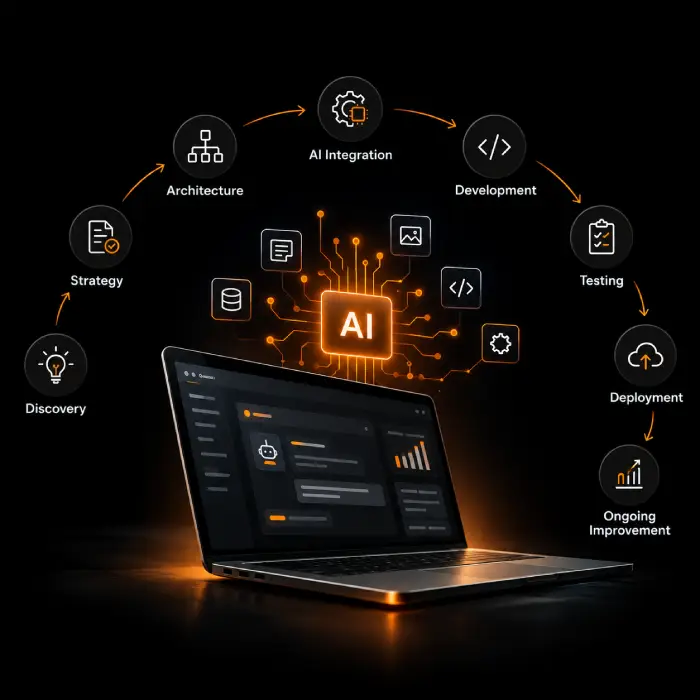
A promising AI idea, an internal mandate, or a product that needs new AI-powered capability is the starting point, not the finish line. Getting from there to something reliable, secure, and used by real customers takes product strategy, engineering architecture, AI integration, and an operational foundation, not just a working demo. Wappnet.ai's AI Product Engineering services cover that full journey: discovery, architecture, AI integration, software development, testing, deployment, and ongoing improvement, scoped to what your product actually needs rather than a fixed template.
What Does AI Product Engineering Services Include?
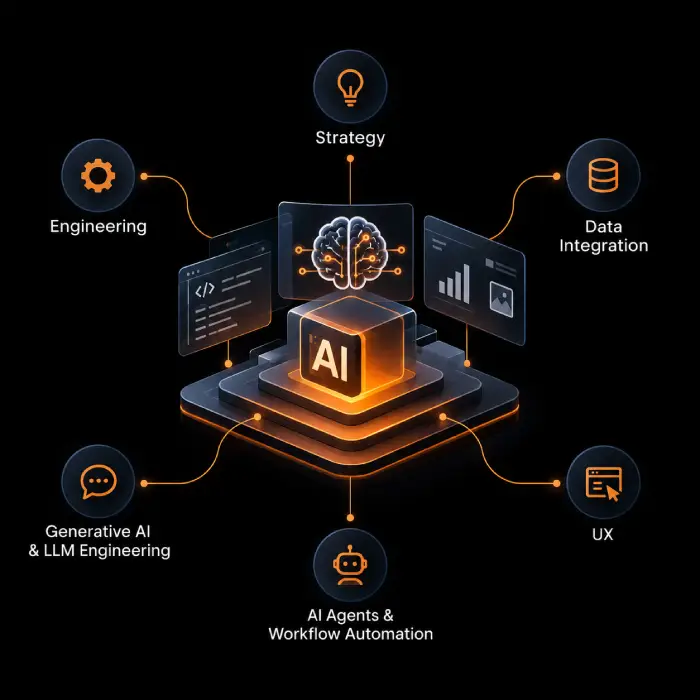
Our AI Product Engineering Services turn AI concepts and business requirements into reliable, production-ready products through strategy, engineering, data integration, and UX. Our AI Product Engineering Solutions also include focused support for Generative AI & LLM Engineering and AI Agents & Workflow Automation, helping businesses build scalable AI products with seamless user experiences and long-term reliability.
A typical AI Product Engineering engagement covers:
- Validating which product requirements and user needs the AI capability is actually meant to serve, before any architecture decision is made.
- Designing an AI product architecture that connects product, data, and AI components into one coherent system, rather than a model bolted onto an existing application.
- Building and integrating the application, backend, data, and AI/model layers so the product behaves predictably for real users, not only in a controlled demo.
- Testing and evaluating AI-specific behavior, security, and access control alongside standard software quality assurance.
- Preparing the product for production deployment and supporting its monitoring, feedback, and improvement after launch.
- Scoping the engagement as a standalone build or as part of broader Custom AI Product Development Services, matched to how much of the product already exists.
Why Businesses Invest in AI Product Engineering Services
These problems rarely show up as one dramatic failure. They show up as a prototype that impresses in a demo, then quietly never becomes a product teams can rely on.
Unclear Product Requirements
An AI capability gets built before the underlying user need and the right use case have been validated, so the resulting feature impresses in a demo but does not get adopted.
Integration With Existing Systems and Data
The AI capability works in isolation but struggles to connect cleanly to the applications, data stores, and workflows the rest of the product already depends on.
Moving Beyond an Isolated Prototype
A proof of concept demonstrates that something is possible, but production-grade reliability, error handling, and scale were never part of the original build.
Reliability & Changing Model Behavior
Models and prompts change, inputs vary, and outputs are probabilistic, which makes consistent, predictable product behavior an engineering problem, not an assumption.
Security, Governance & Access Control
Enterprise buyers expect the same access controls, data boundaries, and auditability as any other product, and these must be designed in rather than added after launch.
AI Product Engineering Solutions Built for Your Business
Most engagements start with product discovery and architecture, with Custom AI Product Solutions and AI-Powered Product Development Solutions tailored to your product’s needs and production goals.
Product Discovery & Technical Planning
Clarifying the user need, the business opportunity, and the technical constraints an AI product must work within before architecture decisions are made, often starting as a short AI Product Engineering Consulting conversation.
AI Product Architecture
Designing how the product, data, and AI/model layers fit together so the system is coherent, not assembled from disconnected parts.
Product Prototyping & Validation
Building a working prototype quickly enough to validate the use case and gather real feedback before committing to full development.
AI Model & API Integration
Connecting the application to the right model, hosted API, or custom-trained component for the product's accuracy, cost, and latency requirements.
Application & Backend Development
Building the software product itself: the frontend, backend, and services that make the AI capability usable as part of a complete experience.
Data & System Integration
Connecting the product to the data sources, APIs, and business systems it needs to be useful in a real workflow, not a standalone demo.
AI-Enabled User Experience Design
Designing how users interact with AI-powered functionality, including confidence signals, failure states, and when a person should stay in the loop.
Testing & Evaluation
Evaluating AI-specific behavior against defined quality thresholds, alongside standard software testing, before a release ships.
Security & Access Control
Building identity, access, and data-boundary controls into the architecture from the start, matched to the product's requirements.
Deployment Preparation
Preparing the product for a production release: release readiness, rollout planning, and handoff to ongoing operations.
Monitoring & Product Improvement
Tracking how the product performs and is used after launch, and feeding that signal back into prioritization and iteration.
Product Roadmap & Evolution
Planning what the product should become next, based on real usage rather than the assumptions made before launch.
Have an AI Product Idea or Requirement to Scope?
Whether you're starting from a concept, a business opportunity, or an existing product that needs new AI capability, our AI Product Engineering team can help you work out what a reliable, production-ready version of it actually requires.
Our AI Product Engineering Development Process
A clear, repeatable path from idea to production, though the right starting point and depth of each step depend on where your product stands today.
- 1
Product Discovery & Feasibility Assessment
We clarify the user need and business opportunity, then assess whether the proposed AI use case is worth pursuing. This is where our AI Product Development Consulting typically begins.
- 2
Product & AI Architecture Planning
We design how the product, data, and AI components fit together, and confirm which models and platforms the product will depend on.
- 3
Product Design, Development & AI Integration
We build the application, backend, and AI-enabled experience as one coherent product, and connect the model or AI capability to the systems it needs.
- 4
Testing, Evaluation & Security Validation
We test AI-specific behavior and standard software quality together, and validate access controls before release.
- 5
Production Deployment & Release Preparation
We prepare the product for a production release, including rollout planning and handoff to ongoing operations.
- 6
Monitoring, Feedback & Continuous Improvement
We track how the product performs and is used after launch, and feed that signal back into what gets built next.
AI Product Engineering Services: Use Cases
Examples of how AI becomes part of a complete business product, rather than a standalone technology demo.
AI-Powered SaaS Products
A SaaS application where AI-powered functionality, such as drafting, summarization, or recommendations, is a core part of the product experience, not an add-on — one of the most common AI Software Product Solutions we engineer.
Intelligent Enterprise Applications
An internal or customer-facing enterprise application engineered with AI-assisted decisioning built into its core workflows.
AI-Enhanced Customer Platforms
A customer-facing platform where AI-powered features help users complete a task faster, with a human escalation path when needed.
Personalized Recommendation Features
Product functionality that tailors what a user sees based on their behavior and context, engineered as part of the core product.
AI-Enabled Workflow Applications
A business application where AI capability moves a multi-step workflow forward, connected to the systems that workflow depends on.
Intelligent Search & Information Discovery
Product search that understands intent and meaning, built on top of our Enterprise RAG & Knowledge AI work where relevant.
Document-Driven Business Applications
A product built around understanding, extracting from, or generating documents as a core part of its workflow.
Conversational Product Interfaces
A conversational layer built as part of the product itself, connected to our AI Agents & Workflow Automation work where the product needs to take multi-step action.
AI Product Engineering vs. Traditional Software Development
AI Product Engineering does not replace traditional software engineering. It combines the same engineering fundamentals with the additional considerations AI-enabled functionality introduces.
Technologies We Use to Build AI Product Engineering Solutions
Technology choice depends on your product's requirements, not a fixed stack we require every client to adopt.
Industries We Help With AI Product Engineering
Why Choose Wappnet AI as Your AI Product Engineering Company?
As an AI Product Engineering Company, Wappnet.ai designs each engagement around your product's actual requirements, not a templated build. We combine product strategy, software engineering, and AI integration under one team, so decisions made during discovery still hold up by the time the product reaches real users. That approach carries through from initial discovery to architecture, development, and deployment, and continues into monitoring and ongoing improvement after launch, rather than ending the moment the product ships.
Product Outcomes Before Technology
We start by understanding which user need and business opportunity the product serves before any model or architecture decision is made, so the engineering choices that follow are shaped by what the product actually has to do, not by whichever tool is newest.
Full Lifecycle Under One Roof
Discovery, architecture, development, AI integration, testing, and deployment are handled by one accountable team, without the handoff gaps between strategy, engineering, and operations that commonly cause production issues after launch.
Security & Evaluation as First-Class Work
Access control, testing, and evaluation are part of the architecture from day one, not a review added before launch, informed by our Data Engineering and Responsible AI practices and matched to your product's actual risk profile.
Specialist Teams When You Need Them
When a product needs deep LLM, agent, RAG, or MLOps work, our AI Product Engineering team brings in the specialist teams behind those services under the same engagement, rather than improvising or outsourcing the work separately.
Real-World AI Product Engineering Solutions We've Delivered
Case studies of production AI products engineered for reliability, enterprise scale, and user adoption.
End-to-End Engineering of an AI Document Analysis SaaS
Architected and built a multi-tenant SaaS application integrating proprietary LLM workflows, automated billing, and secure role-based access control.
Intelligent Decision-Support Platform for FinTech
Engineered an AI-augmented underwriting workflow with real-time risk scoring, explainability dashboards, and high-throughput backend services.
Scaling an AI Knowledge Assistant to 50k Daily Users
Refactored an experimental prototype into a resilient, containerized product with caching, rate limiting, and 99.9% uptime.
Not Sure Which Stage Your AI Product Is At?
Tell us where your AI product idea or requirement stands today, and we'll give you an honest read on what an AI Product Engineering engagement would need to address first as an AI Product Development Partner, not a one-off vendor.
Latest AI Insights & Industry Trends
 RAG
RAG vs Fine-Tuning vs Prompt Engineering: Which Approach Fits Your Use Case?
Compare RAG, fine-tuning, and prompt engineering to explore costs, use cases, and the best approach for enterprise AI.
 AI Copilot
What is an AI Copilot? Use Cases & Build Guide
What is an AI Copilot? Learn how it works, how it differs from AI agents, key use cases, and how to build one for your business.
 RAG
What Is RAG? A Complete Guide to Retrieval-Augmented Generation
Learn what RAG is, how Retrieval-Augmented Generation works, reduces AI hallucinations, and powers smarter enterprise AI.
Frequently Asked Questions
AI Product Engineering is the engineering work needed to turn an AI product concept, business opportunity, or existing product requirement into a reliable, production-ready application, covering discovery, architecture, AI integration, development, testing, deployment, and ongoing improvement.
A typical engagement includes product discovery and technical planning, AI product architecture, prototyping and validation, AI model and API integration, application and backend development, data and system integration, testing and evaluation, security and access control, deployment preparation, and post-launch monitoring and improvement.
AI Product Engineering does not replace traditional software engineering; it combines the same engineering fundamentals with the additional considerations AI introduces: probabilistic system behavior, data and model dependencies, evaluation alongside testing, and monitoring for model drift over time.
It typically moves through product discovery, use-case validation, architecture planning, data and model selection, product design and development, AI integration, testing and security validation, deployment preparation, and ongoing monitoring and improvement, adapted to where a given project starts.
Yes. Many engagements add AI-powered capability to an established product rather than starting from scratch, which requires integration work that respects the product's existing architecture, data, and users. If you already have a working AI prototype and need to move it into production, see our PoC-to-Production service for that narrower transition.
By defining acceptance criteria before building, including a realistic test set, quality thresholds, latency and cost budgets, and defined failure behavior, then evaluating against them rather than relying on how the product performs in a one-off demo.
Whether the provider starts from your product requirements rather than a fixed template, can show how it handles evaluation, security, and monitoring rather than assuming they work automatically, and treats product engineering, data engineering, and AI/model work as one coordinated effort rather than separate handoffs. This applies whether you're evaluating an AI Product Engineering Service Provider or an AI Product Development Service Provider; the two terms describe the same kind of partner.
AI Product Engineering Solutions generally refers to the packaged outcome, a working, production-ready AI-powered product, while AI Product Engineering Services describes the scoped engineering engagement that builds it. Wappnet.ai delivers both under one roof: AI Product Engineering Solutions designed around your requirements, built through a defined services engagement.