
Business Process Redesign Services
Approvals that sit in inboxes, the same data keyed into three systems, and teams that run the same process three different ways are usually design problems, not effort problems. Our business process redesign consulting maps how work actually runs today, redesigns the steps, handoffs, ownership, and decisions, and prepares your teams to adopt the result. It is written for COOs, transformation leaders, process owners, CIOs, and CTOs. We redesign before we automate, and we say so when a smaller fix is the better answer.
What Do Business Process Redesign Services Include?
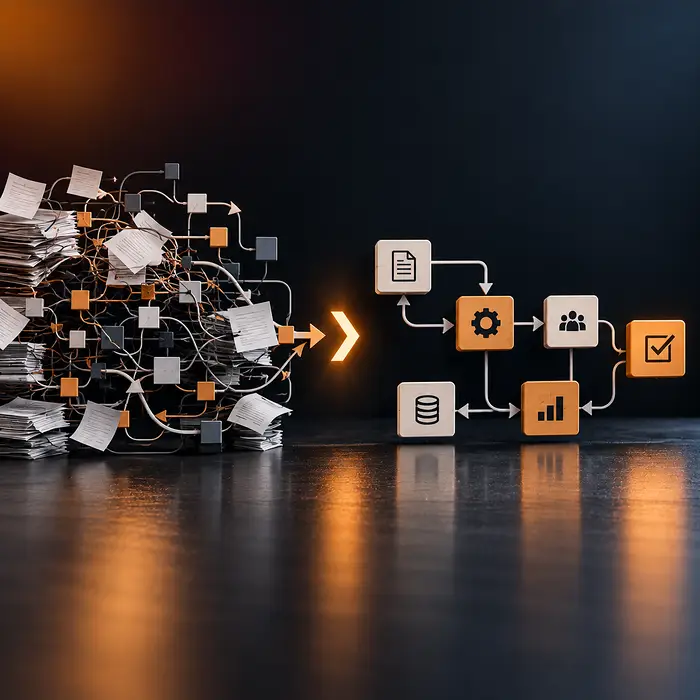
Business process redesign is the structured rethinking of how a piece of work moves through an organization: its steps, handoffs, decision points, roles, and supporting systems. Our business process redesign solutions cover the full path from understanding the process as it runs today, to designing a better future state, to planning adoption and measuring the result. The depth of change depends on the process and your goals; some need a few steps removed, others a rebuilt flow.
- Current-state process assessment and mapping
- Bottleneck, handoff, and root-cause analysis
- Business workflow redesign and standardization
- Roles, responsibilities, and process governance
- KPI definition and performance measurement
- Implementation planning and change management
Why Businesses Invest in Business Process Redesign
Businesses invest in business process redesign when existing workflows create delays, inconsistent outcomes, rising operational costs, or barriers to growth. Unlike incremental process improvement, business process redesign examines how work is structured across teams to identify opportunities for greater efficiency, accountability, and scalability.
Simpler Workflows With Fewer Handoffs
Removing steps that exist out of habit, merging duplicate approvals, and shortening decision paths give work fewer places to stall.
Clear Ownership and Consistent Execution
With one accountable owner per step and one agreed way of working, results no longer depend on who handles the request.
Visibility Into How Processes Perform
KPIs such as cycle time, rework, and backlog show leaders where work waits and whether a change helped, instead of relying on anecdotes.
A Sounder Base for Automation and Growth
A clear, consistent process is easier to automate, easier to train new staff on, and easier to scale than one held together by workarounds.
Right-Sized, Built to Last
We scope the redesign to your problem, plan adoption from the start, and track agreed KPIs so you can see the results. If a smaller improvement is enough, we will say so.
Business Process Redesign Solutions Built Around Your Workflows
Our business process redesign solutions address specific operational challenges, from unclear approval paths to disconnected systems and inconsistent workflows. We tailor each engagement to your current processes, business priorities, and improvement opportunities, helping you determine which changes will deliver the greatest value.
Business Process Assessment and Mapping
Document existing workflows, responsibilities, and system interactions to establish a clear baseline for business process redesign.
Bottleneck and Handoff Analysis
Identify where tasks stall, information is duplicated, or work returns for correction, then prioritize the root causes of delays.
Business Workflow Redesign
Restructure end-to-end workflows across departments to improve task sequencing, coordination, and operational efficiency.
Approval and Decision-Path Simplification
Review approval rules, authority levels, and decision points to reduce unnecessary delays while maintaining appropriate controls.
Roles, Ownership, and Process Governance
Define process owners, responsibilities, escalation paths, and review procedures to support consistent execution.
Process Standardization Across Teams
Establish common procedures across teams, locations, or departments while retaining necessary business-specific variations.
Process Performance Measurement
Define baseline metrics and KPIs to evaluate changes in cycle time, error rates, rework, and overall process effectiveness.
Technology-Enabled Process Redesign
Identify where workflow platforms, system integrations, or AI-assisted tasks can support the redesigned process.
Enterprise Process Redesign and Modernization
Coordinate complex business process redesign initiatives across multiple departments and systems through a phased implementation strategy.
Not Sure Whether You Need a Redesign or a Smaller Fix?
Not every workflow requires a complete redesign. Our business process assessment helps identify whether your challenges need targeted process improvement, a structural redesign, or workflow automation. Share your goals and current challenges to explore the right approach for your business.
Our Business Process Redesign Process
Our business process redesign methodology takes your team from initial discovery to a measurable improvement plan. Each stage builds on the previous one, ensuring that redesigned workflows reflect business requirements, stakeholder needs, and practical implementation considerations.
- 1
Goals, Scope and Stakeholder Discovery
Define business objectives, process boundaries, stakeholders, and success criteria.
- 2
Current-State Assessment and Mapping
Document existing workflows, responsibilities, system dependencies, and operational challenges.
- 3
Bottleneck and Root-Cause Analysis
Evaluate delays, duplication, rework, and inconsistent execution to prioritize improvement opportunities.
- 4
Future-State Process Design
Create an optimized workflow with defined roles, decision rules, handoffs, and performance indicators.
- 5
Implementation Planning and Adoption
Develop a phased rollout plan covering documentation, training, change management, and supporting technology requirements.
- 6
Measurement and Continuous Improvement
Compare results against baseline KPIs and establish regular reviews to identify further process improvements.
Business Process Redesign Services: Use Cases
Business process redesign can address operational challenges across finance, HR, procurement, customer service, and other business functions. Explore common use cases where restructuring workflows can improve coordination, accountability, and process consistency.
Invoice and Payment Approval Workflows
Invoices pass through several approvers, with data re-entered between systems. Redesign clarifies who approves what and at which threshold, removes duplicate entry, and defines how exceptions are handled.
Employee Onboarding and HR Requests
New-hire tasks are spread across HR, IT, and facilities with no single owner. Redesign sequences the tasks, assigns ownership, and gives managers visibility into what is still open.
Procurement and Purchase Approvals
Requests stall because nobody is sure who must sign off. Redesign defines approval paths by value and category and removes steps that add delay without reducing risk.
Customer Request and Service Handling
A request is passed between teams and customers repeat themselves. Redesign defines intake, routing, and escalation so each request has one owner and one record.
Claims, Case or Application Intake and Review
Submissions arrive in different formats and reviewers handle them differently. Redesign standardizes intake, defines review criteria, and clarifies when a case needs a specialist.
Sales-to-Operations Handoffs
A closed deal reaches delivery with missing details. Redesign defines what information must accompany the handoff and who confirms it before work begins.
Reporting and Month-End Cycles
Recurring reports depend on manual consolidation across teams. Redesign clarifies inputs, owners, and deadlines, and identifies which steps are worth automating afterwards.
Cross-System Exception Handling
Exceptions require someone to check several systems before acting. Redesign defines who decides, what data they need, and when a case should escalate.
Process Improvement vs. Process Redesign vs. Process Reengineering
Understand the key differences between process improvement, redesign, and reengineering to determine the right approach for optimizing workflows, improving efficiency, and achieving your business goals.
Tools and Technologies That Support Business Process Redesign
We leverage the right tools and technologies to optimize workflows, automate tasks, analyze performance, and integrate systems based on your business needs and security requirements.































Industries We Help With Business Process Redesign
Why Choose Wappnet AI for Business Process Redesign?
Wappnet AI combines business process redesign consulting with practical engineering expertise to help organizations turn process improvements into implementable solutions. We focus on your operational goals, existing systems, and long-term requirements to deliver a redesign strategy that fits your business.
Process First, Technology Second
We assess the workflow before proposing tools, so technology supports the redesigned process instead of driving it.
Design Backed by Engineering
Strategy and engineering sit under one team, so a redesigned process is checked against what your systems and data can really support.
Works Inside Your Existing Tools
We connect to the CRMs, ERPs, and internal tools you already run, usually without asking you to replace them.
Clear Scope and Ongoing Review
Scope, timeline, and cost are agreed before work starts, and we plan monitoring and review so the redesigned process keeps improving.
Real-World Business Process Redesign Solutions We've Delivered
Ready to Improve Your Business Processes?
Let's discuss your operational challenges and identify opportunities to streamline workflows, reduce inefficiencies, and improve business performance. Wappnet.ai can help you define a practical business process redesign strategy aligned with your goals.
Latest AI Insights & Industry Trends
 RAG
RAG vs Fine-Tuning vs Prompt Engineering: Which Approach Fits Your Use Case?
Compare RAG, fine-tuning, and prompt engineering to explore costs, use cases, and the best approach for enterprise AI.
 AI Copilot
What is an AI Copilot? Use Cases & Build Guide
What is an AI Copilot? Learn how it works, how it differs from AI agents, key use cases, and how to build one for your business.
 RAG
What Is RAG? A Complete Guide to Retrieval-Augmented Generation
Learn what RAG is, how Retrieval-Augmented Generation works, reduces AI hallucinations, and powers smarter enterprise AI.
Frequently Asked Questions
Business process redesign is the structured evaluation and restructuring of workflows, responsibilities, and decision paths to improve operational efficiency and align processes with business objectives.
Business process redesign services help organizations assess existing workflows, identify inefficiencies, develop optimized process designs, and plan implementation based on their operational needs.
Business process redesign typically involves discovery, current-state mapping, root-cause analysis, future-state design, implementation planning, and performance measurement.
Business process redesign can improve workflow efficiency, clarify responsibilities, reduce unnecessary rework, strengthen process consistency, and create a better foundation for automation and growth.
The terms overlap and are often used interchangeably. Reengineering usually means a radical rebuild from a clean sheet, often across functions, while redesign usually means restructuring a process, keeping what still works. We size the change to the process and the business goals.
Process improvement makes incremental changes to how an existing process runs, such as removing a step or fixing a recurring error. Redesign questions the structure of the process itself, including its handoffs, decision paths and ownership. Improvement fits when the design is sound; redesign fits when the design is the problem.
Common signals include persistent delays or rework, inconsistent results between teams, heavy manual effort, unclear ownership, growth that the process cannot absorb, and plans to automate a process nobody has reviewed. If results are close to target, a smaller improvement may be enough.
Most repeatable workflows can be, and operational process redesign often starts with approvals, onboarding, procurement, customer request handling, claims or case intake, reporting cycles and handoffs between sales and operations. Processes that cross several teams or systems often benefit most because no single team owns the whole flow.
We evaluate workflow maps, operational data, employee feedback, and process performance metrics to identify delays, duplicated tasks, unnecessary approvals, and recurring errors.
Business process redesign identifies and removes unnecessary steps before automation begins, helping organizations automate consistent workflows while preserving human oversight for decisions that require judgment.
By setting a baseline before the change and tracking agreed KPIs after it, such as cycle time, rework or error rate, backlog, and adherence to the new process. Qualitative feedback from the people who run the process helps explain the numbers.
A business process redesign engagement typically delivers documented workflows, prioritized improvement opportunities, a future-state process design, agreed performance metrics, and an implementation plan tailored to the organization.
It depends on the number of processes, how many teams and systems they cross, how much data exists, and how much change the organization can absorb at once. We propose a phased plan after discovery rather than quoting a fixed timeline upfront.
Cost depends on scope: how many processes, how many teams, how deep the assessment goes, and whether implementation support or technology work is included. We agree on scope, timeline, and cost with you before work starts, once we understand the process.