
AI Strategy and Roadmap Services
Our AI Strategy and Roadmap Services help enterprise leaders decide where AI genuinely fits their business, not just where it's technically possible. We align AI initiatives with your business objectives, assess how ready your data, systems, and teams actually are, identify and prioritize the opportunities worth pursuing, and turn the resulting recommendations into a phased implementation roadmap with governance, milestones, and success measures built in. The goal is a plan you can defend to your board and hand to your delivery team, not a slide deck that never leaves the room.

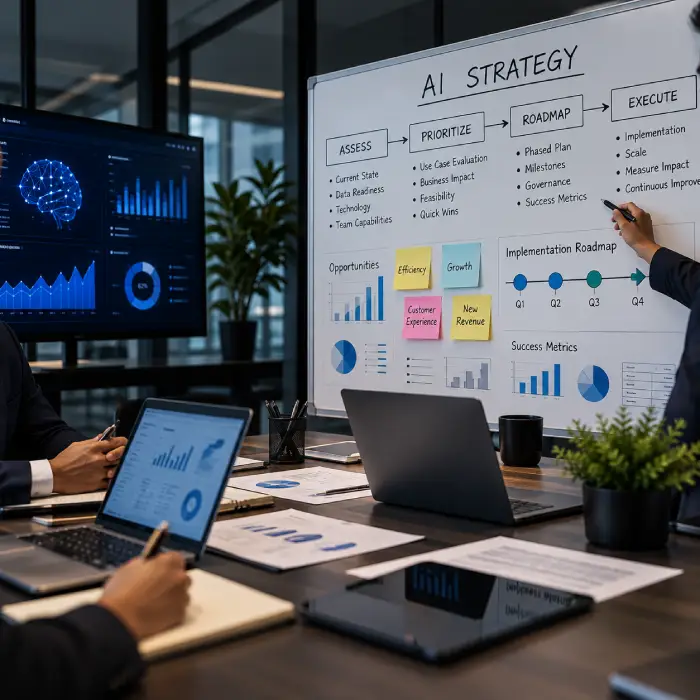
What Do AI Strategy & Roadmap Services Include?
AI strategy and roadmap services cover the planning work that has to happen before, and alongside, any AI build: aligning AI to business goals, understanding what your organization can realistically execute, choosing the opportunities worth pursuing, and sequencing them into a roadmap with governance built in. This is AI strategy consulting services, and more broadly, AI strategy services, focused on decisions, not a generic survey of AI technologies.
- We align AI initiatives with your business objectives and real operational needs, not technology for its own sake.
- We run a structured AI readiness assessment and AI maturity assessment of your data, systems, and teams.
- We carry out AI opportunity assessment and discovery, weighing each opportunity's value, feasibility, and risk.
- We apply AI use-case prioritization, ranking opportunities by impact, feasibility, cost, and time to value.
- We build AI feasibility assessments and business cases, with cost-benefit analysis and ROI assumptions.
- We support AI investment planning through phased, risk-balanced funding decisions.
- We plan AI governance and risk management: ownership, compliance, oversight, and accountability.
- We develop a phased implementation roadmap with milestones, dependencies, and KPIs.
Why Businesses Invest in AI Strategy & Roadmap Services
Most organizations don't struggle to find AI ideas; they struggle to decide which ones deserve real investment, and in what order. Structured strategy and roadmap planning exists to answer that, not to guarantee a specific return. We're direct about what it can and can't promise.
Unclear Priorities Among Competing AI Ideas
When every department has an AI idea, and none are scored against the same criteria, investment decisions default to whoever argues loudest, not what creates the most business value.
Pilots That Don't Connect to a Larger Strategy
Disconnected proofs of concept can demonstrate a technology works without ever showing whether it's worth scaling, leaving leadership with interesting demos and no clear next step.
Uncertainty About Investment Value
Without a documented business case, it's hard to compare an AI initiative against other capital priorities, and harder still to defend the spend if results take longer than hoped.
Data and System Limitations Discovered Too Late
Projects that skip a readiness assessment often discover data quality, access, or integration problems mid-build, when they're far more expensive to fix than they would have been upfront.
Governance Treated as an Afterthought
Privacy, security, and oversight questions that surface after deployment tend to stall or unwind initiatives that could have been designed around them from day one.
AI Strategy & Roadmap Solutions Built Around Business Goals
As an AI strategy consulting company, our AI roadmap development services help businesses assess readiness, evaluate AI opportunities, build business cases, and define governance and implementation priorities tailored to their objectives.
AI Readiness and Maturity Assessment
Before we recommend anything, we evaluate your data maturity, infrastructure, workflows, and team skills so leadership has a clear, evidence-based view of what the organization can realistically support today, as part of a broader AI readiness assessment engagement.
AI Opportunity Assessment and Prioritization
We score candidate opportunities on business value, feasibility, dependencies, and risk, turning a long list of ideas into a ranked, defensible shortlist leadership can act on with confidence.
AI Feasibility and Business-Case Assessment
We pressure-test a promising opportunity against cost, data, and delivery reality, then build the cost-benefit analysis and ROI assumptions behind a business case leadership can approve or decline.
Enterprise AI Strategy Development
When AI activity is scattered across departments with no shared direction, we consolidate objectives, readiness findings, and prioritized opportunities into a single enterprise AI strategy leadership and teams can align to.
Generative AI and Agentic AI Opportunity Planning
Generative and agentic AI are easy to pilot and hard to scale responsibly. Our generative AI strategy consulting and agentic AI strategy work assesses where LLMs, retrieval-augmented approaches, and AI agents genuinely fit your workflows, with implementation depth available through our generative AI and agentic AI development teams.
AI Governance and Risk Planning
We define governance structures, risk controls, and review processes before deployment, not after, so privacy, security, and oversight gaps don't surface once an initiative is already live. Full implementation support is available through our responsible AI development team.
AI Investment Planning
We build phased investment options tied to risk and expected value, so leadership can commit budget in stages that match your planning cycle instead of approving a single large bet upfront.
AI Implementation Roadmap Development
We sequence the recommended initiatives into an AI implementation roadmap with milestones, dependencies, pilots, resources, and KPIs, ready to hand to a delivery team, including our own MLOps and AI infrastructure practice for what comes after.
Not Sure Where to Start With AI?
Tell us about your business objectives, what you already know about your AI readiness, and the investment priorities you're weighing. We'll help you work out what a realistic strategy and roadmap engagement should cover for your organization, with no assumption that full-scale AI transformation is the right first step.
Our AI Strategy & Roadmap Process
Our AI roadmap consulting services follow a structured, business-focused process to identify AI opportunities, prioritize initiatives, and plan implementation. We tailor each engagement to your business goals, data maturity, and organizational needs, with timelines agreed upon after the initial assessment.
- 1
Understand Business Objectives and Challenges
We start with your goals, operational pain points, and customer needs rather than a technology wish list, and document the business objectives every later recommendation will be measured against.
- 2
Assess AI Readiness, Data, Systems, and Capabilities
We review data maturity, existing systems, workflows, organizational skills, and adoption barriers, so the readiness picture reflects what your teams can genuinely support rather than what we'd prefer to assume.
- 3
Identify and Evaluate AI Opportunities
We surface AI opportunities relevant to your business and evaluate each one on business value, feasibility, dependencies, and risk before any opportunity earns a place on the shortlist.
- 4
Prioritize Use Cases and Assess Feasibility
We rank opportunities by impact, feasibility, data availability, complexity, cost, and time to value, then stress-test the strongest candidates against real delivery constraints.
- 5
Define Investment, Governance, and Implementation Requirements
We translate the shortlist into phased investment options alongside the governance, risk, and oversight structures each initiative needs before it's approved.
- 6
Develop an AI Implementation Roadmap With Milestones and KPIs
We sequence the recommended initiatives into a roadmap with dependencies, pilot projects, resourcing, and KPIs that your team and ours can execute against- the core output of our AI roadmap development services.
AI Strategy & Roadmap Use Cases
AI strategy and roadmap planning can support a range of business initiatives, from enterprise AI adoption and workflow automation to predictive analytics and AI-powered customer service. The right approach depends on your business challenges, available data, and operational requirements.
Enterprise AI Adoption Planning
A business wants to move beyond isolated experiments to a coordinated AI program. Strategic decisions involve setting enterprise-wide objectives and governance; key factors are executive sponsorship and cross-functional data access.
Customer Service Transformation
Rising support volume makes a conversational or agentic AI investment attractive. Strategic decisions involve scope and escalation design; key factors are data quality, integration complexity, and change management for support teams.
Intelligent Workflow Automation
Manual, repetitive processes are consuming staff time across departments. Strategic decisions involve which workflows to automate first; key factors are process variability and the systems the workflow touches.
Data and Analytics Modernization
Fragmented or low-quality data is limiting what any AI initiative can realistically achieve. Strategic decisions involve sequencing data work against AI ambitions; key factors are data ownership and existing infrastructure.
Generative AI Adoption Planning
Leadership wants to apply generative AI but isn't sure where it adds defensible value. Strategic decisions involve use-case selection and risk tolerance; key factors are content sensitivity and model governance needs.
Enterprise Knowledge Management
Institutional knowledge is scattered across systems and hard to retrieve. Strategic decisions involve scope of the knowledge base and access controls; key factors are document quality and search or retrieval requirements.
Predictive Analytics Initiatives
A business wants to anticipate demand, risk, or churn rather than react to it. Strategic decisions involve which predictions are decision-grade versus directional; key factors are historical data depth and model monitoring needs.
AI-Assisted Decision Support
Decision-makers want AI input into complex judgment calls without ceding the decision itself. Strategic decisions involve where human oversight sits in the loop; key factors are explainability and accountability requirements.
AI Agent and Multi-Agent Initiative Planning
A business is considering AI agents to handle multi-step tasks autonomously. Strategic decisions involve the level of autonomy to grant and how failures are caught; key factors are system access, oversight design, and rollback planning.
AI Strategy vs. AI Roadmap vs. AI Implementation
AI strategy defines your business goals, the roadmap outlines how to achieve them, and implementation turns plans into working solutions. Aligning all three helps businesses reduce risks, prioritize investments, and drive successful AI adoption.
Technologies, Platforms, and Frameworks We Evaluate
We evaluate technologies and frameworks based on your business goals, existing infrastructure, data readiness, security, scalability, and budget to recommend the right AI strategy for your needs.























Industries We Help With AI Strategy & Roadmap Planning
Why Choose Wappnet AI for AI Strategy & Roadmap Services?
An AI strategy that only your consultants can read isn't a strategy your business can execute. As an AI strategy and roadmap consulting company and AI strategy services provider, we build strategies and roadmaps your leadership team and your delivery team can both act on, and we're the same company that can build what the roadmap calls for.
Business-First AI Planning
We start from your objectives and operational reality, not a preference for the newest AI technology. If a smaller pilot or a non-AI fix solves the problem, that's what we recommend.
Practical Feasibility Assessment
We test opportunities against your actual data, systems, and team capacity before they reach a roadmap, rather than assuming feasibility from a demo.
Alignment Between Strategy and Implementation
Because we also build generative AI, agentic AI, and data engineering solutions, our roadmaps are shaped by what's realistic to deliver, not just what's strategically appealing.
Responsible AI and Risk Awareness
Governance, privacy, and oversight are part of the planning conversation from the start, supported by our dedicated responsible AI development practice.
Real-World AI Strategy and Roadmap Solutions We've Delivered
Real-world AI strategic engagements helping enterprise leaders prioritize high-impact AI investments and execute with confidence.
Enterprise AI Opportunity & Readiness Assessment
Evaluated 30+ candidate AI initiatives across operations and customer care, delivering a ranked 18-month execution roadmap and board-ready business cases.
Responsible AI Framework & Risk Strategy
Established enterprise AI risk classification, model inventory, and oversight checkpoints aligned to NIST AI RMF for a global financial institution.
Generative AI Feasibility & Build-vs-Buy Roadmap
Stress-tested vendor solutions vs custom LLM architecture for internal knowledge retrieval, defining phased capital allocation and ROI milestones.
Ready to Talk Through Your AI Priorities?
Bring your business objectives, what you know about your current AI readiness, and the opportunities you're weighing. We'll help you think through priorities, feasibility, and investment options, and suggest a practical next step, with no obligation and no promise of a guaranteed outcome.
Latest AI Insights & Industry Trends
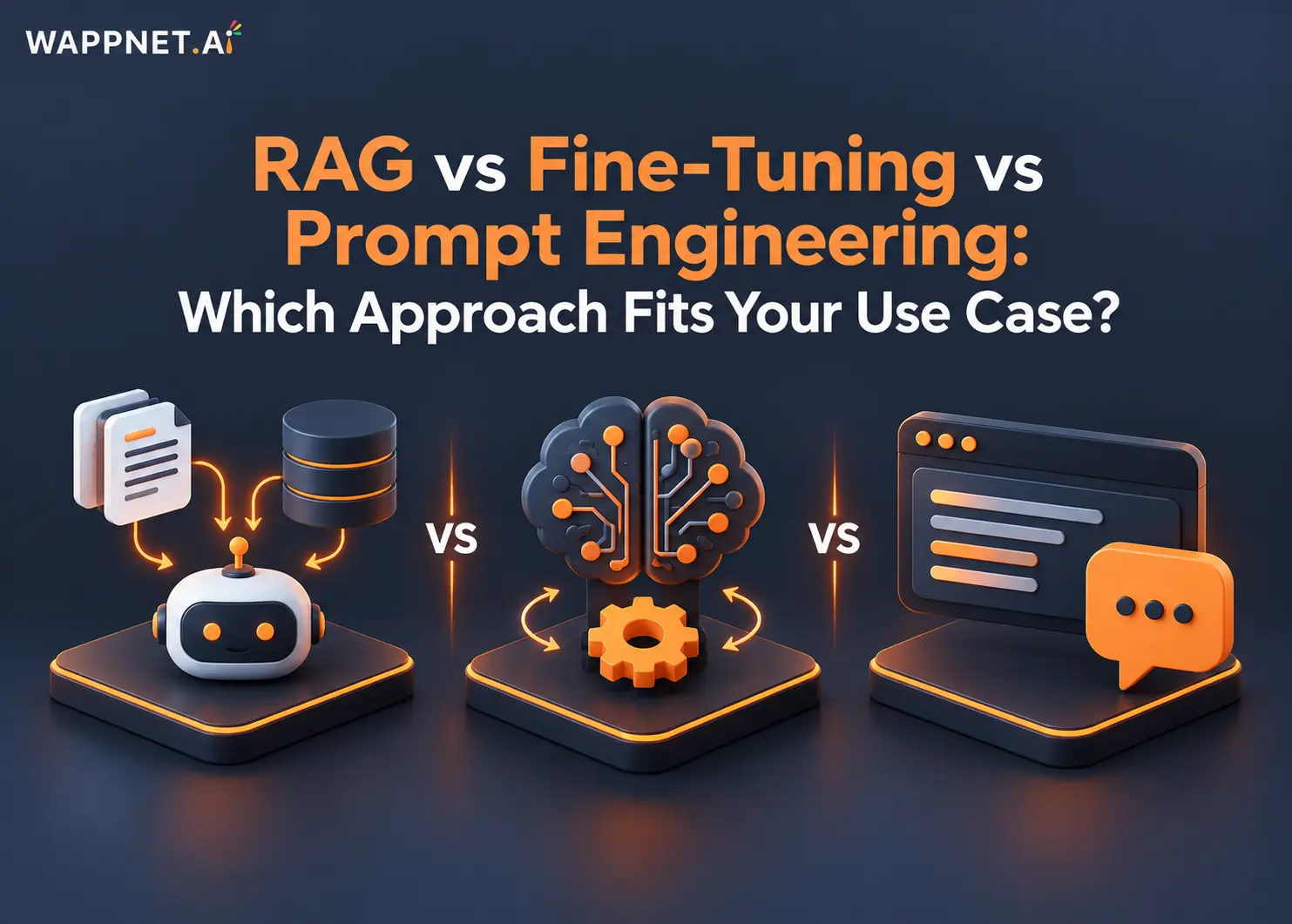 RAG
RAG vs Fine-Tuning vs Prompt Engineering: Which Approach Fits Your Use Case?
Compare RAG, fine-tuning, and prompt engineering to explore costs, use cases, and the best approach for enterprise AI.
 AI Copilot
What is an AI Copilot? Use Cases & Build Guide
What is an AI Copilot? Learn how it works, how it differs from AI agents, key use cases, and how to build one for your business.
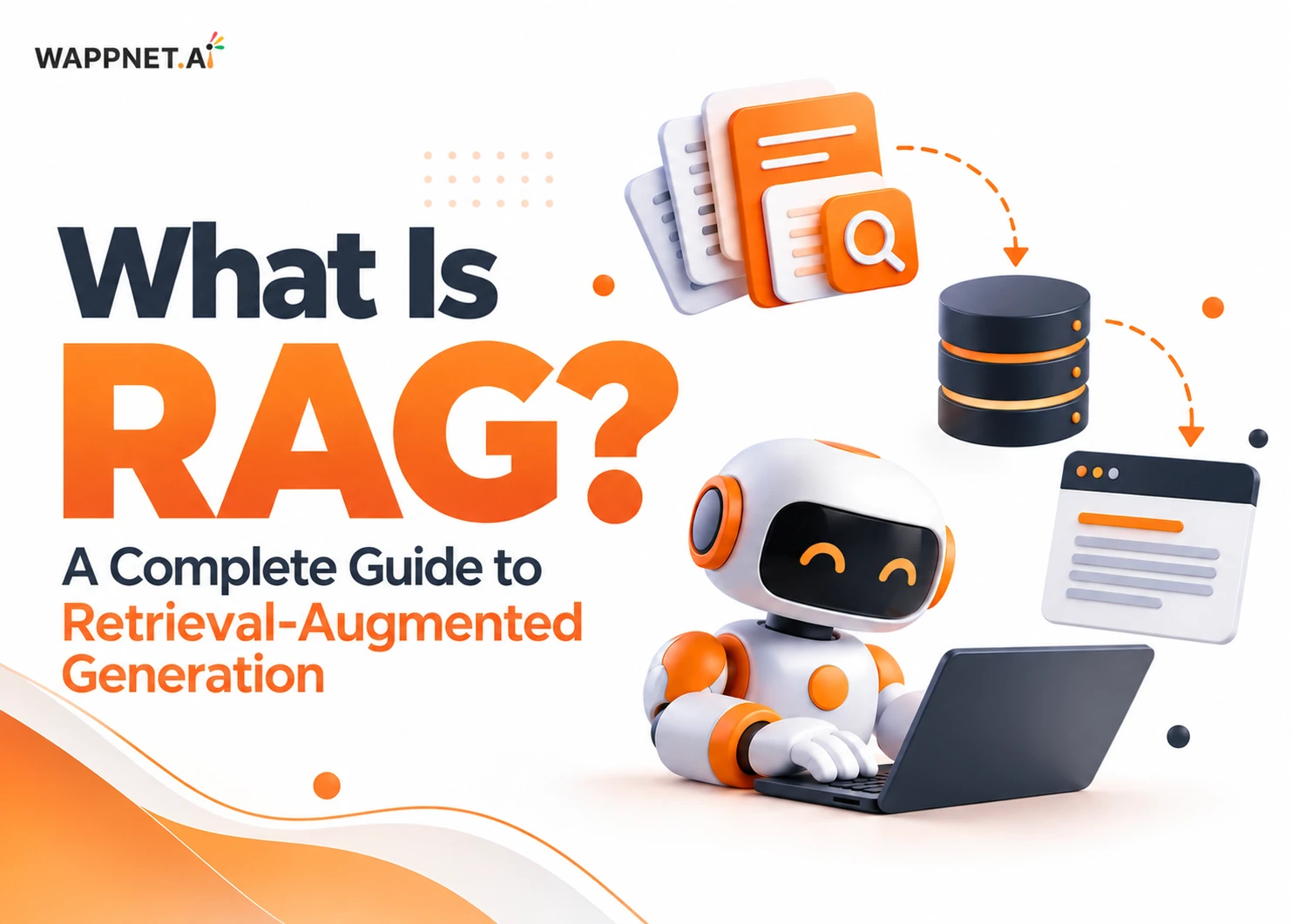 RAG
What Is RAG? A Complete Guide to Retrieval-Augmented Generation
Learn what RAG is, how Retrieval-Augmented Generation works, reduces AI hallucinations, and powers smarter enterprise AI.
Frequently Asked Questions
AI strategy and roadmap services are the planning work that aligns AI initiatives with business objectives, assesses organizational readiness, identifies and prioritizes AI opportunities, builds the investment case, plans governance, and turns the recommendations into a phased implementation roadmap with milestones and KPIs.
An AI strategy assessment typically covers business objective alignment, an AI readiness and maturity review, opportunity discovery and evaluation, use-case prioritization, feasibility and business-case analysis, and an initial view of governance and investment requirements.
We review data maturity and availability, existing systems and infrastructure, current workflows, organizational skills, and adoption barriers, producing a readiness report that flags the gaps most likely to affect an AI initiative's success.
We identify opportunities relevant to your business and rank them against business impact, feasibility, data availability, implementation complexity, cost, and time to value, so the reasoning behind each priority is visible and defensible.
Through feasibility assessment and business-case development: a documented cost-benefit analysis and explicit ROI assumptions for each prioritized initiative, reviewed against your budget and risk appetite. We don't quote fixed ROI figures before this analysis is done.
An AI strategy decides where AI should create value for the business and which opportunities to prioritize. An AI roadmap sequences those priorities into an executable, time-bound plan with milestones, dependencies, resourcing, and KPIs.
Governance (responsible AI practices, privacy, security, risk management, applicable compliance requirements, human oversight, and accountability) is addressed during strategy and roadmap planning itself, not left until after an AI system is already built.
It depends on organizational complexity, data maturity, and the number of stakeholders involved. We propose a scoped timeline after the initial objective-alignment and readiness-assessment steps rather than quoting a fixed duration upfront.