
AI Build vs. Buy Advisory Services
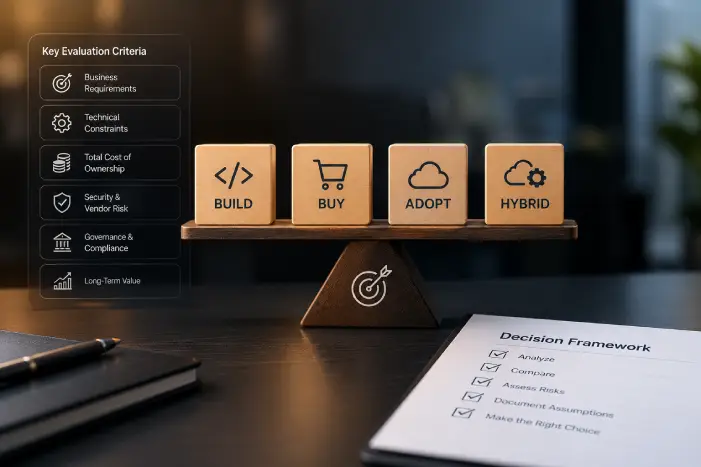
Most AI budgets are spent before the real question gets asked: should this be built, bought, adopted through a platform you already run, or some combination of the three? Our AI build vs. buy advisory services give you a structured, evidence-based answer, weighing your business requirements, technical constraints, total cost of ownership, security and vendor risk, and long-term value, before you commit engineering time or budget. We do not start from the assumption that building is better or that buying is cheaper; we start from your situation.

What Is AI Build vs. Buy Advisory?
AI build vs. buy advisory helps businesses decide whether to develop a custom AI solution, purchase a commercial AI product, adopt capabilities already available in existing platforms, or combine these approaches. As an AI build vs. buy consulting company, Wappnet AI evaluates business objectives, technical feasibility, costs, and risks to develop an AI build vs. buy strategy aligned with your requirements.
- Our AI build vs. buy consulting services begin with your business objectives and use cases, not a preferred technology or vendor.
- We compare custom AI development feasibility with commercial AI platform and vendor options.
- Our AI investment assessment considers total cost of ownership and long-term operating costs.
- We evaluate integration requirements, security, governance, and vendor risks.
- You receive a documented build, buy, adopt, or hybrid recommendation with a practical implementation roadmap.
Why Businesses Need Build vs. Buy Advisory
AI investment decisions often get made under pressure, by whichever team argues loudest, or by copying what a competitor announced. That approach is a common source of wasted budget. A documented, criteria-based comparison of build, buy, adopt, and hybrid options gives decision-makers a clear basis for the choice and a record of the assumptions behind it. Structured enterprise AI advisory services reduce uncertainty in the decision; they do not guarantee a particular saving, outcome, or result, since much depends on execution, data quality, and adoption.
Unclear AI Investment Priorities
Many organizations face a list of possible AI use cases with no agreed way to rank them, or to decide which deserve custom development versus an off-the-shelf tool.
Unnecessary Custom Development
Teams sometimes build AI capability that a commercial product or an existing platform feature already provides, adding delivery risk and ongoing maintenance for no strategic gain.
Vendor Products That Don't Fit
A commercial AI tool that looked strong in a demo can fail on integration, data requirements, customization limits or pricing once usage scales.
Uncertain Operating Costs
Model usage, API fees, infrastructure, monitoring, and maintenance are frequently underestimated on both sides of the decision, distorting the real total cost of ownership.
Security, Governance and Dependency
Data ownership, privacy, compliance obligations, and the risk of depending on a single vendor's roadmap all change the calculation and are often reviewed too late.
Our AI Build vs. Buy Advisory Services
Our AI solution assessment services help businesses compare build, buy, adopt, and hybrid approaches based on their business goals, technical requirements, budget, and long-term needs. Each engagement focuses on the specific decision at hand, from evaluating a single use case to planning AI investments across the organization.
AI Opportunity & Requirements Assessment
We clarify the business objective, use cases, data availability, expected outcomes, and technical constraints before any build-or-buy option is evaluated. This is an AI opportunity assessment, not a sales pitch for a direction.
AI Platform & Vendor Evaluation
We assess relevant AI platforms, foundation models, commercial products, and APIs against your requirements, conducting a thorough AI vendor evaluation covering functional fit, pricing mechanics at scale, and contract terms worth negotiating.
Custom AI Development Feasibility
We run an AI feasibility assessment on whether a custom AI application, model, agent, or workflow offers enough strategic or functional advantage to justify the development, maintenance, and talent commitment it requires.
Total Cost of Ownership (TCO) Comparison
We compare development, licensing, infrastructure, integration, model usage, monitoring, and ongoing operating costs across every option on the table over a multi-year horizon rather than year one alone.
Technical Architecture & Integration Review
We assess compatibility with your existing systems, data infrastructure, APIs, security requirements, scalability needs, and deployment environment for each option under consideration.
Security, Privacy & Governance Review
We review data ownership, privacy obligations, intellectual property, model dependency, vendor lock-in, and exit options as part of the decision, not as an afterthought.
Business Value & Investment Assessment
We compare expected business benefits, feasibility, time to value, implementation risk, and long-term strategic value across the options, so the decision is grounded in more than cost alone.
Decision Matrix & Recommendation
We document a structured build, buy, adopt, or hybrid recommendation, weighted to the priorities and constraints you define, with the reasoning and assumptions made explicit.
AI Adoption & Implementation Roadmap
We lay out practical next steps, such as custom development, vendor selection, a proof of concept, platform integration, or a phased adoption plan, so the recommendation turns into a plan your team can execute.
Not Sure Which AI Options Are Even on the Table?
Tell us the business problem, your current systems, and the AI options you're already weighing. We'll help you identify what's realistic to evaluate and scope a focused first assessment.
Our AI Build vs. Buy Advisory Process
Our process moves from requirements discovery and option evaluation to a documented recommendation and implementation roadmap. The scope and timeline depend on your use cases, data complexity, and vendor requirements, which we confirm during discovery.
- 1
Understand Business Objectives & Requirements
We clarify the problem, intended outcomes, users, data, and technical constraints, and turn them into an agreed scope and requirements brief.
- 2
Assess AI Opportunities, Data & Systems
We review your data readiness, existing platforms, integration points, and any constraints that rule options in or out, producing a feasibility and readiness summary.
- 3
Evaluate Commercial Options & Build Feasibility
We assess relevant AI platforms, vendors, and APIs alongside a custom-development feasibility review, using the same evaluation criteria for both, and narrow the field to a shortlist of viable options.
- 4
Compare Cost, Architecture, Risk & Value
We model total cost of ownership, review architecture and integration fit, assess security and vendor risk, and estimate business value for each shortlisted option, laid out as a side-by-side comparison.
- 5
Recommend the Most Suitable Approach
We document a build, buy, adopt, or hybrid recommendation weighted to your stated priorities, with assumptions and trade-offs made explicit in a decision matrix.
- 6
Define the Implementation Roadmap
We turn the recommendation into a sequenced plan with milestones, owners and the first check-in point, ready to hand to your delivery team, so the decision doesn't stall once the report is delivered.
AI Build vs. Buy Advisory Use Cases
Explore how build-vs-buy decisions apply to common AI use cases. The right approach depends on your business goals, data, existing systems, team capabilities, and the level of competitive differentiation you want to achieve.
Enterprise Knowledge Assistants
A commercial assistant or retrieval-augmented add-on can work well when the knowledge base is well-structured; custom development tends to matter more when proprietary data, workflows, or access controls are complex.
Customer Support Automation
Standard inquiries are often well served by a commercial or platform-native chatbot; a custom solution becomes more attractive when deep integration with internal systems or highly specific escalation logic is required.
AI-Powered Workflow Automation
Where the workflow mirrors common business processes, buying or adopting existing automation features is usually faster; where the logic is unique to how your business operates, building offers more control.
Custom AI Agents
Agent platforms can accelerate a first deployment, but agents operating on sensitive data, proprietary tools or regulated decisions often warrant custom development or a tightly governed hybrid.
Predictive Analytics
Standard forecasting problems may be served by platform features already in your analytics stack; models built on your own historical and operational data can offer an edge where that data is genuinely unique.
Document Processing
Commercial document AI tools handle many common formats well; custom development becomes more relevant for unusual document types, strict accuracy requirements or deep system integration.
Generative AI Applications
Foundation model APIs let most generative use cases start quickly; building becomes more relevant when fine-tuning, proprietary data or tight brand and compliance controls are central to the application.
AI-Enabled Business Applications
Where an existing enterprise platform already offers the AI capability you need, adopting it is usually the fastest path; building makes sense when the capability must be woven tightly into a differentiated product experience.
Build vs. Buy vs. Adopt vs. Hybrid: How the Four Approaches Compare
No single approach works for every situation. Build vs. buy AI solutions decisions depend on customization needs, time to value, and your team’s capacity to manage ongoing ownership. Our AI solution selection consulting compares these options, including custom AI development vs. existing AI solutions, based on your specific business requirements.
| Approach | What it means | Customization | Typical cost pattern | Time to value | Control & data ownership | Ongoing maintenance |
|---|---|---|---|---|---|---|
Build | A custom AI solution, model, agent or workflow designed around your specific requirements | Highest, shaped entirely to your use case | Higher upfront cost; depends on scope and team retained after launch | Longest, depending on scope and team capacity | Highest; you own the model, logic and data pipeline | Your team handles updates, monitoring and retraining |
Buy | A commercial AI product or platform licensed to meet an existing, largely standard need | Limited to vendor configuration options | Lower upfront cost; licensing and usage fees typically grow with scale | Fastest for well-matched, standard use cases | Lower; data and logic often sit within the vendor’s environment | Largely handled by the vendor within contract terms |
Adopt / Integrate | AI capability already available inside a platform or system you currently run | Limited to what the platform supports | Often the lowest incremental cost if already licensed | Fast, since no new procurement or development cycle is required | Moderate; governed by your existing platform agreement | Shared with the platform vendor, depending on its update cycle |
Hybrid | Commercial components such as models, platforms and APIs combined with custom applications, workflows or integrations | High where needed, standard elsewhere | Mixed; often offers good multi-year value for mid-complexity needs | Moderate, depending on the custom scope | Shared between your team and vendors | Split between internal ownership and vendor-managed components |
Technologies, Platforms, and Frameworks We Evaluate
Our AI technology advisory and AI platform selection services help businesses evaluate technologies based on their use cases, technical requirements, budget, scalability, security, and long-term ownership needs. We compare relevant platforms, models, and tools to identify the most suitable build, buy, adopt, or hybrid approach without implying unverified vendor partnerships or certifications.









Industries We Help With AI Build vs. Buy Advisory
Why Choose Wappnet AI for AI Build vs. Buy Advisory?
We are an AI advisory services company that also builds AI systems, which means our cost and feasibility assessments are grounded in delivery reality, not theory. We are direct about trade-offs, including when the right answer is to buy, adopt, or do nothing yet.
Advisory Grounded in Delivery Experience
Our teams provide hands-on custom AI development consulting and also build custom AI applications, agents and data platforms, so our feasibility and cost estimates reflect what development and operation actually require, not a generic estimate.
No Default Toward Building
As an AI strategy consulting company, our recommendation is not biased toward billable custom development. Where a commercial product or existing platform capability is the better fit, that is what we recommend.
Full Cost & Risk Picture
We account for total cost of ownership, security, governance, and vendor risk together, rather than evaluating cost in isolation from long-term dependency and exit options.
A Plan You Can Act On
Every engagement ends with a documented recommendation and implementation roadmap. As an enterprise AI consulting services provider, our AI consulting and development team can carry it through to delivery when you’re ready.
Real-World AI Build vs. Buy Advisory Solutions We've Delivered
Real-world evaluations helping enterprise leaders weigh custom engineering against commercial SaaS platforms for optimal ROI.
Customer Service AI Platform Selection & Build Feasibility
Compared 4 enterprise copilot vendors against a custom LangGraph agent architecture for an e-commerce retailer, proving a hybrid approach saved $320k annually.
Healthcare Clinical Document Intelligence Platform Audit
Evaluated specialized commercial medical OCR against custom open-source fine-tuned models, identifying HIPAA compliance gaps and optimizing multi-year TCO.
Enterprise Knowledge Assistant Build vs. SaaS Decision Matrix
Modeled 3-year TCO for internal knowledge retrieval across 10,000 employees, choosing a commercial foundation model API paired with a custom internal RAG pipeline.
Ready to Settle Your Next AI Build vs. Buy Decision?
Bring your use case, current systems, and the options you’re weighing. We’ll discuss your requirements, data, and investment priorities, and help you scope a practical first assessment, with no obligation.
Latest AI Insights & Industry Trends
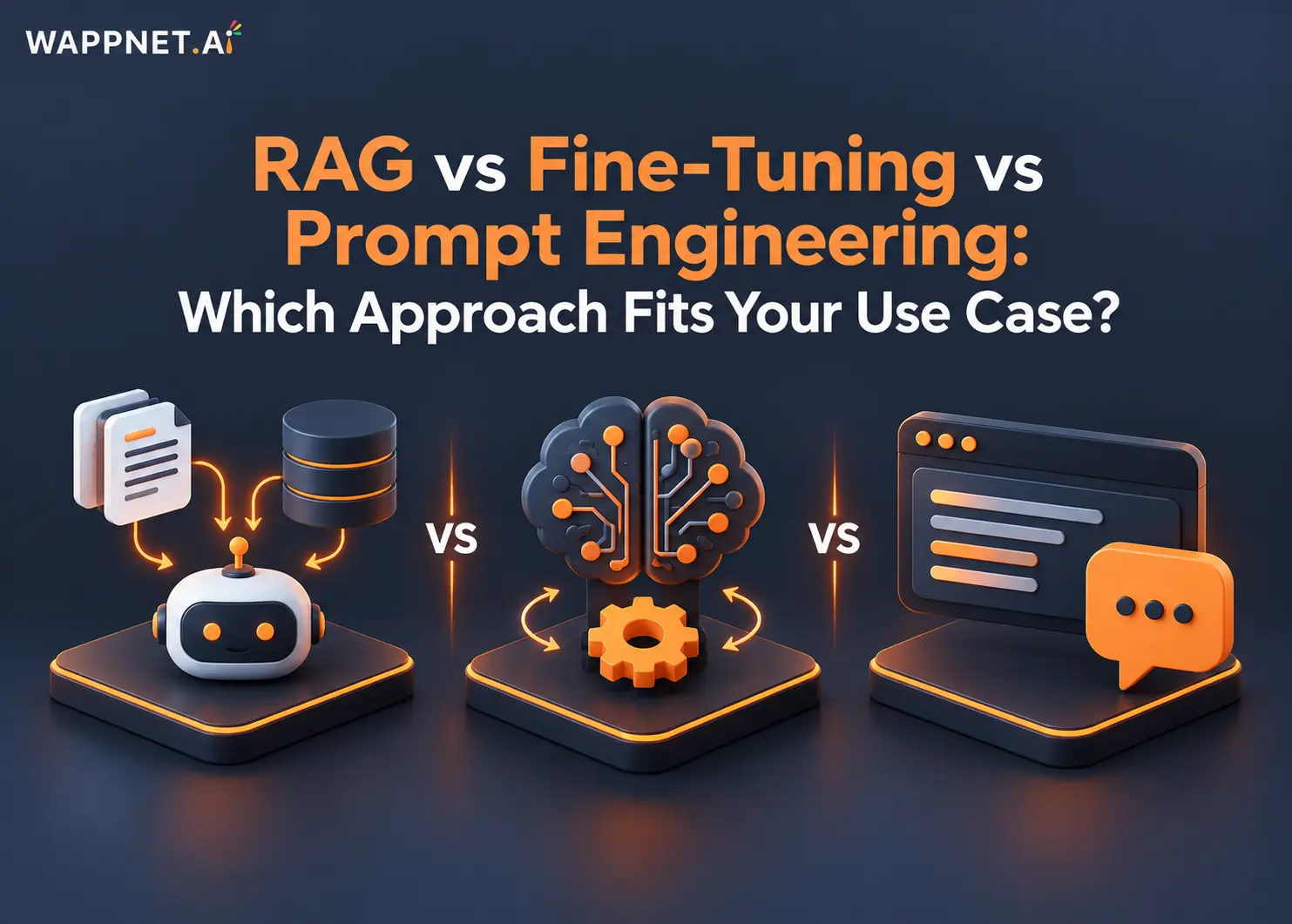 RAG
RAG vs Fine-Tuning vs Prompt Engineering: Which Approach Fits Your Use Case?
Compare RAG, fine-tuning, and prompt engineering to explore costs, use cases, and the best approach for enterprise AI.
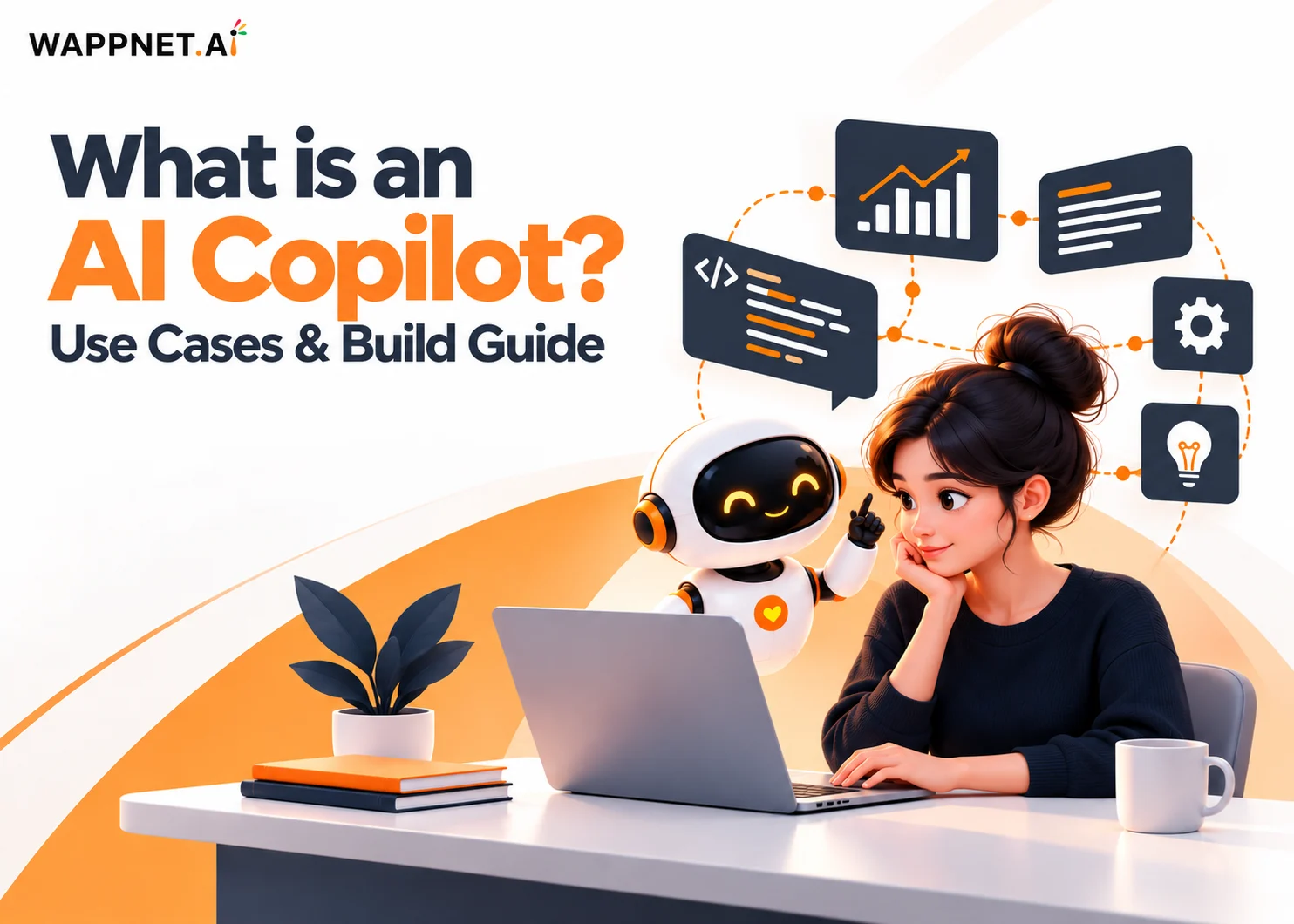 AI Copilot
What is an AI Copilot? Use Cases & Build Guide
What is an AI Copilot? Learn how it works, how it differs from AI agents, key use cases, and how to build one for your business.
 RAG
What Is RAG? A Complete Guide to Retrieval-Augmented Generation
Learn what RAG is, how Retrieval-Augmented Generation works, reduces AI hallucinations, and powers smarter enterprise AI.
Frequently Asked Questions
It's the evaluation work that happens before an AI investment decision, not after. An advisor scores a specific use case against the four paths available: custom build, commercial purchase, a capability you already have access to, or a blend of these, on cost, data fit, security, and timeline, so the final call rests on evidence rather than whichever option a team already favors.
Building tends to make sense when the AI capability is genuinely differentiating, relies on proprietary data or workflows that a vendor can't replicate, requires deep integration with core systems, or must meet governance and data control requirements that commercial options can't satisfy. It is rarely the right choice for standard, well-served needs.
Buying tends to fit when the requirement is close to a standard, well-understood problem, speed to value matters, the organization doesn't need deep customization, and a vendor's product has already proven itself on similar use cases. The trade-off is less control and ongoing licensing costs that can grow with usage.
Building means developing a custom AI solution around your specific requirements. Buying means licensing a commercial AI product or platform. Adopting or integrating means using AI capability already available inside a system or platform you already run. A hybrid approach combines commercial components with custom applications or workflows where differentiation matters most.
We build a total cost of ownership comparison across both options, covering development or licensing, infrastructure, integration, model usage, maintenance, and monitoring, over a multi-year horizon rather than year one alone. Commercial options often look cheaper upfront but can carry significant usage-based cost growth; custom builds often carry higher upfront cost but different long-term maintenance obligations.
Through AI platform selection consulting and AI vendor selection consulting services, we assess vendors against your specific requirements: functional fit, pricing mechanics at your expected scale, data handling and security terms, integration effort, contract terms including model version change notices, and the vendor's ability to demonstrate results on a representative sample of your own data.
Data privacy, intellectual property, compliance obligations, and how easily you could exit a vendor relationship all factor into the recommendation, not just cost and functionality. Regulated data or workflows typically raise the bar for any option that routes data through third-party infrastructure. Confirm specific legal and compliance obligations with your own advisers.
Typical deliverables include a documented requirements and opportunity assessment, a platform/vendor evaluation and build feasibility review, a total cost of ownership comparison, a security and governance review, a weighted decision matrix with a build, buy, adopt, or hybrid recommendation, and an implementation roadmap with next steps.
Timing depends on the number of use cases, how many vendors are in scope, and the complexity of your existing systems and data. We propose a timeline once we understand your requirements rather than quoting a fixed duration in advance.
Look for a partner that starts from your business requirements rather than a favorite technology, shows its evaluation criteria for both build and buy options, and is upfront about when the better answer is to buy or adopt. That's the standard we hold ourselves to as an AI advisory services company, and it's why every recommendation we give comes with the reasoning attached, not just a verdict.