
Generative AI Development Services
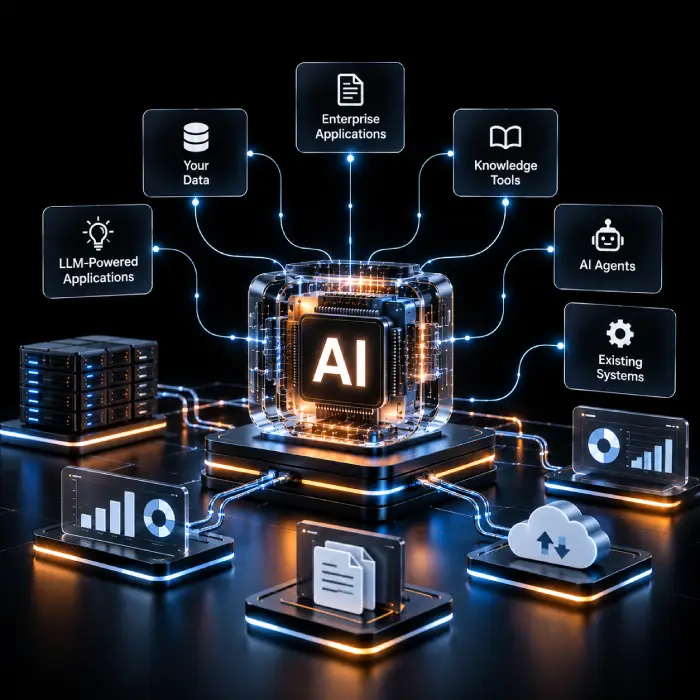
You're evaluating a generative AI development company to build something real, not another demo. Wappnet AI designs and builds enterprise generative AI systems: LLM-powered applications, retrieval-grounded knowledge tools, and AI agents that take real actions inside the software you already run. We build around your data, your compliance requirements, and your existing systems from day one.
What Do Generative AI Development Services Include?
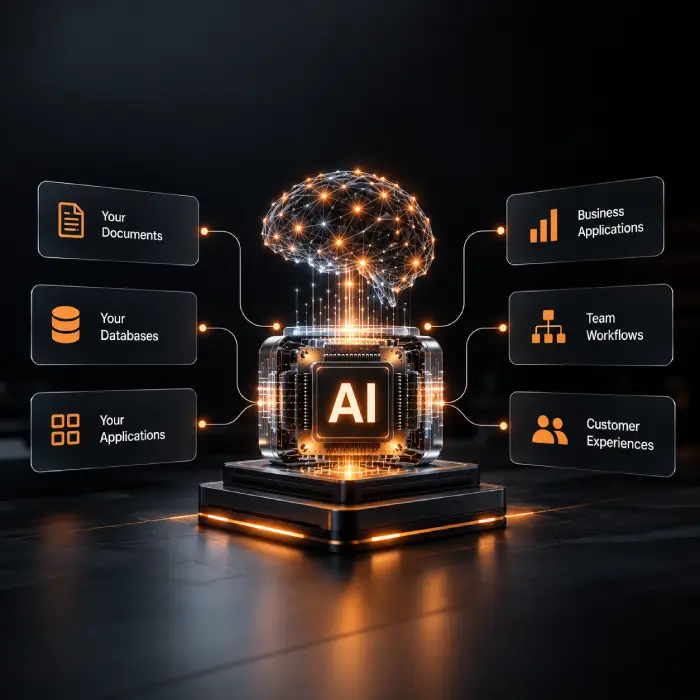
Generative AI development services turn a foundation model into a production system that fits how your team already works. Not a demo, not a plugin. The goal is simple: ground it in your own data, connect it to your real workflows, and put it in front of the people who need it, so it creates measurable business value from day one.
A successful generative AI development project moves through four connected disciplines:
- Find the generative AI use cases that can deliver the greatest ROI for your business.
- Get your data ready to ground a model reliably: retrieval, cleaning, and access control.
- Build the application, agent, or copilot around the workflow your team already depends on.
- Integrate the output into your existing systems (CRM, ERP, or internal tools) without disrupting how your team works.
Why Businesses Invest in Generative AI Development Services
The model is rarely the hard part. Here is why businesses bring in a partner instead of building alone.
Your Pilot Won't Get You There Alone
Most AI pilots stall over cost, unclear value, and weak risk controls, not the model. Getting to production takes the engineering discipline of a generative AI consulting partner.
Generic Tools Don't Know Your Business
Generic copilots run on public data and generic workflows. A custom generative AI solution is grounded in your documents, systems, and approval logic, so your team actually uses it.
Build It Right the First Time
Retrofitting security and integration onto a rushed prototype costs more than designing it in. Get architecture and governance right first, before reaching for an AI model fine-tuning shortcut.
Keep Your Data in Your Control
Public AI tools can send your documents to infrastructure you don't control. Proper generative AI application development keeps access control, encryption, and audit trails in your environment.
Launch Is Only the Start
Models drift and costs creep once real users arrive. Evaluation, monitoring, and support keep accuracy and spend predictable, a core part of generative AI software development.
Generative AI Solutions Built for Your Business
Every business's path into generative AI looks different. Here's how we group our work into four generative AI solution areas; most engagements combine two or three of them.
Generative AI Consulting Services
We start with a scoping conversation, not a sales pitch: which workflows are worth automating, what a realistic architecture looks like, and where generative AI isn't the right tool for the job.
Custom Generative AI Model Development
Custom applications built around a large language model or multimodal model, shaped around your workflow, not a generic wrapper around someone else's chatbot.
Enterprise Generative AI Integration Services
We connect model output back into your CRM, ERP, or internal tools through proper generative AI integration, so a generated result triggers a real workflow in your business, not a chat window.
Conversational AI & Intelligent Chatbots
In-product copilots and support assistants that sit inside the software your team or customers already use, including multimodal AI development, where the input is a document, image, or spoken query instead of plain text.
RAG Pipeline Development
Retrieval-augmented generation that grounds answers in your own content: knowledge assistants, document intelligence, and AI-powered search, built on real RAG development services, not a demo pipeline.
AI Infrastructure & MLOps
The vector databases, orchestration layer, and deployment pipeline that keep a generative AI system running reliably in production. This is the enterprise AI development work most teams underestimate.
Custom LLM Development & Fine-Tuning
We fine-tune foundation models on your proprietary data for a specific tone, format, or domain vocabulary: practical LLM application development paired with AI model fine-tuning aimed at your use case, not a general-purpose benchmark.
AI Agents & Agentic AI Development
Agents that plan, call your tools and APIs, and complete multi-step tasks on your behalf, not just answer questions. Built with orchestration frameworks and connected through standards like MCP, with guardrails scoped to exactly what the agent is allowed to do: the core of AI agent development and agentic AI development work.
AI Optimization & Post-Launch Support
Evaluation, monitoring, and tuning after launch, tracking accuracy, cost, and drift so the system keeps performing as your data and usage change.
Not Sure If You Need RAG, Fine-Tuning, or an AI Agent?
Tell us the workflow you're trying to fix. We'll tell you honestly which approach fits, and if the answer is "none of the above," we'll say that too.
Our Generative AI Development Process
Every engagement follows the same four-stage generative AI development process, even though the technical work inside each stage depends on your use case.
- 1
Discovery & Readiness Assessment
We will map the workflow you want to change, check whether your data is clean and accessible enough to ground a model in it, and tell you honestly if a use case isn't a good fit.
- 2
Architecture & Proof of Concept
We will choose RAG, fine-tuning, an agent, or a combination, and build a working proof of concept against your real data so you can judge output quality before committing to a full build.
- 3
Production Development & Governance
We will build your full application: integrations, guardrails, access controls, and an evaluation suite that holds up under your real traffic.
- 4
Deployment, Monitoring & Optimization
We will deploy, monitor accuracy and cost in your production environment, and tune retrieval, prompts, or model choice as your usage evolves.
Generative AI Development Services: Use Cases
Generative AI isn't one thing; it's a set of capabilities you apply to different problems. Here's where our generative AI development services typically create the most value inside a business like yours.
Knowledge Assistants & Document Q&A
Ground answers in your own manuals, policies, and knowledge base instead of the open web core RAG development services work.
Workflow Automation Agents
Agents that complete multi-step tasks across your existing tools, from research to routing to updating records AI workflow automation in practice.
Custom Chatbots & Copilots
In-product assistants trained on your business logic and tone, not a generic script.
Content & Code Generation
Drafting, summarizing, and code-assist tools tailored to your team's formats and standards, practical LLM application development.
Data Extraction & Document Intelligence
Pull structured data out of contracts, invoices, and forms your team currently handles by hand.
Enterprise Search & Research Assistants
Point a model at your internal systems so your team can ask a question once instead of searching five tools, the kind of enterprise AI development work we do most.
RAG vs. Fine-Tuning vs. AI Agents: Which One Do You Need?
These are the three most common ways to put a foundation model to work; picking the wrong one is one of the most common reasons a generative AI project stalls. Here's how we help you decide.
Technologies We Use to Build Generative AI Solutions
We don’t default to one model or vendor. We choose the right technology based on your accuracy, latency, privacy, and cost requirements.




Industries We Help With Generative AI
Why Choose Wappnet AI as Your Generative AI Development Company?
Wappnet AI is a Generative AI Development Company built for enterprises that need a system they can operate, not just a demo they can show. We scale from a focused advisory engagement to a full delivery team, matched to where you are in your generative AI journey.
Business-first discovery
We'll tell you honestly when RAG, fine-tuning, or an agent isn't the right fit for your use case.
Model-agnostic architecture
We build around your constraints, not one vendor's roadmap.
Evaluation & monitoring built in
Your accuracy, cost, and drift get tracked after launch, not just at demo time.
Security & governance from day one
Access control and human-in-the-loop checkpoints designed into your system, not bolted on.
Real-World Generative AI Solutions We've Delivered
Production generative AI applications delivering real business value.
Enterprise Policy & Compliance Assistant
RAG knowledge system providing instant cited answers from 50,000+ internal documents.
Autonomous Workflow Automation System
Multi-agent AI integration automating multi-system data processing and routing.
Internal Knowledge Base & Search Engine
Enterprise search engine connecting legacy ERP and CRM databases with LLM-grounded retrieval.
Have a Use Case You're Not Sure Fits Generative AI?
Bring us the workflow you're stuck on, and we'll scope it honestly. Tell us what a production-ready version would take for your team, and we'll tell you whether generative AI is the right tool for it and what the simpler alternative would be if it isn't.
Latest AI Insights & Industry Trends
 RAG
RAG vs Fine-Tuning vs Prompt Engineering: Which Approach Fits Your Use Case?
Compare RAG, fine-tuning, and prompt engineering to explore costs, use cases, and the best approach for enterprise AI.
 AI Copilot
What is an AI Copilot? Use Cases & Build Guide
What is an AI Copilot? Learn how it works, how it differs from AI agents, key use cases, and how to build one for your business.
 RAG
What Is RAG? A Complete Guide to Retrieval-Augmented Generation
Learn what RAG is, how Retrieval-Augmented Generation works, reduces AI hallucinations, and powers smarter enterprise AI.
Frequently Asked Questions
It's the engineering work of turning a foundation model into a production application connecting it to your data through retrieval, deciding whether fine-tuning is needed, building the integrations and guardrails around it, and testing it against real inputs before it goes live. It's a software project with an AI model at the center, not a single prompt or plugin.
RAG grounds a model's answers in your live documents and data at query time the right default when your information changes often. Fine-tuning adjusts the model's own behavior, which suits getting a very specific tone, format, or domain vocabulary right. Most production systems end up using RAG for facts and light fine-tuning for style, rather than picking one exclusively.
When the task genuinely requires multiple steps and decisions looking something up, deciding what to do with it, then taking an action in another system rather than producing one answer. If a well-grounded RAG application can answer the question directly, an agent adds complexity and risk without adding value. We'll tell you when a simpler build is the better call.
It depends mainly on data readiness, integration scope, and whether the use case needs an agent or just a grounded application. A scoped proof of concept is a smaller investment than a full production build with monitoring and governance. We scope cost against your specific workflow during discovery rather than quoting a flat number up front.
A proof of concept built against your real data is the fastest way to validate an approach before committing to a longer build. Full production timelines depend on integration complexity, data readiness, and whether the system needs agent behavior or governance review. We give a realistic estimate once we understand the specific workflow.
Mainly through retrieval quality: an answer is only as good as what the model was allowed to see, so we invest heavily in how documents are chunked, indexed, and retrieved before generation happens. We also run structured evaluation against real questions, test for groundedness, and add human review checkpoints for anything with real consequences.
Access control, encryption, and scoped permissions are built into the architecture, and we test for risks specific to generative AI systems, like prompt injection, not just standard application security. We connect output directly to your CRM, ERP, or internal tools rather than leaving it in a standalone chat window. We can't make legal or compliance guarantees on your behalf, but we build with your regulatory environment in mind from the start.