Phone:(+1) 312-698-3083
Email:
info@wappnet.ai
Introduction
AI is not a layer of enhancement that has been added to electronic products anymore; it has become the core of contemporary web platforms. Enterprises are constructing AI-native systems in 2026 in which the intelligence drives automation, personalization, analytics, and real-time decision-making.
The question facing CTOs and technology leaders is not about whether or not to embrace AI but about how to create a scalable AI architecture capable of providing support to performance, governance, cost optimization, and long-term innovation.
We are one of the top AI web development firms, offering AI consulting and development services of enterprise quality, advanced LLM development, and guided LLM integration solutions to ensure that businesses construct intelligent and scaled digital ecosystems.
This blog discusses the architecture trends CTOs need to capture emerging trends to remain competitive in 2026.
Key Takeaways
✔ AI has to be incorporated on the architectural level.
✔ AI Dev Service and Consulting: Professional.
✔ Development of Enterprise LLM needs governance and monitoring.
✔ Contextual AI depends upon vector databases.
✔ Microservices make AI performant at scale.
✔ Edge AI improves a real-time user experience.
✔ One cannot disregard security and compliance.

12 minute(s) read
March 10, 2026
Table of Contents
- The Rise of AI-Native Web Architecture
- 1. AI Consulting and Dev Service: The Strategic Foundation
- 2. LLM Development: Moving Beyond Basic Chatbots
- 3. Vector Databases: Enabling Context-Aware Intelligence
- 4. AI APIs Integration: Modular Intelligence at Scale
- 5. Edge AI Architecture: Reducing Latency and Enhancing Performance
- 6. Scalable Microservices: The Backbone of AI Infrastructure
- 7. Security, Governance, and Compliance in AI Systems
- Business Benefits of Scalable AI Architecture
- Why Choose Wappnet.ai?
- Final Thoughts
- Frequently Asked Questions (FAQ)
The Rise of AI-Native Web Architecture
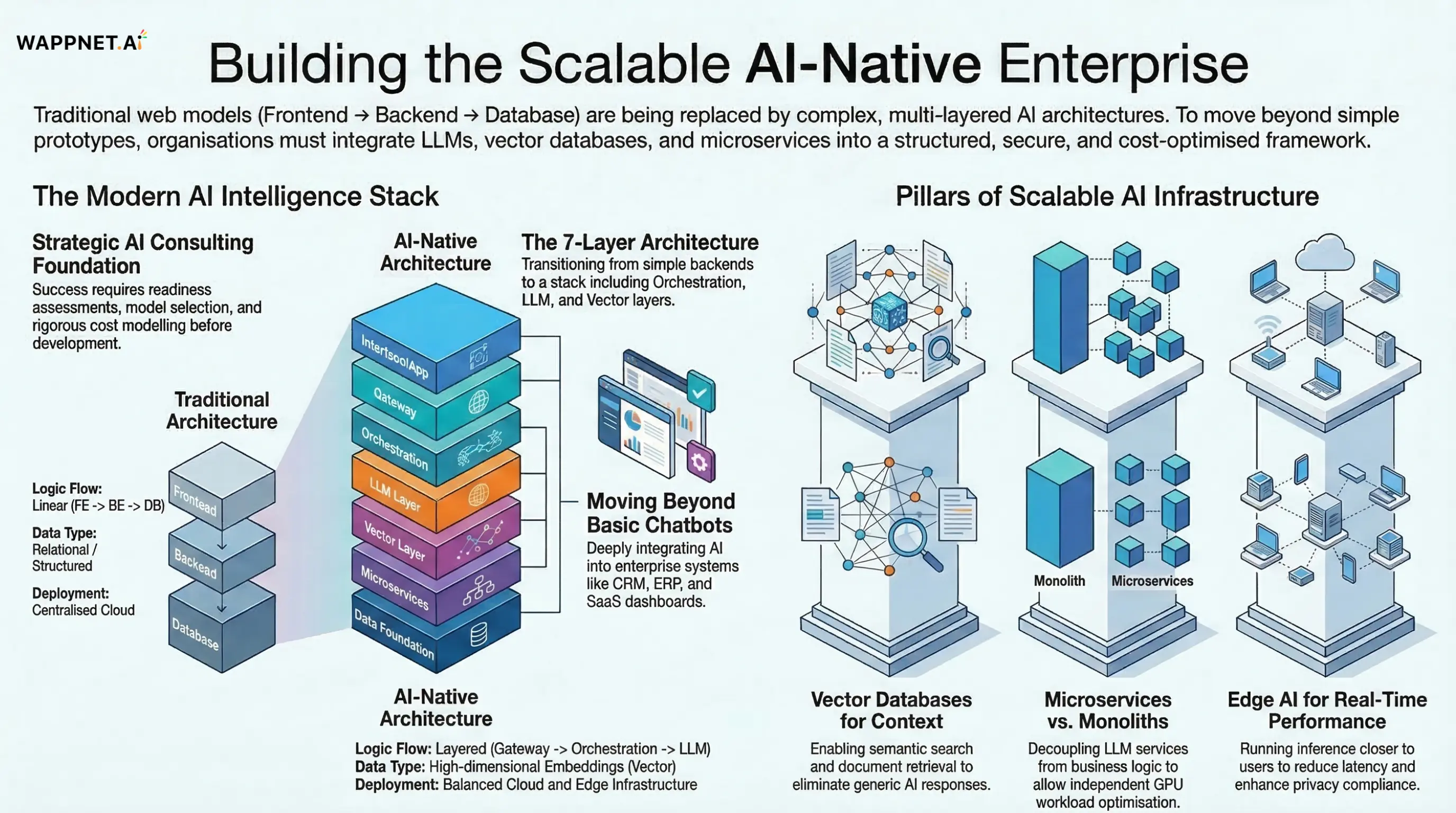
Traditional web applications followed a simple model:
Frontend → Backend → Database
Modern AI-powered web applications now follow a layered intelligence stack:
Frontend → API Gateway → AI Orchestration Layer → LLM Layer → Vector Database → Microservices → Cloud / Edge Infrastructure
This shift introduces new complexities:
- Effective management of AI APIs.
- Dealing with unpredictable loads of inference.
- Contextual storage and retrieval of data.
- Assuring compliance and data security.
- Cost optimization of tokens and computer performance.
In the absence of an organized AI consulting and development service, most organizations cannot scale AI beyond prototypes.
1. AI Consulting and Dev Service: The Strategic Foundation
AI projects usually end up failing because of inadequate architectural planning. CTOs will require more than developers; they will need tactical AI consultation.
A professional AI consulting and development service includes:
- AI readiness assessment
- Use-case testing in business.
- Model selection strategy
- Infrastructure planning
- LLM development roadmap
- Security and compliance design.
- Cost optimization and modeling.
Working with an established AI web development firm, the business can transition to production AI systems.
2. LLM Development: Moving Beyond Basic Chatbots
The implementation of chatbots is not the only way to develop LLMs in 2026. Big Soap Works Large language models are implemented with enterprise systems, such as
- CRM platforms
- ERP systems
- E-commerce engines
- SaaS dashboards
- Customer service robotization.
- Knowledge management systems within the organization.
Enterprise-ready LLM development services require:
- High-tech, timely engineering systems.
- Pipelines of context management.
- RAG systems: Retrieval-Augmented Generation (RAG) systems
- Strategies of token optimization.
- Hallucination control and guardrails.
- Monitors and observable abilities.
The integration of LLM at the level of production requires the careful design of its architecture to ensure that the performance is not low and the cost of operation is minimized.
3. Vector Databases: Enabling Context-Aware Intelligence
Large language models need context to provide the correct answer. This is where the use of the vector databases is necessary.
Vector databases for AI allow organizations to:
- Store embeddings
- Perform a semantic search
- Service contextual document retrieval.
- Enhance AI responsiveness.
Without vector databases, AI systems:
- Lack of business-specific knowledge
- Produce generic responses
- Increase hallucination risks
A robust, scalable AI architecture integrates:
- Embedding generation models
- Vector indexing systems
- LLM orchestration layer
- Secure APIs
- Microservices framework
This ensures AI systems operate with enterprise-level contextual intelligence.
4. AI APIs Integration: Modular Intelligence at Scale
The modern AI systems utilize numerous AI APIs rather than creating everything internally.
Common AI APIs include:
- Natural Language Processing APIs
- Vision APIs
- Speech-to-text APIs
- LLM-based APIs
However, unmanaged AI API calls can result in:
- High latency
- Escalating token costs
- Security vulnerabilities
A structured AI consulting and development service ensures:
- API orchestration and routing
- Intelligent caching
- Load balancing
- Cost optimization frameworks
This modular approach improves flexibility while maintaining scalability.
5. Edge AI Architecture: Reducing Latency and Enhancing Performance
Edge AI enables the inference of AI to be performed closer to users instead of cloud servers.
Benefits of Edge AI architecture include:
- Lower latency
- Faster real-time processing
- Reduced bandwidth usage
- Improved privacy compliance
Edge AI is particularly important for:
- Fintech applications
- IoT-driven platforms
- Real-time analytics systems
- Industrial automation dashboards
An effective, scalable AI architecture helps the clouds and edges to balance their workloads intelligently.
6. Scalable Microservices: The Backbone of AI Infrastructure
There is a lot of variation in AI workloads. Monolithic architectures are not very responsive to dynamic scaling.
A scalable microservices architecture enables:
- Scaling the AI inference engine independent of data.
- GPU workload optimization
- Fault isolation
- Pipelines of continuous deployment.
- Faster innovation cycles
In a production-ready system, AI services are separated into
- LLM service
- Vector database service
- AI orchestration layer
- Business logic services
- Analytics systems and monitoring.
This modular design ensures resilience, scalability, and operational efficiency.
7. Security, Governance, and Compliance in AI Systems
Enterprise AI introduces new governance risks.
CTOs must address:
- Data encryption standards
- Role-based access control
- AI model governance
- Audit logging
- Regulatory compliance
An AI web development firm is a professional firm that deploys AI to global standards and complies with global performance and innovation.
Business Benefits of Scalable AI Architecture
Organizations that invest in structured LLM development and scalable architecture realize:
- Faster product innovation
- Lower infrastructure expenses.
- Enhanced personalization
- Better operational efficiency.
- Higher automation rates
- Better customer engagement
A scalable AI architecture is a key to the actual ROI, rather than the implementation of AI functions.
Why Choose Wappnet.ai?
We are a forward-thinking AI web development company delivering:
- Dev Service and AI Consulting End-to-End.
- LLM development services at the enterprise level.
- High-end LLM integration services.
- Web application development using AI.
- Scalable AI architecture on the cloud.
- AI-first product engineering solution.
We help CTOs transform AI from an experimental initiative into a strategic business engine.
Final Thoughts
In 2026, competitive advantage will be in the organizations that will view AI as a piece of infrastructure and not a feature.
Businesses can create high-performance AI-driven web applications that can be scaled to grow their businesses and be measured through structured AI consulting and dev services, advanced LLM development, and well-thought-out scalable AI architecture.
It is time to design your next AI-based platform in a proper manner.
Frequently Asked Questions (FAQ)
1. What is a scalable AI architecture?
Scalable AI architecture is a system architecture where AI models (LLMs, vector databases, APIs, etc.) can be independently scaled as workload requirements change. It guarantees performance, reliability, and cost optimization in the enterprise AI systems.
2. Why is LLM development important for enterprises?
Allowing businesses to bring intelligent automation, contextual chat systems, predictive analytics, and workflow automation to their digital platforms, LLM development allows businesses to integrate them into their digital services. LLM development with enterprise-grade guarantees safe, dependable, and inexpensive implementation.
3. What do AI consulting and development services include?
A typical AI consulting and development service consists of AI strategy planning, architecture design, model selection, LLM integration, infrastructure setup, governance planning, and continuous optimization to make sure that it is production-ready.
4. How do vector databases improve AI performance?
Vector databases store embeddings that allow AI systems to perform semantic searches and retrieve relevant contextual information. This significantly improves the accuracy and reliability of LLM responses.
5. Why should companies work with an AI web development company?
Professional AI web development agencies will offer systematized integration of LLM, scalable architectures of microservices, security management, and optimization of costs to have AI systems reliably operate at scale.
Kishan Patel
Kishan Patel is the Co-Founder and CTO of Wappnet Systems with over 12 years of experience in technology leadership and product engineering. He leads the company’s engineering strategy, focusing on AI-driven applications, scalable architecture, and modern DevOps. Kishan has built and scaled high-performance platforms across healthcare, fintech, real estate, and retail, delivering secure and scalable solutions aligned with business growth.
Related Post

AI Automation for Small Business: The Complete ROI Guide for 2026
July 29th , 2026
How Much Does It Cost to Hire AI Developers in 2026?
July 20th , 2026
Top AI Use Cases by Industry in 2026
May 21st , 2026