Phone:(+1) 312-698-3083
Email:
info@wappnet.ai

Introduction: Why 2026 Is Different (The Rise of AI-Native Enterprises)
The period of 2023-2024 was the time when businesses tried AI.
In 2025, they optimized use cases.
The winners in 2026 will be AI-native companies.
What makes 2026 different?
AI gets integrated into the workflow of the enterprise.
Generative AI is manufacturable.
Manual operational layers are being eliminated by AI agents.
Businesses do not require trial and error.
AI is not innovation nowadays but infrastructure. Firms that integrate AI into their business foundations constitute sustainable competitive advantages. Individuals who postpone implementing an AI strategy properly are bound to remain reactive rather than proactive.
Executive Summary
By 2026, AI will no longer be a demonstration project any longer. It is core infrastructure. Those organizations that continue to focus on AI as a side project are being overtaken by AI-native competitors that integrate intelligence into operations, products, and decision-making.
A powerful AI implementation plan will see AI programs go beyond pilots and become scalable, secure, and revenue-generating enterprise systems.
The guide would be aimed at CEOs and CTOs interested in implementing enterprise AI solutions, selecting the appropriate AI development firm, and collaborating with an AI transformation partner with a long-term perspective.

16 minute(s) read
February 26, 2026
Table of Contents
- The 2026 AI-Native Enterprise Roadmap: From Pilot Projects to Scalable Infrastructure
- Industry Data & Authority Signals
- Why 80% of AI Pilots Fail
- CEO Perspective: AI as an ROI Multiplier & Competitive Moat
- CTO Perspective: Architecture, Integration & Scalability
- The Enterprise AI Infrastructure Stack (2026 Model)
- AI Governance & Security Framework
- 90-Day AI Execution Roadmap
- 2026 Belongs to AI-Native Companies
- Talk to an AI Strategist.
- Frequently Asked Questions (FAQs)
The 2026 AI-Native Enterprise Roadmap: From Pilot Projects to Scalable Infrastructure
Industry Data & Authority Signals
Enterprise AI Adoption in 2026: What the Data Represents.
The adoption of AI is no longer a figment of imagination, as it is quantifiable and rapidly growing.
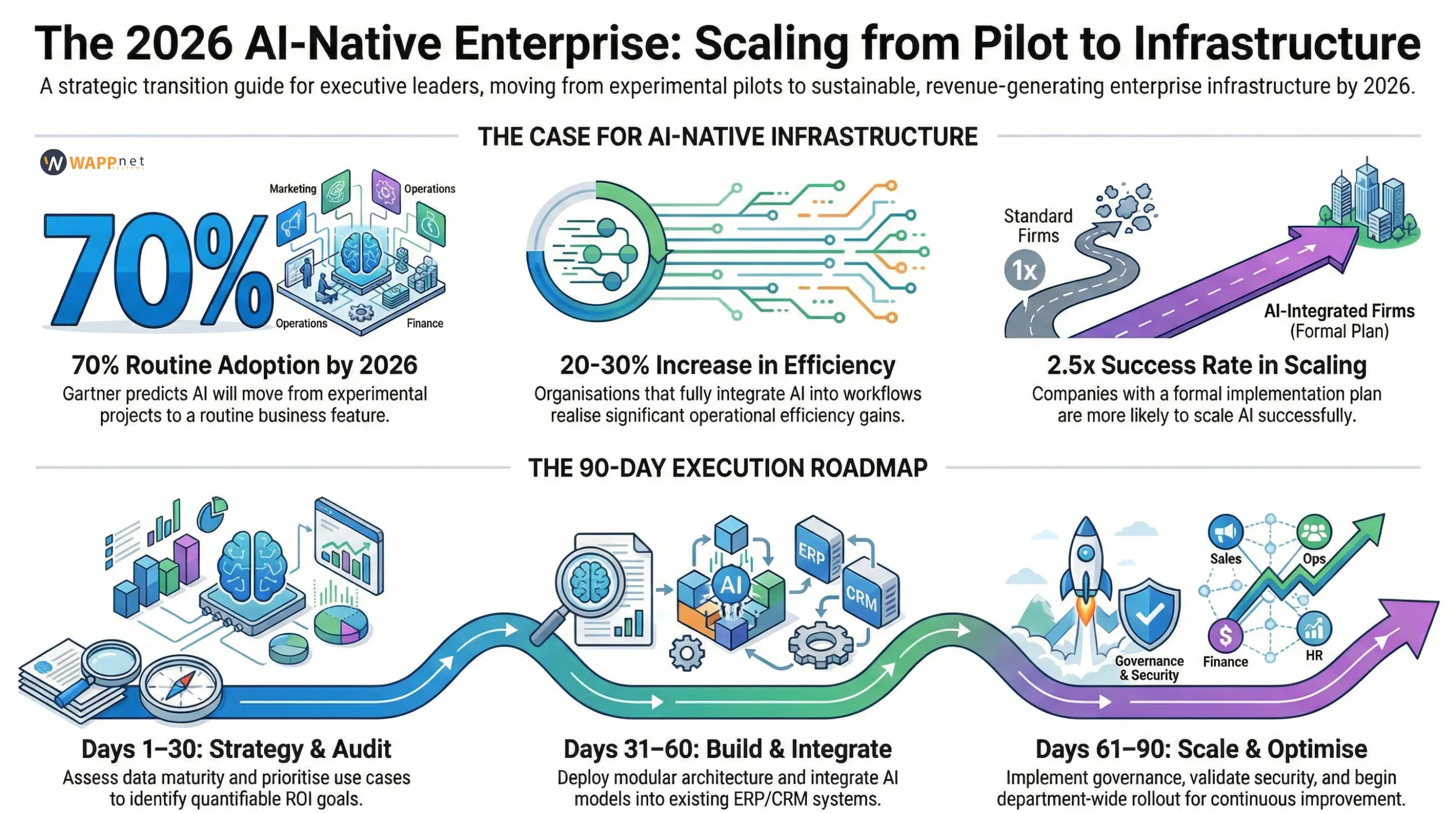
The report of McKinsey indicates that over 50 % of organizations have already implemented AI in one or more business functions, and firms that have completely incorporated AI in workflows experience a high growth in revenues, by far outpacing their rivals.
According to Gartner, more than 70 % of businesses will have implemented AI structures as a routine business feature, not as an experimental one, by 2026.
According to research conducted by major international advisory firms, it is also the case that:
The companies operating using AI realize a 20-30 % increase in operational efficiency.
Companies that plan their AI implementation are more likely to successfully scale AI by 2.5 times.
Companies that go past pilots to production-scale enterprise AI solutions fare better than other companies in retention and maturity of automation.
Artificial intelligence will no longer be a competitive advantage in 2026 but a competitive requirement.
This is the reason why it becomes crucial to choose the appropriate AI transformation partner and a company with experience in AI development to be able to sustain the process in the long term.
Why 80% of AI Pilots Fail

Most AI pilots do not scale despite the hype. It is not technology that is the reason but strategy.
1. Lack of Business-First Thinking
Most organizations start with tools rather than results. They do not use AI models without:
- Clear revenue objectives
- Cost-reduction KPIs
- Executive alignment
The success of an AI implementation plan begins with business objectives and not algorithms.
2. Poor Data Readiness
AI systems are as good as they are trained to be. Common issues include:
- Siloed enterprise data
- Inconsistent formats
- Lack of governance
- Lack of a centralized data architecture.
Even the most appropriate enterprise AI solutions will not work well without structured data pipelines.
3. No Scalable Architecture
The majority of the pilots are constructed as proof-of-concept. They lack:
- API-first design
- Microservices architecture
- Cloud-native infrastructure
- ERP/CRM system integration.
This is the reason why it is crucial to choose an appropriate AI development company; scalability has to be thought out since the first day.
4. Governance & Security Gaps
Enterprise risks are presented by using Shadow AI and unsecured models. Lack of structured governance means the pilots stall because of issues of compliance.
CEO Perspective: AI as an ROI Multiplier & Competitive Moat
In the case of CEOs, AI is not a matter of technology. It is a concerning development, the increment of margins, and sustainability.
1. AI as a Revenue Accelerator
An adequately planned AI implementation plan can:
- Enhance the accuracy of lead scoring.
- Enhance personalization.
- Increase conversion rates.
- Empower predictive upselling.
The AI transforms marketing into responsive campaigns and forecasting growth mechanisms.
2. Cost Optimization Through Automation
The use of AI agents and smart workflow minimizes:
- Manual processing costs
- Customer service overhead
- Operational delays
- Human error
This is the point where scalable enterprise AI solutions have a direct effect on EBITDA.
3. Competitive Moat Creation
The proprietary data and custom models are the true strength of AI. Firms that develop AI internally develop defendable advantages.
Having an established partner in AI transformation will make AI become strategic IP, as opposed to a third-party subscription.
4. Investment Prioritization
CEOs should ask:
Which department generates the best ROI?
In which places are manual costs the most repetitive?
What journeys of the customers require intelligence?
AI needs to shift experimental expenditure to systematic capital expenditure.
CTO Perspective: Architecture, Integration & Scalability
For CTOs, AI success depends on architecture.
What CTOs Must Prioritize:
Modular AI Architecture
Scalable enterprise AI solutions are comprised of:
- API-first microservices
- Cloud-native infrastructure
- Containerized deployments
- Edge and hybrid cloud strategies.
Monolithic artificial intelligence is not scalable.
Enterprise System Integration
AI must integrate with:
- CRM systems
- ERP platforms
- Data warehouses
- Internal APIs
An effective AI development company provides smooth interoperability.
MLOps & Continuous Deployment
AI models require:
- CI/CD pipelines
- Continuous training
- Theoretical performance monitoring.
- Drift detection
AI is not “deploy and forget.” It is a continuous evolution.
Scalability & Performance
- Compute scaling
- Latency optimization
- Observability
- Secure access controls
An AI implementation strategy is forward-thinking and takes into consideration the development of the enterprise.
The Enterprise AI Infrastructure Stack (2026 Model)
Scalable AI ecosystem: A scalable AI ecosystem is made up of a layered architecture:
1. Data Layer
- Data lakes
- Ingestion pipelines in real-time.
- ETL/ELT frameworks
- Data governance policies
2. Model Layer
- Large Language Models
- Enterprise models that are fine-tuned.
- Domain-specific AI
3. Application Layer
- AI agents
- Chatbots
- Predictive engines
- Recommendation systems
4. Orchestration Layer
- Workflow automation
- API gateways
- Event-driven processing
5. Security & Governance Layer
- Role-based access
- Audit trails
- Bias monitoring
- Regulatory compliance
Consultation with an established AI transformation partner will ensure that these layers are functioning as towards together as opposed to becoming fragmented systems.
AI Governance & Security Framework
Uncontrolled enterprise AI is an enterprise risk.
An AI implementation strategy has to be mature and contain:
- AI usage policies
- Access control frameworks
- Explainability standards of models.
- Data privacy compliance
- Systems of risk classification.
AI governance safeguards intellectual property, customer information, and brand loyalty.
In the case of regulated industries, the option of governance is not available; it is compulsory.
Read More: How Agentic AI and Generative UI Will Reshape SaaS Experiences by 2026
90-Day AI Execution Roadmap
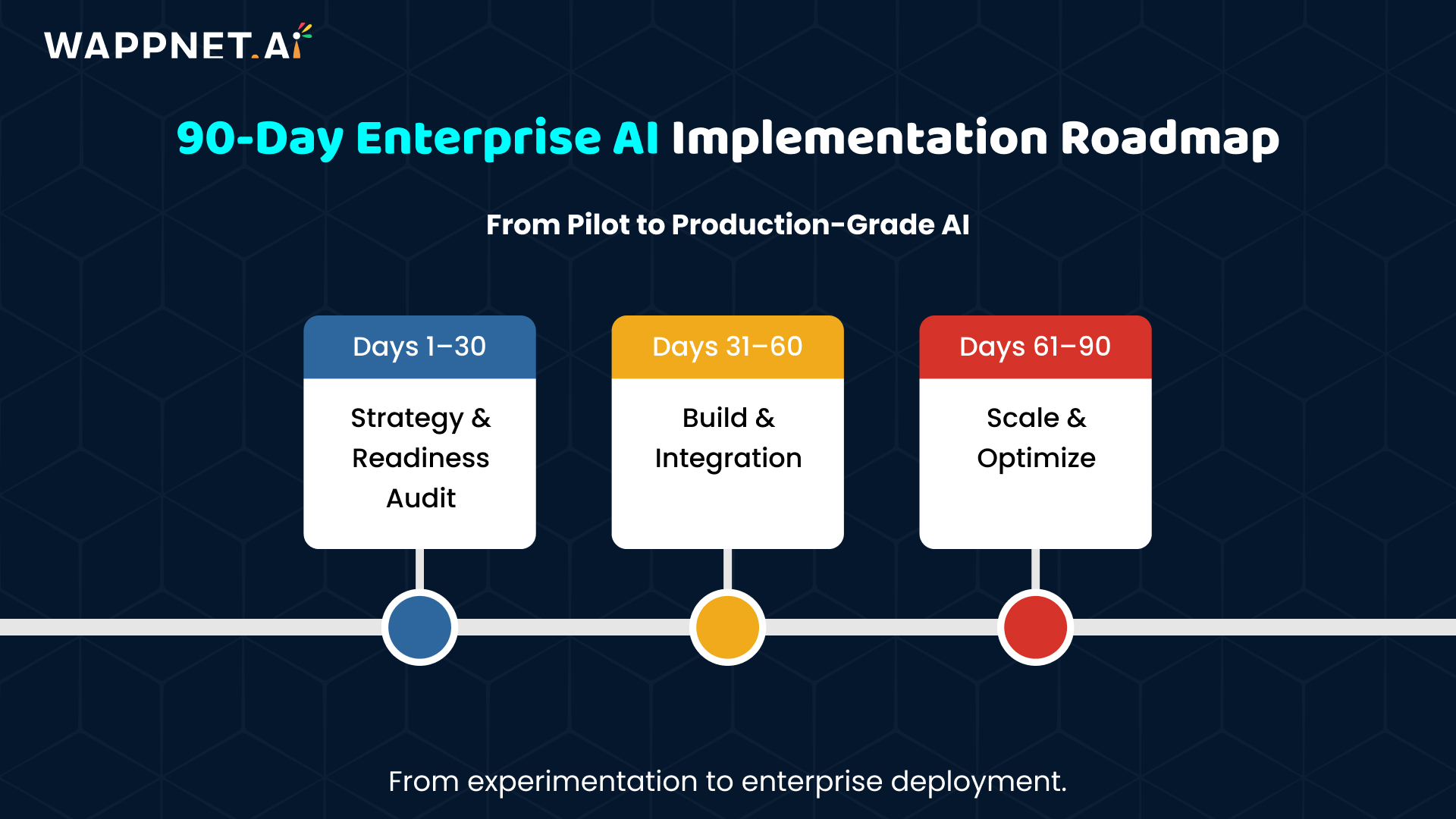
The pilot-to-production transition needs to be rolled out.
Phase 1: Days 1–30—Strategy & Audit
- AI readiness assessment
- Prioritization of business use case.
- Data maturity evaluation
- Executive workshops
- Technology stack audit
This phase identifies quantifiable ROI goals.
Phase 2: Days 31–60—Build & Integrate
- Architecture deployment
- Implementation of Pilot AI models.
- API integrations
- Workflow automation
- KPI tracking systems
By selecting the appropriate AI development firm, clean integration is guaranteed.
Phase 3: Days 61–90—Scale & Optimize
- Performance optimization
- Security validation
- Governance implementation
- Department-wide rollout
- Continuous improvement process.
This blueprint will make pilots scalable enterprise AI solutions.
The transformation of AI is not a software acquisition. It is an operational shift.
Provided by the right AI development company is:
- End-to-end AI consulting
- Custom architecture design
- Enterprise-grade security
- Long-term support & scaling
A strategic AI transformation partner links AI efforts to business achievement as opposed to autonomous technical constructions.
- This ensures:
- Faster time-to-market
- Less risk of implementation.
- Higher ROI
- Sustainable AI growth
2026 Belongs to AI-Native Companies
The future is not of businesses that explored AI.
It is a part of AI-based companies.
To succeed in 2026:
- Move beyond pilots.
- Align CEO & CTO priorities.
- Develop scalable architecture.
- Good governance at the very beginning.
- Adhere to a planned AI implementation.
Organizations that implement secure and scalable enterprise AI solutions receive leverage in their operations and a competitive advantage.
It is not a matter of whether or not to embrace AI anymore.
It is “How fast can we scale it?”
Talk to an AI Strategist.
If your organization is ready to move from AI experimentation to scalable systems, now is the time to act.
Partner with a trusted AI transformation partner and experienced AI development company to design, deploy, and scale intelligent enterprise systems.
Build your competitive advantage with a proven AI implementation strategy that delivers measurable business impact.
Frequently Asked Questions (FAQs)
1. What is an AI implementation strategy?
An AI implementation plan is a systematic arrangement that spells out how a business arranges, releases, combines, and develops AI systems to produce quantifiable business results without compromising governance, security, and scalability.
2. Why do most AI pilots fail?
The failure of most AI pilots is because of executive mismatch, inadequate data preparedness, unclear ROI indicators, and implementation of an unscalable architecture. In the absence of serious planning, AI is more of a proof-of-concept rather than an enterprise-grade AI solution.
3. How long does enterprise AI implementation take?
Implementation of enterprise AI is usually based on a 60-90 day systematic roadmap in the initial implementation. Nevertheless, it can require 6-12 months for the full organization to change based on scale and complexity through a comprehensive AI implementation strategy.
4. What is the role of an AI development company?
The AI development company helps design, develop, integrate, and scale AI systems in accordance with enterprise objectives. They guarantee the scalability of the architecture, security of the system, automation of the workflow, and a certain ROI of AI investments.
5. How do enterprise AI solutions create a competitive advantage?
Enterprise AI solutions generate a competitive edge by automating operations, increasing personalization of customers, using predictive analytics, and developing proprietary AI resources that are impossible to duplicate by competitors.
6. Why is choosing the right AI transformation partner important?
A knowledgeable AI transformation partner facilitates the alignment of AI efforts with business strategy, implements securely, deploys AI with enterprise systems, and helps AI efforts to scale beyond pilot projects.
Ankit Patel
Ankit Patel is the visionary CEO at Wappnet, passionately steering the company towards new frontiers in artificial intelligence and technology innovation. With a dynamic background in transformative leadership and strategic foresight, Ankit champions the integration of AI-driven solutions that revolutionize business processes and catalyze growth.
Related Post

AI Automation for Small Business: The Complete ROI Guide for 2026
July 29th , 2026
How Much Does It Cost to Hire AI Developers in 2026?
July 20th , 2026
Top AI Use Cases by Industry in 2026
May 21st , 2026