Phone:(+1) 312-698-3083
Email:
info@wappnet.ai
Introduction
The SaaS market across the globe is experiencing the most radical changes since the move to cloud computing in the early 2010s. With reference to the market outlooks, it has been noted that the global SaaS value will reach around 1.58 trillion in 2026, which is fourfold of early 2025. This burst is motivated by the fact that the software goes beyond merely handling data to the software that acts.
Executive Summary: The 60-Second Takeaway
By 2026, the SaaS business will have fully switched from reactive tools to proactive digital teammates.
- AI Becomes Autonomous: It will be capable of planning and executing multi-step workflows on its own.
- UI Becomes Intent-Driven: Generative UI (GenUI) will be used to substitute the fixed dashboard with an active interface generated in real time according to the aims of users.
- Pricing Becomes Outcome-Based: The seat-based licensing is dying; 85% of companies are moving to the usage- or outcome-based approach, which will help them align cost and business value.

12 minute(s) read
February 11, 2026
Table of Contents
- Why SaaS Leaders Must Prepare Now
- What is Agentic AI in SaaS?
- What is Generative UI (GenUI)?
- The Core Difference: AI Copilots vs. Agentic Systems
- Framework: The 5 Stages of SaaS Evolution
- How Agentic AI Changes SaaS Pricing Models
- Implementation Reality: What It Takes to Deploy
- Managing the "Dark Side": Risks and Governance
- ROI Translation: The Business Case for the CFO
- Proof in Practice: Mini Case Studies
- The "Build vs. Buy" Perspective for 2026
- Roadmap: SaaS Evolution 2026 ➔ 2028
- Are You Ready for Agentic SaaS? (Readiness Checklist)
- Conclusion

Why SaaS Leaders Must Prepare Now
The lead time of competitive advantage is shortening among executives. By 2026, being AI-enabled will be a basic requirement, while being AI-native will set companies apart.
Legacy UI is a Bottleneck: The multi-level menus are too slow in the contemporary enterprise; users are now demanding no-app experiences.
Copilots are not autonomous: Copilots do not act on their own, even though they are supported by humans. This friction is eliminated through agentic AI, which thinks ahead.
Customer Expectations Have Shifted: The customers are no longer interested in purchasing software; they are interested in purchasing the results.
Competitors Are Already Piloting: 45% of F500 companies have already begun piloting agentic systems.
What is Agentic AI in SaaS?
The term “agentic AI” is used to describe autonomous systems (AI agents), which can attain particular objectives with little oversight. These agents can reason, plan, and coordinate multi-step actions across disconnected enterprise platforms, unlike traditional bots.
- Strategic Advantage: By 2028, 33% of enterprise software will have agentic capabilities built in, up from almost none in 2023 (Gartner).
- Specialization: The new age is Vertical SaaS, in which a special foundation model is tuned to industry-specific data in industries such as healthcare and finance.
What is Generative UI (GenUI)?
Generative UI is a paradigm in which the user interface is not designed but is generated dynamically at run time. The system uses real-time generative functionality to generate the specific HTML, analysis charts, and text that a user requires, depending on what they intend to accomplish.
• Intent-Driven Interaction: Proceeding through a CRM, a user types, “Prepare a briefing of my top-lead customer,” and the UI immediately builds the required dashboard.
The Core Difference: AI Copilots vs. Agentic Systems
| Feature | AI Copilot (2024) | Agentic AI (2026) |
| User Input | Requires constant prompts | Goal-driven; acts autonomously |
| Execution | Suggests or drafts content | Plans and executes multi-step workflows |
| Adaptability | Follows rigid rules/scripts | Self-corrects and adjusts to new data |
| Context | Limited to the current window | Cross-system orchestration (CRM, ERP, Email) |
Framework: The 5 Stages of SaaS Evolution
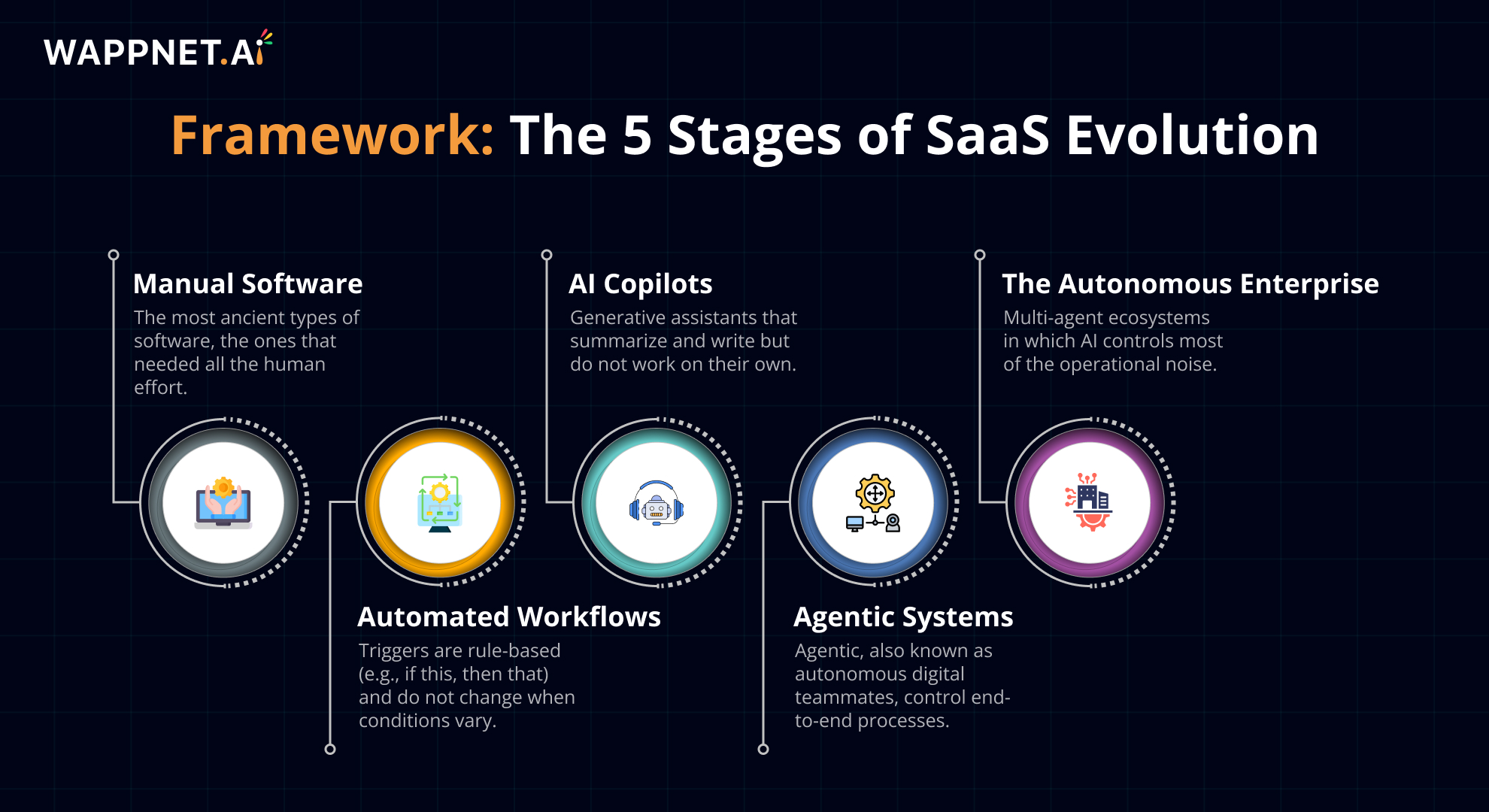
To understand where your organization sits, we utilize the SaaS Maturity Model:
1. Manual Software: The most ancient types of software, the ones that needed all the human effort.
2. Automated Workflows: Triggers are rule-based (e.g., if this, then that) and do not change when conditions vary.
3. AI Copilots: Generative assistants that summarize and write but do not work on their own.
4. Agentic Systems: Agentic, also known as autonomous digital teammates, control end-to-end processes.
5. The Autonomous Enterprise: Multi-agent ecosystems in which AI controls most of the operational noise.
Read More: Agentic AI vs Generative AI: Key Differences and Use Cases
How Agentic AI Changes SaaS Pricing Models
With the agents substituting the work of humans in repetitive tasks, per-seat pricing is being phased out. Given the fact that a user with an agent can accomplish the work that ten can, SaaS vendors are moving to
- Outcome-Based Pricing: Pricing based on performance (e.g., price per claim resolved).
- Consumption-Based Models: Consumption-based models represent a hybrid model that entails a base fee and usage-based pricing, shaped by the consumption of GPU/compute power.
- Efficiency Metric: SaaS companies that perform well now have a new Rule of 40 (Rule of 40: Growth % + Profit Margin % > 40) as a measurement.
Implementation Reality: What It Takes to Deploy
The transition to agentic AI is not an easy plug-in.
- Data Integration: It is common to have many data sources (eight or more) that need to be deployed successfully.
- The Orchestration Layer: You require a conductor model to coordinate various specialized agents and process failure events.
- API Readiness: 86% of enterprises need tech-stack upgrades so that their APIs can support programmatic calls by agents.
- Human Oversight: The implementation should have the human-in-the-loop of high-stakes decision-making to ensure trust.
Managing the "Dark Side": Risks and Governance
The customers of the enterprise sector should focus on agentic governance to avoid agent sprawl, a crisis comparable to shadow IT with autonomous outcomes.
- Hallucination Control: Agents are required to make citations that provide a backlink between outputs and the source content.
- Audit Trails: In this case, the systems should have some action trail that a leader may view to understand why a particular agent took a particular route.
- Security & Privacy: 62% of the practitioners mention security as their number one issue. Companies need to comply with GDPR, CCPA, and AI-related security measures.
ROI Translation: The Business Case for the CFO
- Reduced Operational Costs: AI-based organizations mention up to 20-40% less operating costs.
Faster Decision Velocity: Agentic systems allow cutting workflow cycles by 20-30%. - Higher Employee Leverage: Employees are able to save 40 percent of time on searching for information by automating repetitive work.
Proof in Practice: Mini Case Studies
- IT Support: Power Design had an agentic assistant that automated 1,000+ hours of repetitive work, fixing tickets within minutes, as opposed to days.
- HR Automation: Ciena introduced agentic workflows, which reduced approval times from several days to minutes.
- Sales/CRM: Zendesk installed agents that can answer 80% of questions alone, automatically updating the customer database with no human intervention.
Read More: LLM Benchmarks: The Key to Smarter and More Efficient AI Models
The "Build vs. Buy" Perspective for 2026
- Buy (Existing SaaS): Best when the governance and compliance are too expensive to develop (Systems of Record CRM and ERP).
- Extend (Agent Platforms): Implement agent platforms such as Salesforce Agentforce or Microsoft Agent 365 as the application of agents to existing data.
- Build (Custom Orchestration): Required in proprietary, high-value workflows that create a competitive moat.
Roadmap: SaaS Evolution 2026 ➔ 2028
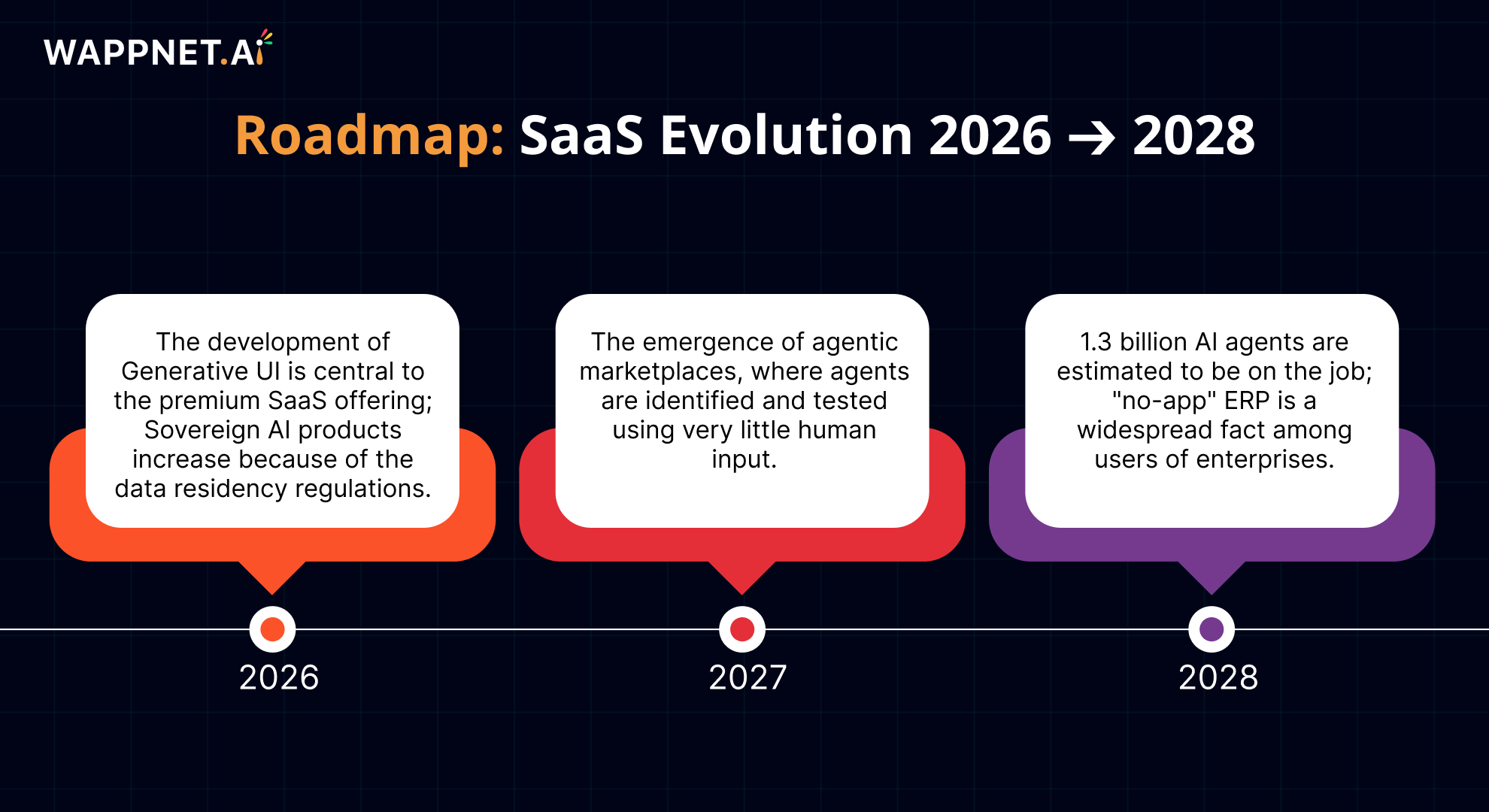
- 2026: The development of Generative UI is central to the premium SaaS offering; Sovereign AI products increase because of the data residency regulations.
- 2027: The emergence of agentic marketplaces, where agents are identified and tested using very little human input.
- 2028: 1.3 billion AI agents are estimated to be on the job; “no-app” ERP is a widespread fact among users of enterprises.
Are You Ready for Agentic SaaS? (Readiness Checklist)
- Unified Data: Does your data silo exist, or does a knowledge graph exist to query AI?
- API Ecosystem: Does your core system have a programmatic (Headless SaaS) access interface?
- Automation Culture: Does your team have AI fluency and agent coaching?
- Governance Model: Does your agent observability and ethics have a framework?
Conclusion
The shift to an AI-native future is not merely a technological reconfiguration but the reinvention of the business. Those organizations that today start preparing their data infrastructure and governance models will dominate the operations of tomorrow that are AI-native.
Want to learn more? To begin, explore our digital transformation and AI development services guides.
Ankit Patel
Ankit Patel is the visionary CEO at Wappnet, passionately steering the company towards new frontiers in artificial intelligence and technology innovation. With a dynamic background in transformative leadership and strategic foresight, Ankit champions the integration of AI-driven solutions that revolutionize business processes and catalyze growth.
Related Post
Agentic AI vs Generative AI: Key Differences and Use Cases
October 03rd , 2025