
Enterprise Risk Management Software
Governance, risk and compliance work often sits in separate tools and is assembled after the fact. This enterprise risk management software brings continuous risk monitoring, compliance control management and financial risk management into one connected platform, with AI-powered risk scoring, governed KRI monitoring and a tamper-evident audit log, deployable as SaaS or self-hosted.
Built for a multi-line financial institution across banking, lending and treasury, and configurable for banks, fintechs, insurers and other regulated enterprises.
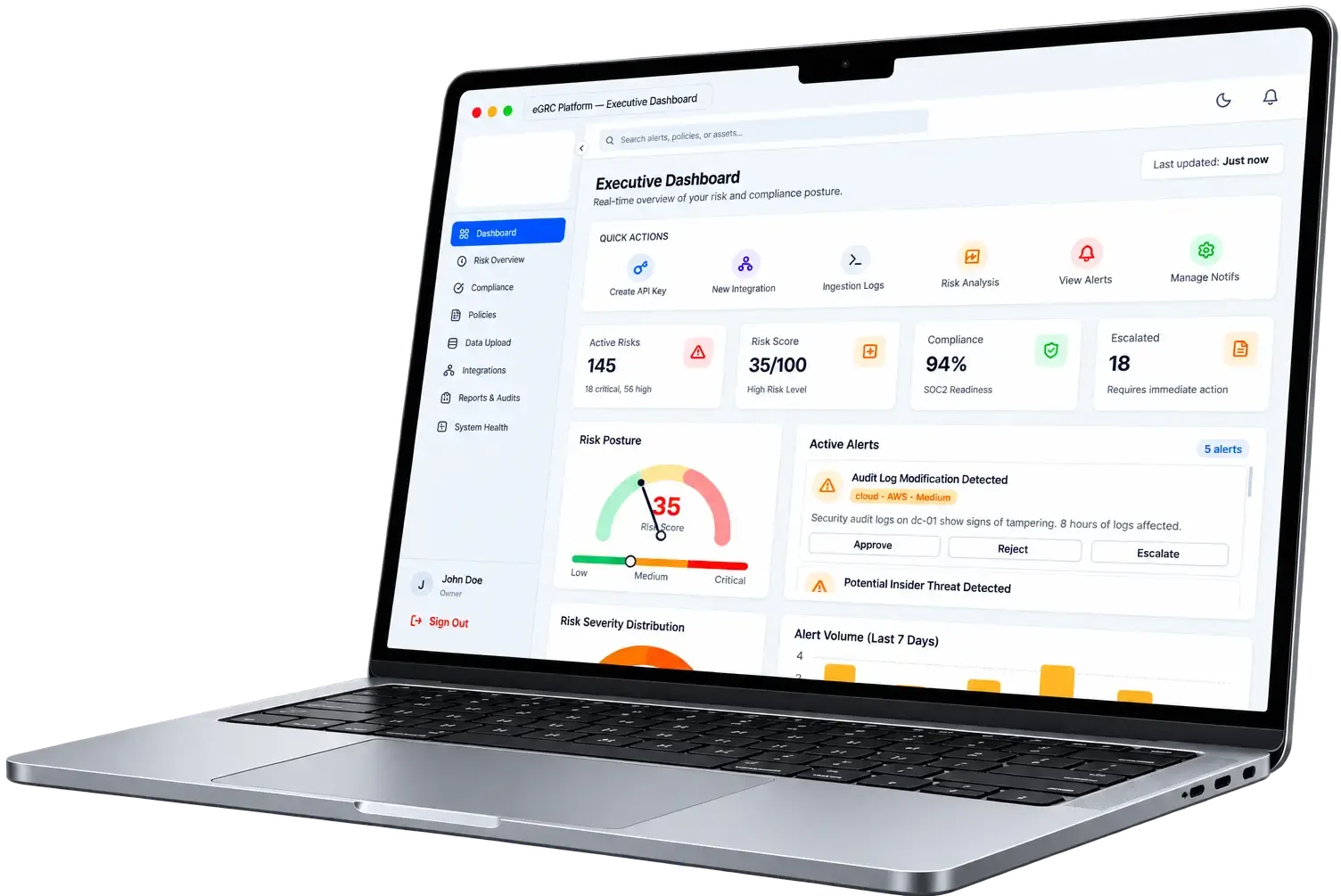
Project Overview
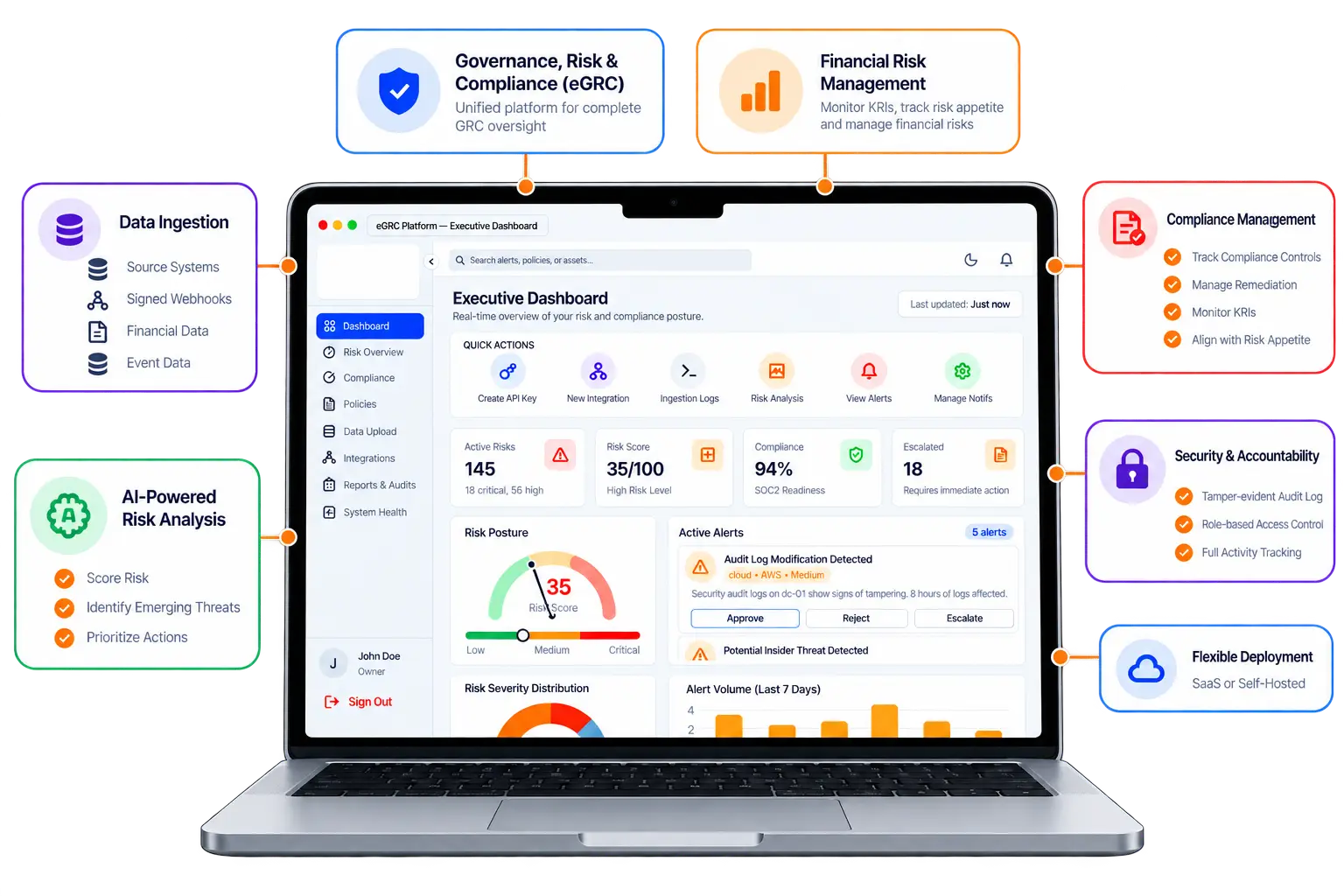
Built as enterprise GRC software, this enterprise risk management software brings governance, risk and compliance into one connected platform for a multi-line financial institution. As risk and compliance management software, it ingests events and financial data from source systems through signed webhooks, scores risk with AI-assisted risk analysis, and tracks compliance controls, remediation and KRI monitoring against risk appetite in two connected workspaces, eGRC and Financial Risk Management.
A tamper-evident audit log and role-based access control keep activity accountable, and it runs as SaaS or self-hosted.
Key Challenges
Financial institutions often have no single system for financial risk monitoring: one that can ingest events and financial data from many sources, score risk continuously, track control compliance, govern KRIs against appetite and keep an audit trail. Six challenges, from manual compliance management to limited auditability, shaped this build.
Fragmented Risk and Compliance Data
Risk, compliance and security information lived in separate tools with no shared data model, so the same event was captured repeatedly and never reconciled.
Manual Compliance Evidence Collection
Evidence was gathered by hand, with screenshots chased by email, which made control status backward-looking and hard to defend.
Retrospective Financial KRI Reporting
Financial KRIs were compiled manually at month-end, with no automatic lineage from the source system to the reported figure.
Disconnected Anomaly Detection
Security and operational anomalies were detected in isolation, separate from the policies and controls they could affect.
Uncontrolled Reporting Periods
There was no governed way to freeze and approve an official reporting period, or to handle a missing data feed through a controlled fallback.
Limited Access Governance and Auditability
Access to sensitive data lacked fine-grained, auditable control, and there was no tamper-evident record of activity.
Solution Delivered
How the platform is put together as governance, risk and compliance software: two workspaces on one shared foundation of ingestion, access control and AI-powered risk management.
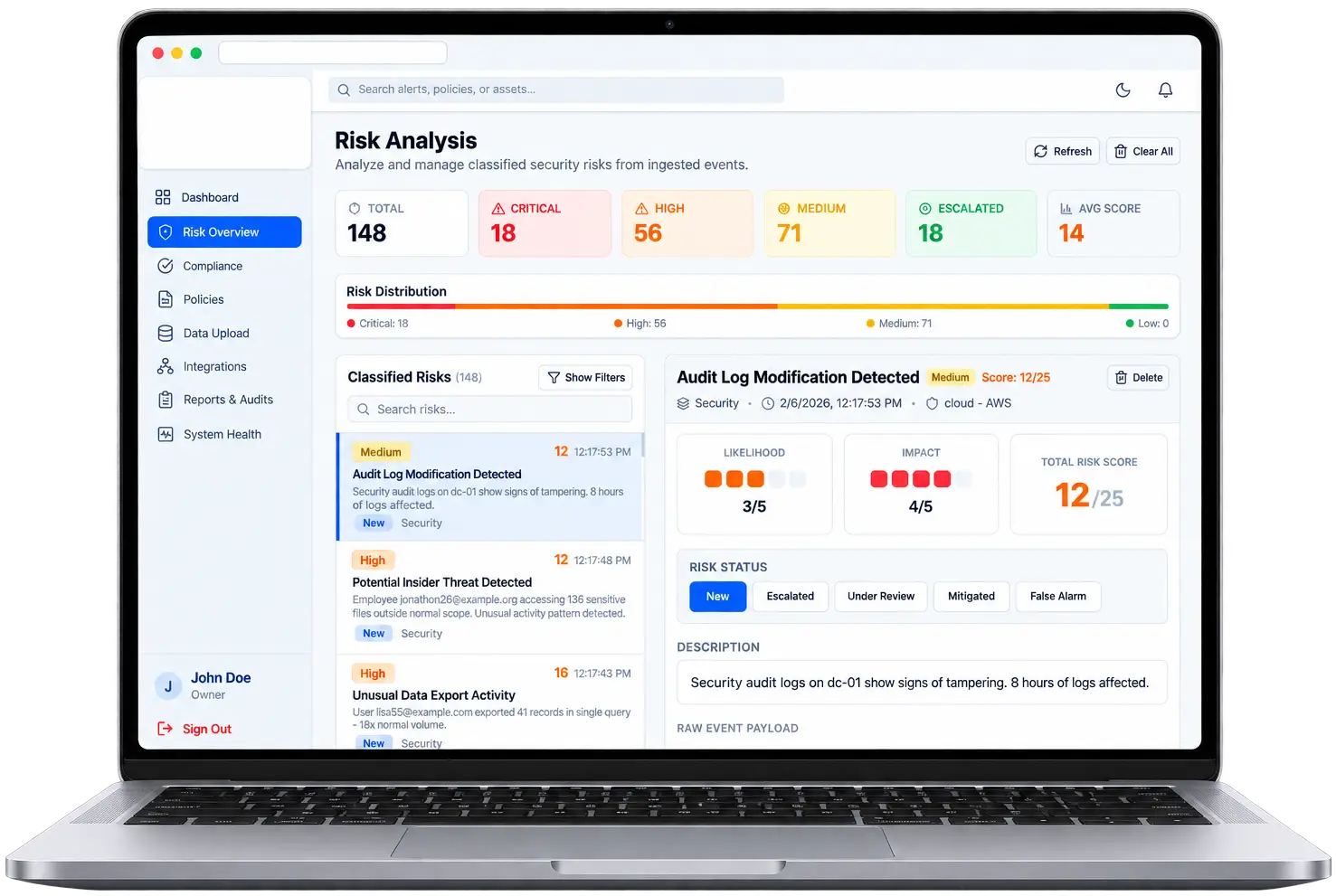
Unified Enterprise GRC Workspace
The eGRC application: executive dashboard, risk analysis, compliance and gap, policies, integrations, and reports and audit modules, all working from one set of records.
Financial Risk Management Workspace
The FRM application is financial risk management software and KRI monitoring software in one: finance integrations, KRI matrix, monthly close, manual capture and live barometers, on the same shared foundation as eGRC.
Multi-Connector Data Ingestion
The entry point. Each source is registered once with its own API key and signed webhook URL, and every event or payload enters one pipeline. See our data engineering services.
Unified Data Transformation
Raw payloads are mapped into the unified data mart (PostgreSQL, processed with Polars), the single model both workspaces read from.
AI-Assisted Risk Scoring
A server-side engine reads the mart and scores events by risk category, likelihood and impact. This AI risk assessment output feeds the risk records that analysts triage.
Compliance Evidence and Remediation
The compliance engine maps controls to a framework catalogue and links evidence and remediation tasks to each control.
Governed KRI and Monthly Close Workflows
The KRI engine compares source-fed values with appetite targets, and a state machine moves each month through Open, Frozen and Approved.
Governance and Auditability
A shared access layer applies role-based access control to every request, a policy service keeps policy version control, and a tamper-evident audit log records each read and write.
Flexible Deployment
The platform deploys as SaaS on managed cloud, or as a self-hosted footprint inside the customer's own environment.
Our Approach
The design decisions behind the build, and the reasoning for each.
Connect Sources Once
We register each source once with its own credentials and signed webhook, rather than building one-off integrations, so every new system follows the same governed path.
Make Risk Data Actionable
We map data to a unified model before scoring it with the AI-assisted risk engine, so every risk is classified on the same terms whatever its source.
Connect Detection with Governance
We tied triage to compliance controls, evidence and remediation inside the same product, rather than leaving alerts in a separate tool.
Make Reporting Defensible
We wrapped the data in RBAC, audit logging, policy versioning and governed monthly states, so lineage and approvals are on record when someone asks how a number was derived.
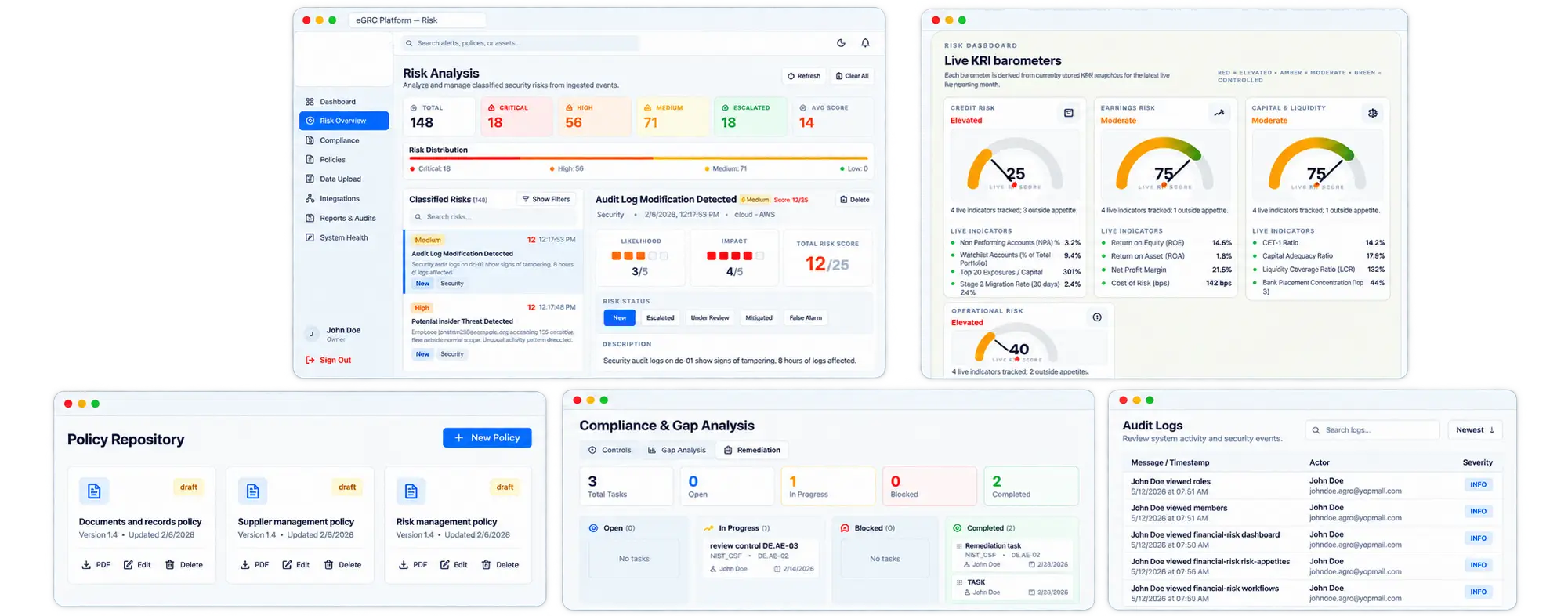
Features Implemented
What users can do in the platform, and the value each capability brings.
Executive Risk Dashboard
See active risks, compliance readiness and escalated items on one screen, with a risk-posture gauge and live alerts that can be approved, rejected or escalated.
Business value: Leaders see current risk posture without waiting for a report.
AI-Assisted Risk Analysis
Review each classified risk with its category, likelihood, impact and total score next to the raw event.
Business value: Analysts begin from a scored first pass they can explain.
Continuous Risk Monitoring
Watch dashboards update live as new events arrive.
Business value: Risk is watched as it changes, not only at month-end.
Compliance Control Management
Browse a framework-mapped control register with status, priority and evidence counts, plus a coverage heatmap.
Business value: Control status stays current and easy to inspect.
Compliance Gap Analysis
Find the controls with weak or missing coverage and assign them for closure.
Business value: Teams see where coverage is weak before an audit does.
Evidence and Remediation Tracking
Attach evidence to controls and move remediation tasks across Open, In Progress, Blocked and Completed.
Business value: Gap closure has an owner, a date and a record.
Financial Risk Management
Work in a dedicated workspace for finance connectors, the KRI matrix and live barometers.
Business value: Finance and risk teams share one governed view of financial risk.
Key Risk Indicator Monitoring
Track each KRI by source, mode, appetite target and value across nine risk categories.
Business value: Indicators are fed from source systems, not rebuilt by hand.
Risk Appetite and Variance Tracking
Compare KRI values with appetite targets and read the result on category barometers.
Business value: Leaders see which indicators sit outside risk appetite.
Monthly Close and Approval Workflow
Freeze a month, approve it and, when needed, reopen it for a governed revision.
Business value: The reported position is locked against quiet change.
Policy Version Management
Keep versioned policies, export them to PDF and attach the current version to controls as evidence.
Business value: The current policy is easy to show and trace.
Multi-Source Data Integration
Add finance and security sources from the integrations screen, and generate, rotate or revoke their API keys.
Business value: Source access stays under the team's control.
Fine-Grained Role-Based Access Control
Assign roles so each user sees only the data they are authorized for.
Business value: Sensitive risk data reaches only the people who need it.
Tamper-Evident Audit Logging
Search the audit log by actor, action, severity and timestamp.
Business value: Activity is reviewable on demand.
SaaS and Self-Hosted Deployment
Choose SaaS or self-hosting when adopting the platform.
Business value: Deployment can follow data-control requirements.
Looking for Enterprise Risk Management Software Built Around Your Frameworks?
Share your source systems, risk frameworks and KRI requirements, and our team will outline how custom risk management software development can deliver a connected enterprise GRC and financial risk management platform for your organization.
Technology Used
The stack behind the platform, from the React interface to the unified data mart and AI-powered anomaly detection, plus the governance controls and deployment options.
Impact & Outcomes
Business value and operational outcomes the platform is designed to support. Actual results depend on each organization's starting point, frameworks and goals.
One Continuous Risk View
Continuous risk monitoring ties risk events, compliance evidence and KRIs to a common data foundation instead of isolated workflows.
More Defensible Compliance
Control status, supporting evidence, remediation activity and audit records help establish traceability.
Governed Financial Risk Reporting
KRIs are measured against appetite, and monthly reporting follows a controlled freeze-and-approval workflow.
Less Repetitive Manual Work
Automated ingestion and scoring reduce repetitive data handling and dependence on manual consolidation, and support automated risk reporting.
Ready to Unify Your Enterprise Risk and Compliance Workflows?
Banks and financial institutions, fintechs, insurers, lending and treasury teams, and regulated enterprises modernizing risk and compliance can talk to us about their source systems, risk frameworks, KRI requirements, governance model and deployment preferences. Explore GRC software development and custom risk management software development with our AI consulting and development team.
Frequently Asked Questions
It is one platform for managing risks, controls, policies and audit evidence together. Enterprise governance, risk and compliance (GRC) software, often shortened to enterprise GRC, helps an organization manage risks, compliance controls, policies and audit evidence in one place. Instead of tracking these in separate tools and spreadsheets, teams work from a shared record. Software supports good governance but cannot by itself guarantee compliance or remove risk.
eGRC covers broad governance, risk and compliance work: security and operational risks, compliance controls, policies and audit. Financial Risk Management (FRM) focuses on financial risk indicators such as credit, earnings, capital and liquidity, and measures them against risk appetite. In this platform they are two connected workspaces that share one ingestion pipeline, role model and data foundation.
AI-powered anomaly detection can scan incoming events and classify each by risk category, likelihood and impact, giving analysts a scored first pass. In this platform the AI supports triage; analysts still review, escalate or dismiss each record. It does not replace human judgment or make autonomous risk decisions.
A Key Risk Indicator (KRI) is a measurable signal of rising or falling risk, such as a non-performing accounts percentage or a liquidity coverage ratio. Here, each of the platform's KRIs has a source, mode, appetite target and value. Values are fed from connected systems, compared with risk appetite to support risk appetite management, and shown on category-level barometers that flag indicators outside appetite.
One shared data model lets any reported number be traced back to its source. A unified data mart maps data from many sources into one model. Because security events, compliance records and financial figures share it, a reported number can be traced back to the source payload that produced it. That data lineage helps answer how a figure was derived when an auditor or regulator asks.
It can hold a control register mapped to a framework, attach evidence to each control, show gaps and track remediation tasks to closure with an owner and due date, which supports day-to-day compliance management. Control status then reflects current work rather than a periodic spreadsheet. The platform supports the process; it does not certify compliance.
Reporting needs an official state that does not change quietly. A governed monthly close moves each month from Open to Frozen to Approved: freezing takes a snapshot and rejects manual entry, and approval locks the position used for board or regulator packs. A controlled reopen allows revision with a record of the change.
Documented controls include fine-grained RBAC across both workspaces, masked, rotatable and revocable API keys, signed webhook URLs per connector, a tamper-evident audit log with actor, action, severity and timestamp, locked monthly states and guard-railed manual KRI capture. These are functional controls, not security certifications.
Yes, this platform is offered as SaaS or self-hosted. Self-hosting keeps the most sensitive risk and financial data inside the organization’s own environment. The right option depends on data-residency needs, security policy and operating capacity, and is agreed during discovery.
Yes. Wappnet can configure the platform’s building blocks around an organization’s risk and compliance frameworks, KRI definitions and appetite, source systems, control requirements, approval workflows, branding and deployment preference. Scope and timeline are defined after discovery rather than fixed in advance. Contact our team to discuss your requirements.