
AI-Powered Sales Coaching
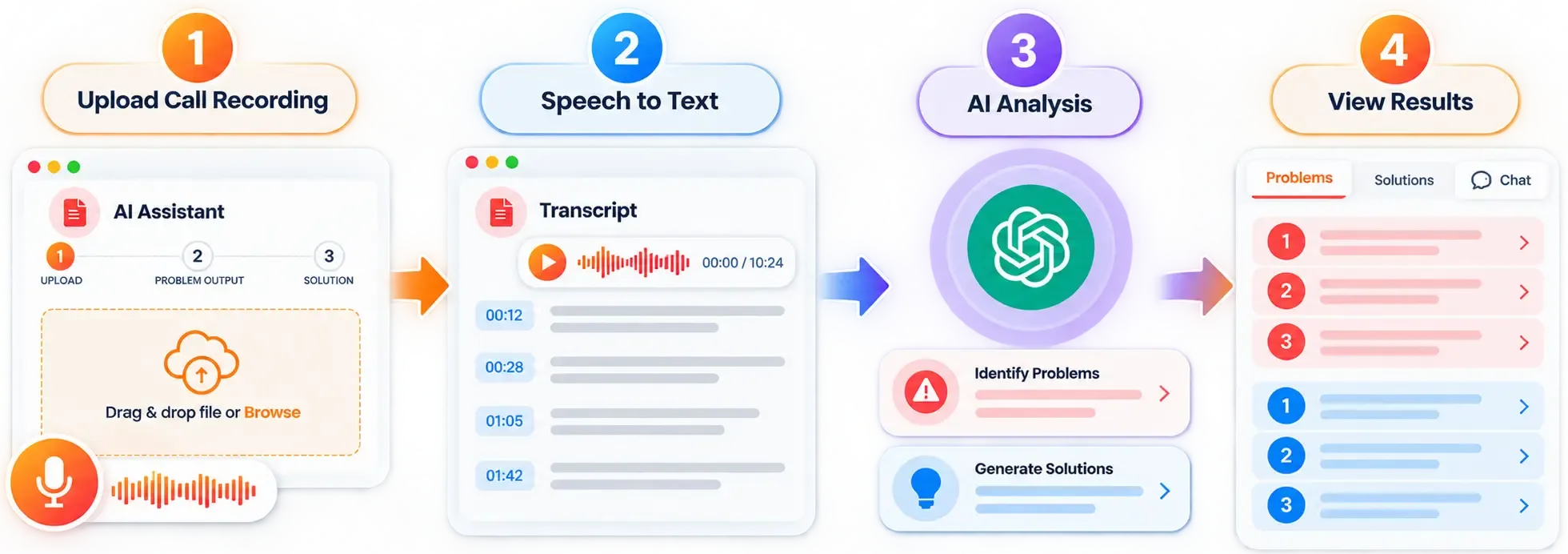
Wappnet AI built this AI sales coaching software to analyze recorded sales conversations. Users upload an audio file, which is converted to text through audio-to-text transcription. OpenAI APIs with customized prompts then identify communication problems and generate sales coaching recommendations that users can read, listen to and discuss with an AI assistant.
Designed for sales professionals, sales leaders and enablement teams who want a structured way to review conversations after they happen, without listening to every call again. It works with uploaded recordings, not live calls.
Project Overview
A recording on its own is hard to review. This AI sales coaching software turns it into a written transcript, a set of identified problems and recommended solutions.
Users upload a recorded call, and the platform converts speech to text. OpenAI APIs and customized prompts then run the AI sales conversation analysis. Feedback can be read, played back through text-to-speech, or explored further in a chat.
Key Challenges
Improving a sales conversation starts with being able to look at it clearly. The platform was shaped around four needs that come up when teams review recorded calls.
Reviewing recorded sales conversations
Sales professionals need a structured way to turn audio recordings into text that can be reviewed and analyzed.
Identifying communication problems
Without organized feedback, it can be hard to tell which parts of a conversation need improvement.
Turning feedback into practical actions
Spotting an issue is only one step. Sales professionals also need recommendations that explain how to improve.
Making feedback easier to consume
Users may prefer to read insights, listen to audio responses and ask follow-up questions in an interactive interface.
Solution Delivered
The platform brings sales call transcription, AI-generated sales insights, voice-based coaching feedback and an assistant into one guided workflow.
Audio-to-text transcription
Recorded sales conversations are converted into text, giving the AI and the user a structured record of the call to analyze.
AI-driven problem identification
OpenAI APIs and customized prompts analyze the transcript to identify potential problems, so users can see which parts of a conversation need attention.
Actionable coaching recommendations
The platform generates solutions intended to help users address the identified issues, moving the feedback from what went wrong to what could be done.
Text-to-speech coaching output
Hugging Face text-to-speech models turn the solutions into audio, with voice options such as Bella and Terrell, so users can listen as well as read.
Guided user workflow
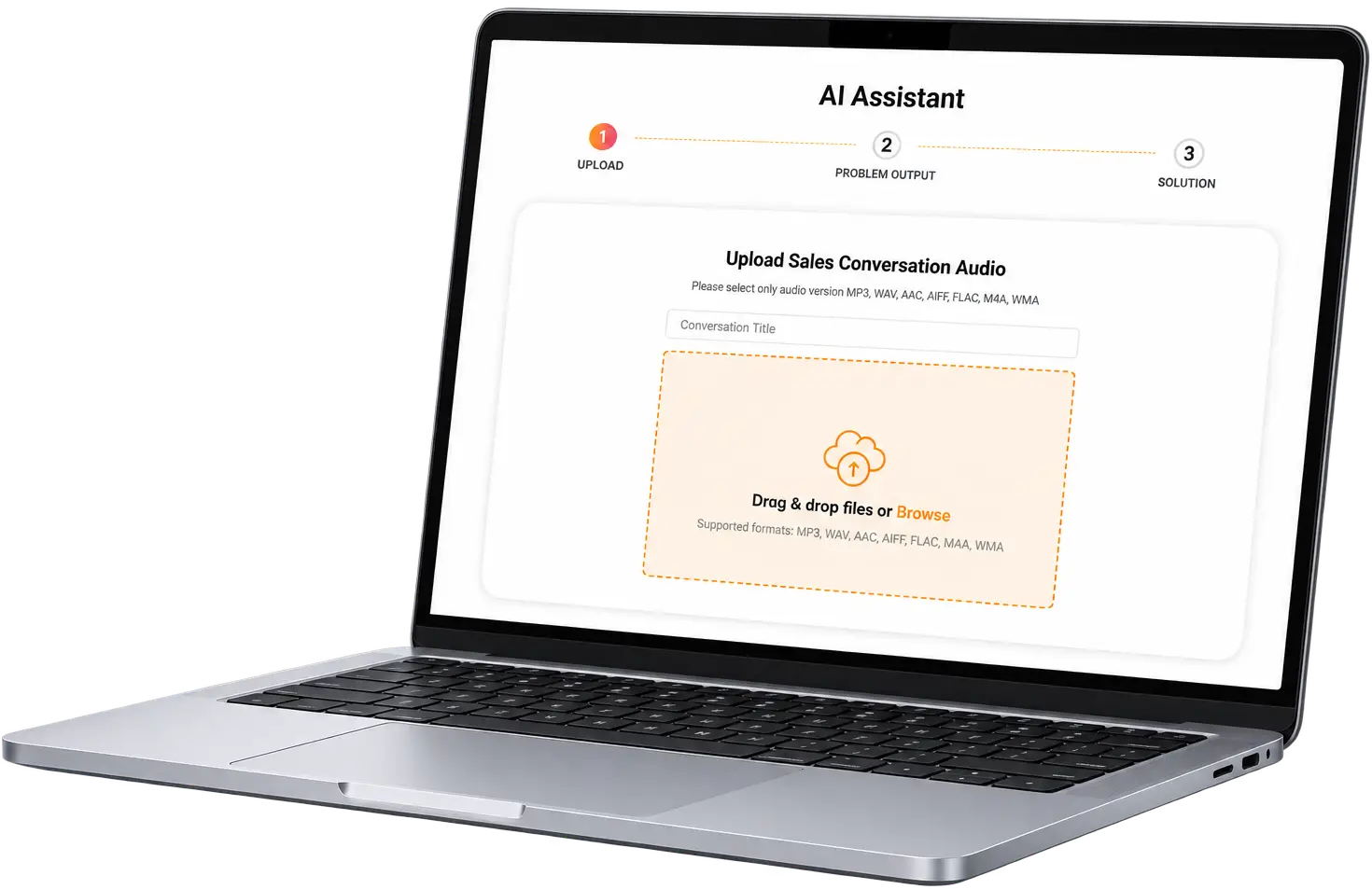
A three-stage flow of Upload, Problem Output and Solution leads users from recording to recommendations, so it is always clear what comes next.
Interactive AI assistant
A chat interface lets users ask follow-up questions about their analyzed conversation by typing or recording a query, and explore the feedback instead of only receiving it. It builds on the same ideas as our AI chatbot development services.
Dashboard experience
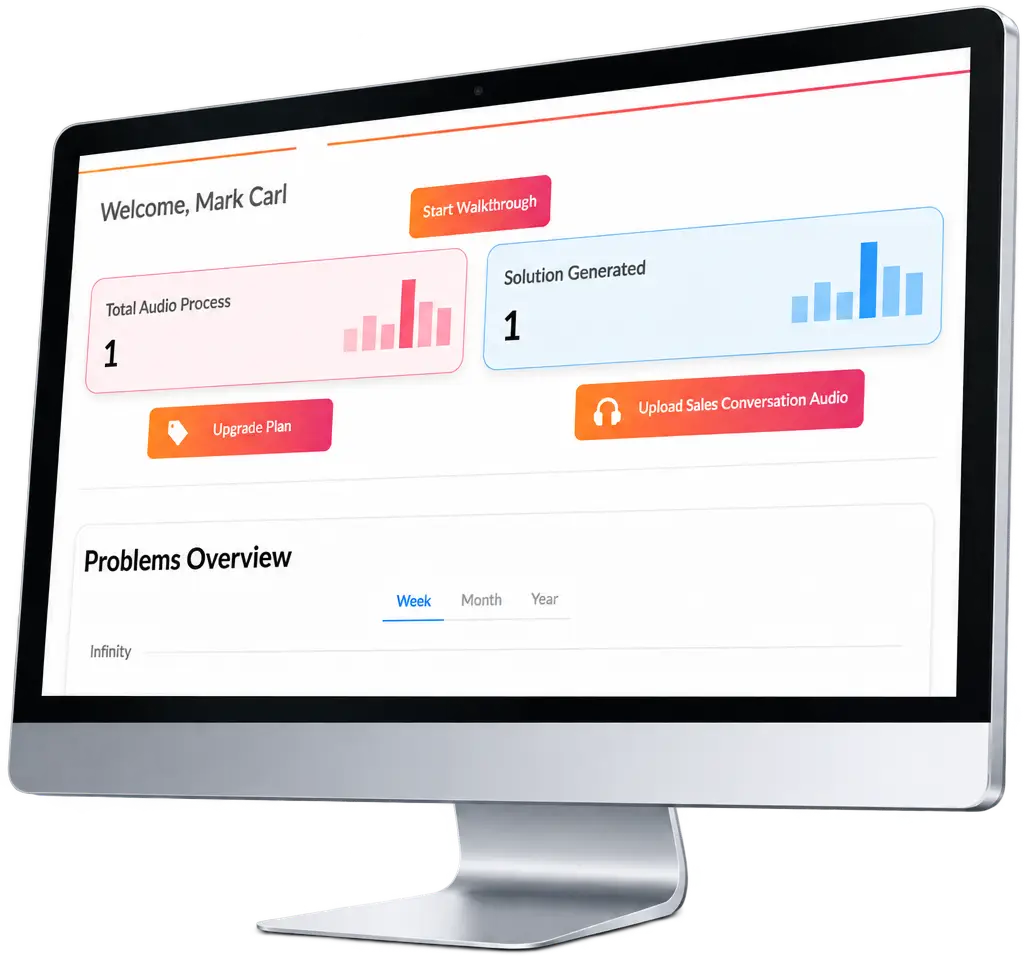
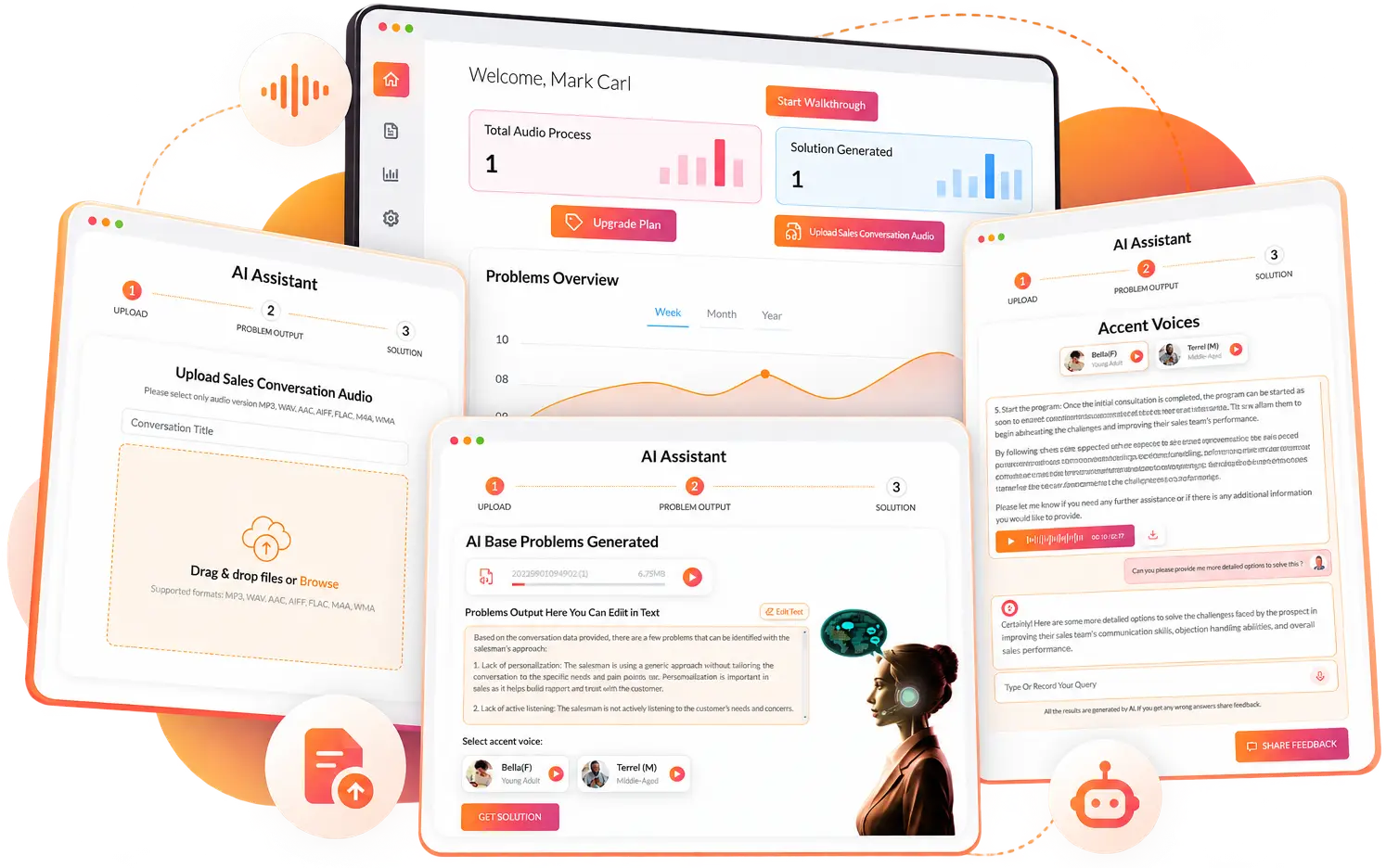
The dashboard shows counters for audio processed and solutions generated, plus a Problems Overview with week, month and year tabs, giving users a quick view of their activity.
Guided product walkthrough
First-time users are directed to a guided walkthrough, which can be started again from the platform menu or settings, so new users can learn the interface at their own pace.
Our Approach
Good sales performance coaching depends on clear steps and feedback people can use. These four decisions shaped the build, and they reflect the way we approach LLM development for business platforms.
Audio before analysis
Recordings are converted to text first, giving the AI a structured foundation. This keeps the analysis tied to what was actually said.
Customized AI analysis
OpenAI APIs and customized prompts produce problems and recommendations from the conversation content, so the output is relevant to each upload.
Multiple ways to consume feedback
Text insights are paired with text-to-speech output, so users can engage with coaching in the way that suits them.
A guided user experience
The React interface organizes the work into clear stages and offers a walkthrough, which keeps the platform approachable.
Key Features
A quick summary of what the platform offers, with the practical purpose and value of each feature.
Audio file upload
Accepts MP3, WAV, AAC, AIFF, FLAC, M4A and WMA files with a conversation title, using drag and drop or a file browser.
Business value: Recordings can be submitted without extra preparation.
Audio-to-text transcription
Converts the uploaded recording into text so the conversation can be analyzed.
Business value: Users get a written record of the conversation to review.
AI-powered conversation analysis
Applies OpenAI APIs and customized prompts to the transcript to look for problems.
Business value: Every uploaded call gets a consistent first review.
Problem statement generation
Lists the identified problems in a text box that users can edit.
Business value: Issues become clear points to discuss in coaching.
Actionable coaching recommendations
Generates solutions for the problems found, shown after the user selects Get Solution.
Business value: Feedback points toward what to do next.
Text-to-speech output
Reads the solution aloud using Hugging Face models, with a player that supports playback speed and download.
Business value: Coaching can be heard as well as read.
Multiple audio voice options
Lets users choose between voices such as Bella (F) and Terrell (M).
Business value: Users can pick the voice they prefer for a more personal experience.
Interactive AI assistant
Answers follow-up questions about an analyzed conversation, with queries typed or recorded.
Business value: Users can ask for more detail whenever they need it.
Guided product walkthrough
Introduces the interface on first use and can be reopened from the menu or settings.
Business value: New users find their way sooner.
Structured coaching workflow
Moves users through three stages: Upload, Problem Output and Solution.
Business value: Conversation review follows a repeatable path.
Planning a similar platform?
Tell us how your team reviews conversations today, and we will help shape a workflow around it.
Technology Used
Each tool has a defined job in this AI software development project.
Impact & Outcomes
What the platform does today, and the business benefits it can reasonably support for a sales team.
A structured review process
Recorded conversations follow one workflow from upload to recommendations.
Easier problem identification
AI-generated problem statements point to areas worth attention.
Actionable recommendations
Solutions give users a starting point for improving their approach.
More ways to take in feedback
Text and audio output suit different preferences.
A guided path through results
Upload, problem, and solution stages keep the review orderly.
A repeatable improvement loop
The same workflow can be used again for each new conversation.
Ready to Build an AI-Powered Sales Coaching Solution?
Sales teams, enablement leads, and businesses exploring AI sales call analysis can work with us to design a platform around their coaching workflow, feedback needs and user experience.
Frequently Asked Questions
AI sales coaching software, sometimes called an AI sales coach, reviews sales conversations and turns them into coaching feedback. In this platform, users upload a recorded conversation.
AI sales coaching software like this works in stages. The recording is converted to text through audio-to-text transcription, then OpenAI APIs with customized prompts analyze the transcript to identify problems and generate recommended solutions. This workflow covers recorded audio files, not live calls.
This platform analyzes uploaded recordings. Live-call features would be scoped during discovery.
A recording cannot be analyzed by a language model until it is text. Audio-to-text transcription provides that structured foundation, so the AI can review what was said in the conversation and the user has a written record to work from.
In this platform, a language model from OpenAI receives the transcript along with customized prompts that ask it to find problems in the salesperson’s approach. The results appear as problem statements, for example a lack of personalization or active listening, which the user can review and edit as text. Output is AI-generated, so people should review it.
Yes. After the problems are shown, the platform generates solutions intended to help the user address them, and users can ask follow-up questions in the chat interface for more detailed options. How useful the guidance is depends on the conversation, the prompts and human review.
Text-to-speech lets users hear coaching feedback instead of only reading it. The platform uses Hugging Face TTS models and offers voice choices, shown in the interface as Bella (female, young adult) and Terrell (male, middle-aged). The audio player also includes a download option.
The platform uses Python, Django and Django REST Framework on the backend, React on the frontend, OpenAI (Turbo 3.5), LangChain and Hugging Face for AI, MySQL for data, and Amazon Web Services (AWS) with an EC2 server for hosting.
Yes. This platform is an example of the custom AI development Wappnet delivers. Whether a new platform would need other input types, languages, integrations, or live-call features depends on your requirements, and those are defined during discovery.